
Garda tells Nkecho inquest the situation ‘could not be de-escalated’
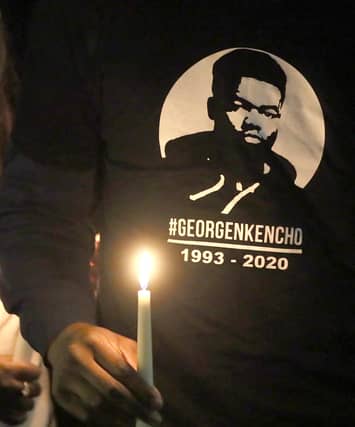

The events leading up to George Nkencho’s death “could not be de-escalated”, a Garda who trains Armed Support Unit (ASU) members has told an inquest.
Mr Nkencho, 27, died after being shot outside his west Dublin home in December 2020.
Sergeant John Heany was one of the instructors on the 12-week training course Garda A took prior to joining the ASU.
Garda A, whose anonymity has been granted by the court, was the ASU member who shot George Nkencho.
Asked by coroner Dr Myra Cullinane if there was “a way in which the situation could have been safely de-escalated”, Mr Heany said: “In this specific case, in my opinion, this scene could not have been de-escalated.”
During his evidence on Wednesday, Mr Heany said candidates are instructed that “you don’t have to go through every use of force to arrive at lethal force”.
“If lethal force is justified, then it can be used straight away,” he added.
The training involves “live role-playing” of multiple scenarios, he said – including some dealing with mental health incidents.
The inquest had previously heard from witnesses who said Mr Nkencho punched a retail worker at a shop and brandished a knife.
Other gardai have testified they had repeatedly shouted at Mr Nkencho to “to stop walking and drop the knife”, but this was “ignored” by Mr Nkencho whose “demeanour was aggressive and intimidating”.
Garda A had also previously described to the court how Tasers and pepper spray had been used on Mr Nkencho before he was shot.
Giving evidence to the inquest last week, members of Mr Nkencho’s family had described trying to tell Gardai he had mental health issues.
Mr Heany said ASU members are trained – when dealing with mental health scenarios – to keep communication low, very clear, to show empathy and to “listen to what the person’s saying”.
He continued: “If they go in and they’re being aggressive with the mental health subject, then the mental health subject will become aggressive, and possibly either self-harm himself, or he may attack the police.”
He described it as “very rigorous”, adding: “If you ask anybody that has been through this course, it’s probably the toughest course they’ll ever do in An Garda Siochana.”
He said it has a “very high” failure rate, explaining of every cohort of 20 candidates, eight or nine do not pass.
Mr Heany also said there were “no significant concerns” about Garda A during their training to become part of the ASU.
The incident was the subject of an independent criminal investigation by the then-Garda Siochana Ombudsman Commission (GSOC), now Fiosru, which concluded in June 2023 with the submission of an investigative file to the director of public prosecutions.
A decision was made not to pursue any criminal prosecution in relation to the shooting.
The inquest into Mr Nkencho’s death is taking place at Dublin District Coroner’s Court.