
Howzat! Cambridge University engineers recreate Venn’s historic bowling machine
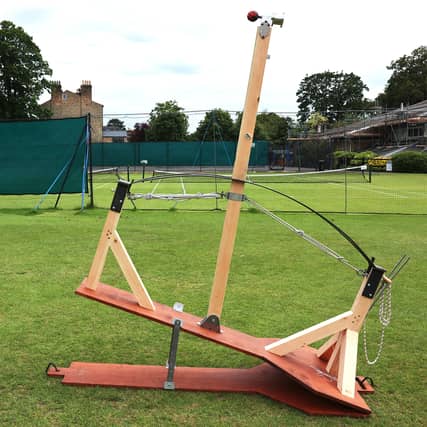

A wooden contraption that bowled out an Australian international cricketer four times in 1909 – and was designed by the mathematician who gave his name to Venn diagrams – has been recreated by Cambridge University engineers.
The bowling machine was the brainchild of Dr John Venn and its recreation can launch balls towards a batter at around 33mph.
Dr Venn, who died in 1923 aged 88, was president of Cambridge’s Gonville and Caius College and created the device in the early 1900s.

Engineers recreated the machine to be used at events and open days to inspire young people who are considering careers in maths and engineering.
All they had to work from was a black-and-white photograph of the 7ft machine, and a patent application from the time.
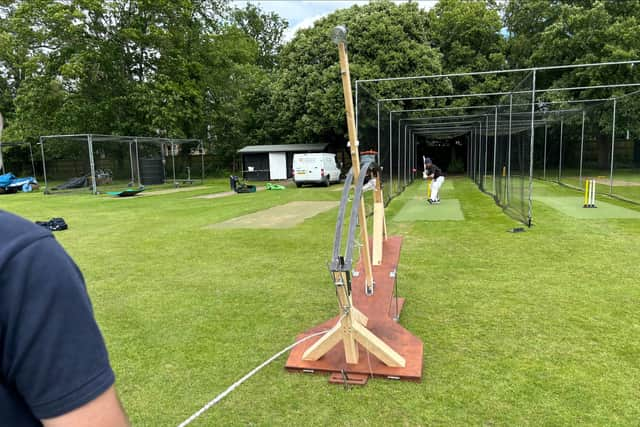
When the arm travels it pulls a string, which turns a spindle and a bobbin, which in turn spins the ball holder and the ball.
Hugh Hunt, professor of engineering dynamics and vibration at Cambridge, set the university’s engineering department the challenge of recreating the machine.
He has previously led teams of investigators on the Channel 4 shows Dambusters: Building The Bouncing Bomb, and Attack Of The Zeppelins, and has a research interest in “spinning things that fly”.
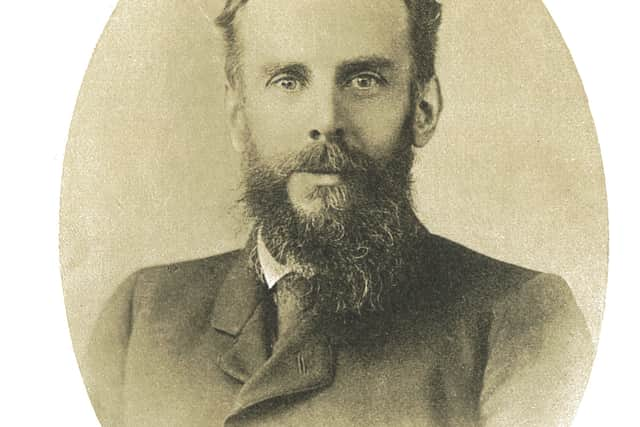
“Most people learn about Venn diagrams at school but not many know about John Venn’s quirky side – that he invented a bowling machine using wood and string and maths, which bowled out members of the Australian cricket team more than a hundred years ago.
“So the idea behind the project was to recreate a bit of history, and to show how much fun you can have with maths.”
Thomas Glenday, head of design and technical services in the university’s Engineering Department, said the engineers had to work out the technical detail of the machine when recreating it.
“It meant we had to sketch it out for ourselves, figure out how the machine was actually going to work, and how it replicates the skill and speed of a spin bowler.
“The spin has been the key piece, and probably the most complicated part of the design.
“It’s thinking about the different forces that are acting on the ball simultaneously, and that transition of energy – it makes one hell of a diagram!”
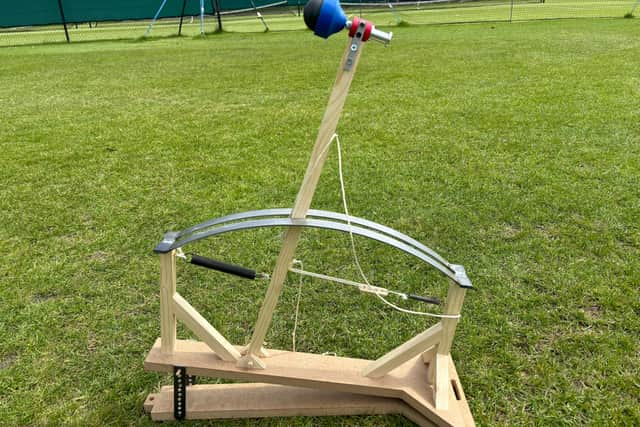
But they settled on bungee cords for the full-scale model “partly through practicality but partly from health and safety considerations as well, just to make sure the machine is safe as it can be”.
“Large coil springs are somewhat more dangerous than a bungee cord,” he said.
He added that radar gun tests showed their machine was bowling at around 33mph.
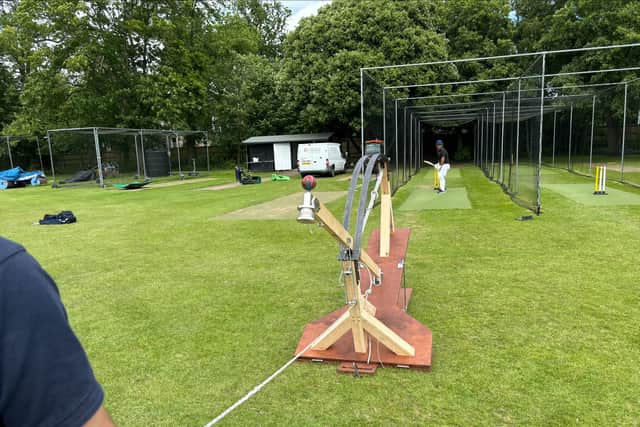
“It would be nice for it to be throwing balls at 100mph but it’s not designed to be a production machine.
“It’s a historic relic which should be treated as such.”
He said that a similar machine today may be made from carbon fibre and using a 3D printer but they wanted to be historically authentic so used hardwood.
“Back then it was where the skill set was – people were used to working with wood, which has natural faults, which moves, which is not necessarily square,” he said.
He added: “It’s a fun project, but we definitely wanted it to look the part.”

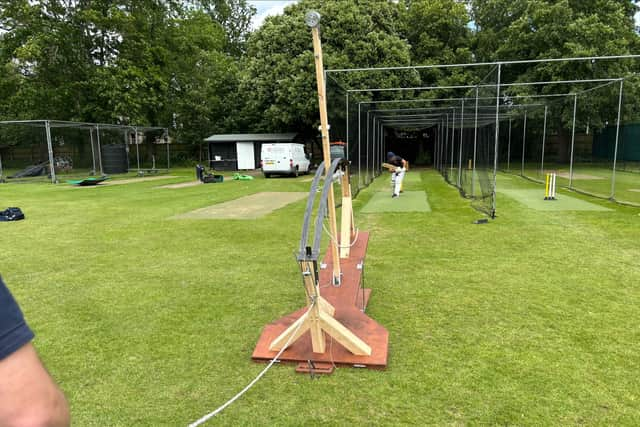
“It’s like no bowler I’ve ever faced before,” said the 23-year-old, who is in her fifth year reading medicine.
“It was like a very tall bowler bowling very close to you and it was quite difficult to predict where it was going to go.
“It spun a lot more than any bowlers I’ve ever faced before.”
She said the gadget did not manage to hit the stumps but it “pitched at a good length and turned a lot – it was a leg spin”.
The Venn bowling machine is to feature at Essex County Cricket Club on Monday as part of an event for the Essex Year of Numbers initiative to inspire a love of learning, with a focus on numeracy.