
‘It started with a sore throat, then I couldn’t speak for three months – it felt like my world was over’


A teacher who had to give up her job after losing her voice for three months and “couldn’t even hum” said she felt like her “world was over” before she Googled: “What jobs can you do if you’re mute?”
Rebecca Wilkinson, 37, a languages teacher from Preston in Lancashire, said she was used to contracting laryngitis and losing her voice at least once a year, due in part to projecting her voice in class and work stress, but it would always come back within a “couple of days”.
On those occasions, rather than take time off work, Rebecca used a microphone headset and amplifier to communicate with her students.
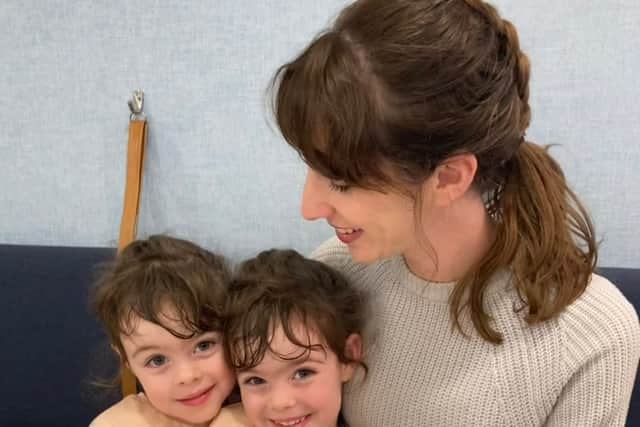
To communicate with her twin girls, Molly and Libby, eight, she said she implemented a clapping system – one clap for her eldest and two claps for her youngest – or used a text-to-speech app with pre-loaded phrases like: “Put your shoes on”.
Rebecca told PA Real Life: “I was really frightened during the whole thing – that’s the word that I would use.
“I was frightened for my health, but I was frightened for my career too.

Rebecca said she felt like she was always “meant to be a teacher” so she was excited to secure a full-time Head of Languages job at a high school in Lancashire in 2013.
Over the years, Rebecca said she noticed she became ill with laryngitis every year around the end of October “in that long slog before Christmas”, meaning she would lose her voice for around four days at a time.

Rebecca said she “learned different ways to cope with it” instead.
Her boss initially encouraged her to talk to the school’s drama teacher about voice projection techniques, before Rebecca said she asked if she could have a microphone and amplifier for the classroom.

Rebecca said: “The children would get used to me having a couple of days without my voice, but we’d get through it.
“It wouldn’t be the best because who can listen to a teacher speak languages without a voice?”

When it didn’t clear up within the usual time frame, she went to her GP and was referred to multiple consultants.
Rebeca said: “I had a load of cameras down the back of my throat and they mentioned that I might have what’s called lingual tonsilitis” – inflammation of the lingual tonsils found near the back of the tongue.
That was the last time Rebecca would work at the school she had been at for over a decade.
Rebecca said she organised cover for her classes, but she still didn’t have her voice back after two full weeks off work, so her school said they “need to know whether you’re coming in or not”.
She replied: “As soon as my voice is back, I’ll be back in.”

An occupational health report from the school would later recommend “ill health retirement”, aged 35, which Rebecca said was “really frightening” for her.
The turning point in Rebecca’s recovery came about through a conversation with a fellow church-goer, Alison McGrath, who is a speech and language therapist. Rebecca started paying £60 per session for treatment from Alison.
This is when she received a diagnosis of muscle tension dysphonia (MTD), a voice disorder characterised by a strained, effortful voice that occurs when the muscles of the larynx become overly tight.

This slowly progressed to humming and simple noises, like saying the letter ‘M’ and then harder sounds like the letter ‘E’.
By mid-February, Rebecca said her first word – Moo – but she was not able to start communicating properly until March.
Rebecca said: “I remember crying because I’d heard my voice.
“One worry that I had was whether my voice would actually come back as ‘my’ voice, or whether it would be a weaker version or a different pitch.
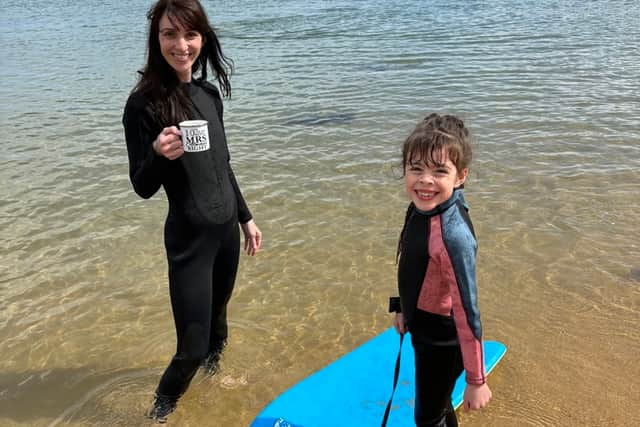
Throughout the almost three-month period of total voice loss, Rebecca implemented a clapping system to communicate with her two children and used a text-to-speech app.
“A lot of people thought I was deaf,” Rebecca said. “I’d use my text-to-speech app in shops and people would use their hands.”
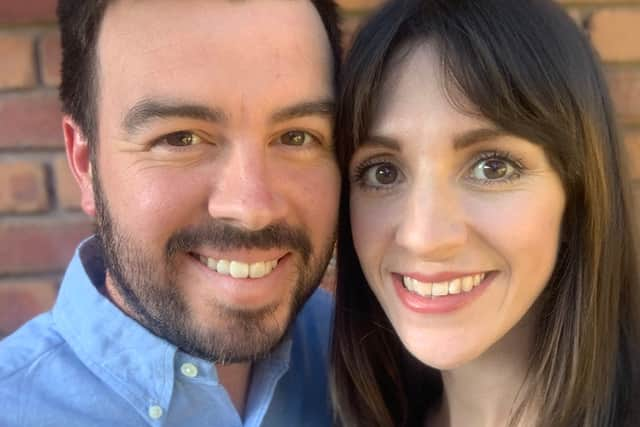
By April, Rebecca said she was still struggling to form sentences, but she remembered being in the car with her husband, Dan, and her twin daughters, where the latter would take turns going through a list of words for their mother to say, like “Timmy”.
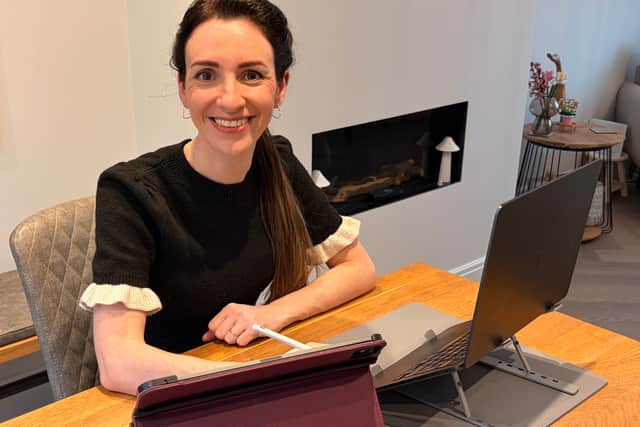
In May, without a job, Rebecca came across a French teaching position with Minerva Virtual Academy, an independent online school for 11 to 18-year-olds.
She could form sentences at this time, so she applied, had an interview, and was offered the job, starting in September 2025.
“I just felt like I had a lifeline again,” she said.
“I don’t have to project my voice into the back of the class, I can just talk at a level where I’m having a conversation with somebody. It’s a relief.”
In her everyday life now, she said she will “never shout”, even when she is cheering on Molly and Libby during their dance competitions, and she will use a portable steamer at night or do her voice exercises if she has had a “voice-heavy” day.
She has had two more short periods of voice loss since the incident that lasted three months, but she has techniques to cope now.
“It’s just a different way of thinking about your voice,” she said.
For more information about Minerva Virtual Academy, visit their website here: https://www.minervavirtual.com/