
Jonathan Anderson revives haute couture at Dior with nature-inspired designs


Jonathan Anderson’s arrival at Dior has been one of the most talked about creative appointments in the fashion industry; from the red carpet gowns worn by Jessie Buckley and Priyanka Chopra at the Golden Globes to his second menswear show which split opinion online.

It is the clearest signal yet of how Anderson plans to reshape one of fashion’s best-known houses, replacing reverence with curiosity and tradition with experimentation.
Late last year, Anderson declared how he was “changing couture at Dior”.

Anderson told i-D last September that his first couture collection for Dior would be “completely abstract” and a laboratory for “newness within form”. Couture, he said, would be about experimentation: art, volume, ideas.
One of Anderson’s starting points was clay. Before the show streamed, a ceramicist explained the context of what to expect of the collection.

Dresses seemed moulded rather than sewn, skirts flared like bell-shaped vessels and bodices rose from the torso as if pulled upwards by hand – it was couture as sculpture.
Raw materials were Anderson’s muse. References ranged from iron meteorites to cyclamen flowers, from shells to swathes of grass. Nature’s logic – its precision, oddness and refusal for symmetry – was painstakingly translated into fabric.

Conical clutches resembled shells and bags sprouted cascades of green, as though overgrown from the roots of the dress. There were puma-headed purses and rounded metallic bags that mimicked bumblebees and ladybirds.
Flowers, of course, are Dior’s heritage motif. Since Christian Dior’s 1947 debut, they have been the house’s most enduring metaphor, carried through the romantic theatrics of John Galliano and the feminist florals of Maria Grazia Chiuri.
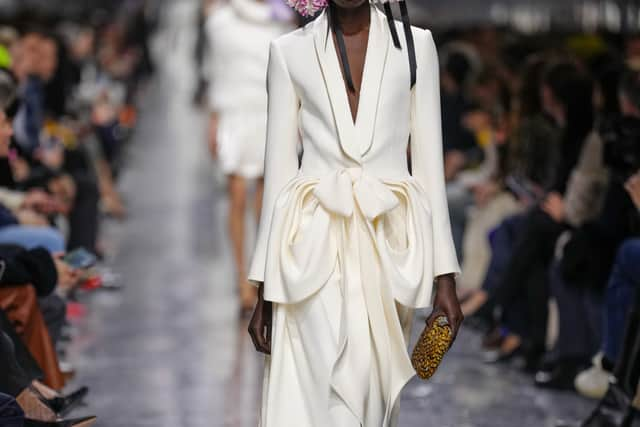
Colours affirmed the predicted trends for the year. Anderson extended the bold palette of his ready-to-wear collection from September 2025: lime and lilac, fiery orange-red, powder blue while peppering in Dior’s soft pinks.
These hues animated gowns with bulbous ruching and layered panels, catching light on iridescent surfaces, as shimmering feathers clung to sculpted forms.


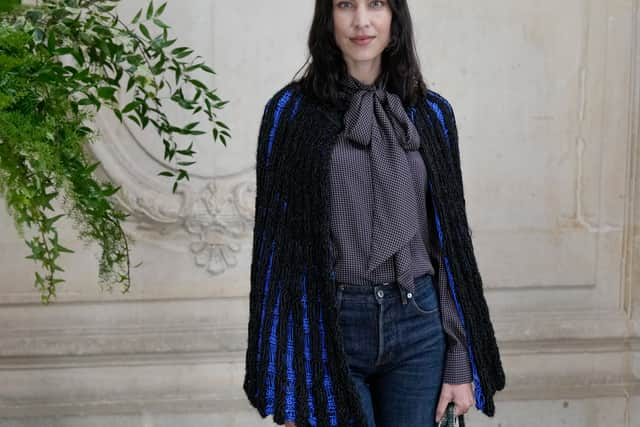
Sitting front row was former creative director of Dior John Galliano. Galliano became creative director in 1996, where he received widespread critical acclaim for his Haute Couture and ready-to-wear collections, becoming a defining figure in the maison’s history.
During his tenure Galliano introduced several legendary designs, including the now iconic Dior Saddle bag, which debuted in the spring/summer 2000 collection.


Like the organic forms that inspired the show, the collection took on a precision and detail that can only be found in nature, but Anderson certainly did his best to replicate it in fashion.
As Vivaldi’s Spring filled the mirrored room, it seemed the closing message was that couture is no longer about preserving beauty based on heritage but about letting it grow.