
Long-term report: How does Mazda’s electric MX-30 compare to its famous MX-5?
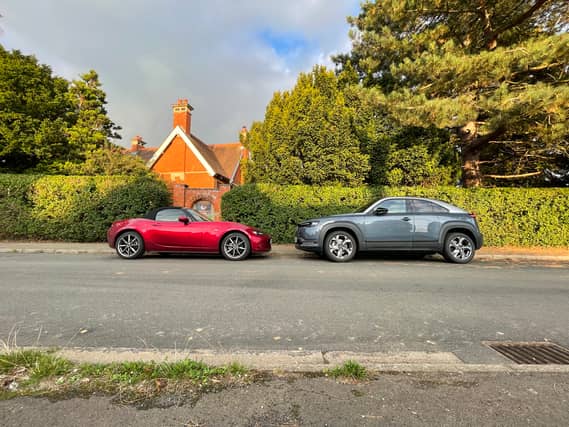

As our time with the MX-30 draws to a close, there’s one thing about it that still causes confusion: the name. In the last year, whenever I’ve been asked what this strange plug-in, three-tone, grey crossover thing I’m driving is, the follow-up question is usually along the lines of: ‘MX-30… Is that like an MX-5, then?’
If I’m honest… no, it isn’t really. But just for belt and braces, I pestered Mazda to send me a shiny new MX-5 so I could work out just why these two very different cars share a sporty prefix on their badges.

For the last two decades, though it’s all been pretty logical: ‘normal’ cars get a plain old number like 3 or 6, crossovers start with ‘CX’, and sportier things start with ‘MX’ or ‘RX’. So, does that ‘sporty’ name actually hold any water when you compare Mazda’s two MX-badged cars side by side?

Once you’re on the move, the differences are even more noticeable. Unsurprisingly, there’s nothing to tie the two cars together in terms of powertrain – the MX-5’s rev-happy 2.0-litre petrol will always be a different beast to a near-silent electric motor – but even the smaller details are noticeable.
Jumping back in after a stint in the MX-5, the MX-30’s steering wheel suddenly seems gigantic, and a bit lazy in its responses. The way it attacks corners is different too: thanks to its rear-wheel-drive layout, the MX-5 confidently pushes itself into every turn, while the MX-30’s front wheels desperately try to drag the rest of the car along in their wake.
None of this is all that surprising, of course: while other Mazdas at least share their engines with the MX-5, the MX-30 can claim barely any direct relation under the skin. And because the MX-30 is a few years newer to market than the MX-5, the interior parts that usually get shared across models – like switches, dials and infotainment system – are all different too.
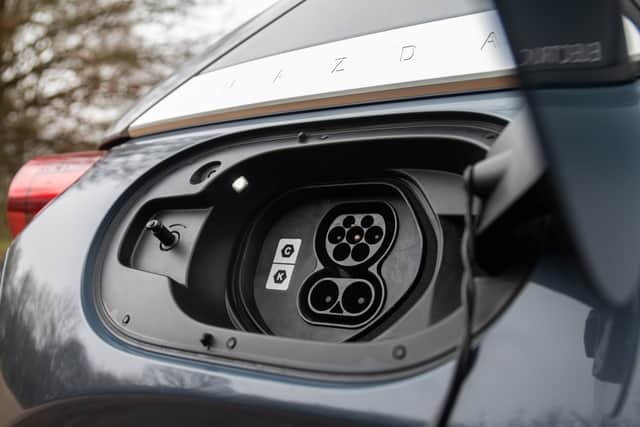
Firstly, let’s remind ourselves of a bit more history. We might associate ‘MX’ with the MX-5 alone, but the first car it appeared on was the MX-6 – a big, comfy front-wheel-drive coupe. It’s also got some engineering pedigree behind it: MX first stood for ‘Mazda Experimental’, and said MX-6 was a pioneer of active all-wheel-steering all the way back in 1988. So really, it’s only natural Mazda would stick this badge on their first foray into a new world of electric vehicles.
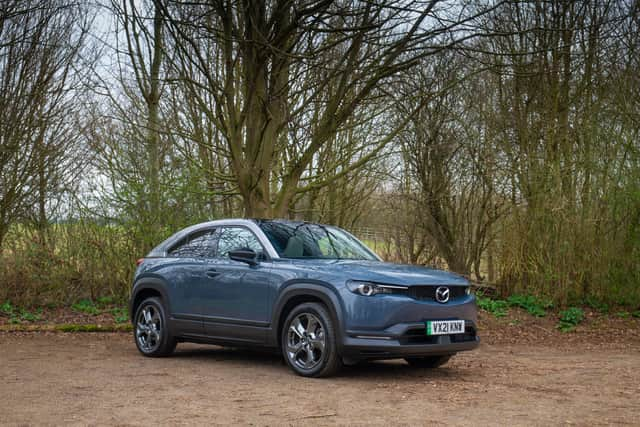
Compared to the lofty CX-5 for example, the MX-30’s driving position suddenly feels low-down, cockpit-like and cocooned. Then there’s the way it drives: the CX-5 might be one of the better handling crossovers on sale, but the MX-30 runs rings around it, despite weighing almost 200kg more.
Even that controversial powertrain works to its benefit here: to anyone jumping out of a slightly lethargic petrol-powered CX-5, the immediate torque of the MX-30’s electric motor feels like you’ve stumbled into the next century.
So there you have it: is the MX-30 anything like an MX-5? No. But is it a true ‘MX’ model? In my mind, I think we can safely say it is.
- Model: Mazda MX-30 GT Sport Tech
- Price: £30,345 (after Govt grant)
- Engine: Single electric motor
- Power: 143bhp
- Torque: 271Nm
- 0-60mph: 9.7 seconds
- Top speed: 87mph
- Fuel economy: 19kWh / 100km
- Emissions: 0g/km
- Mileage: 9,720