
New images of Scotland’s Crown jewels released ahead of royal visit
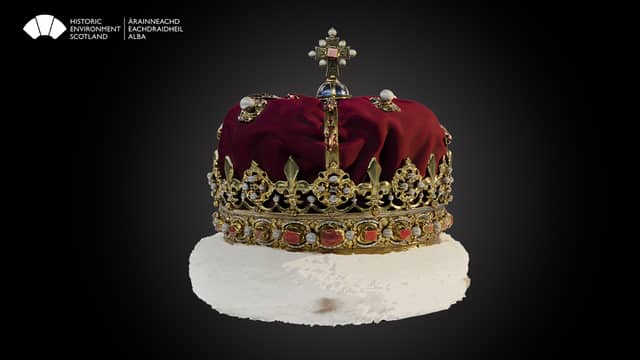

The Honours of Scotland – the oldest Crown jewels in Britain and among the oldest in Europe – have been digitised to allow the public to view them like never before.
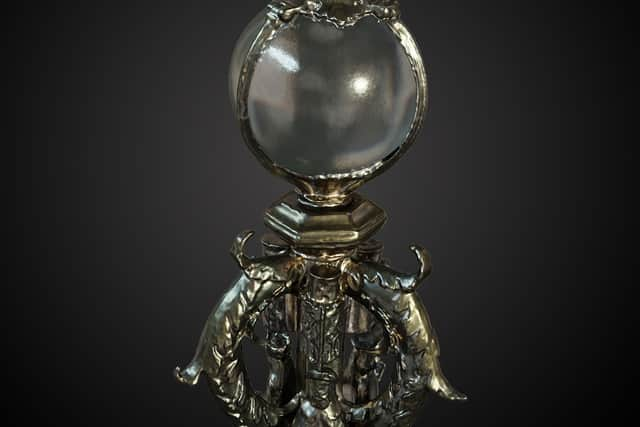
Newly released 3D models of the Crown of Scotland, the Sceptre and the Sword of State have been produced by Historic Environment Scotland (HES) to let people examine the intricate detail of the Honours up close.
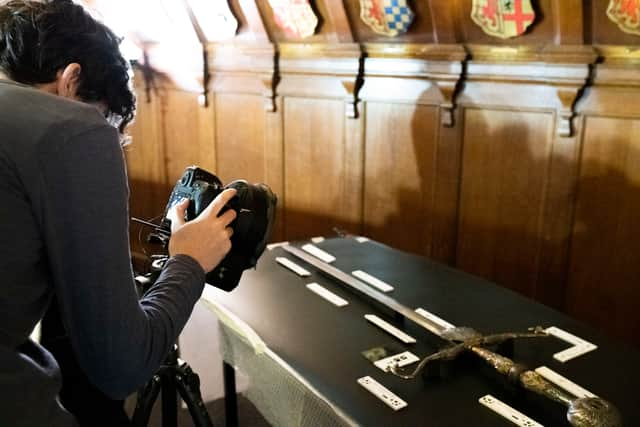
The Honours were digitally captured through a process of photogrammetry, where hundreds of overlapping high-resolution photographs were taken of the objects then analysed by software to work out their relative position.
These aligned photographs were then used to create accurate photorealistic models of the artefacts, which were first used together as coronation regalia in the mid-sixteenth century.
The blade of the Sword of State is said to be in a very fragile condition, having been broken and repaired in the past, likely around the time the Honours were hidden from the forces of Oliver Cromwell sometime in the mid-seventeenth century.
In order to protect the blade, it was retired from use some years ago with the consent of the monarch. The Lord Lyon has commissioned a new sword to be made for ceremonial purposes and HES has agreed to care for this new commission.
The Honours of Scotland have been present at many of the major royal ceremonial events over the past five centuries. Their centrepiece is the Crown of Scotland, crafted of gold and silver and laden with 94 pearls and 43 gemstones including diamonds, garnets and amethysts.
James V had the Crown made in 1540, likely in part from the earlier Scottish Crown which had been damaged, and first wore it at the coronation of Mary of Guise that same year.
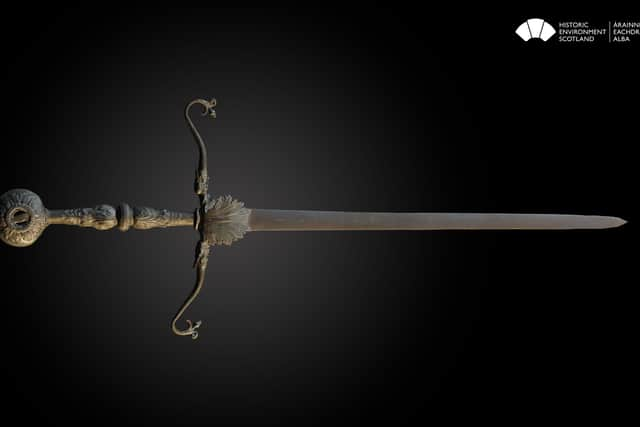
The Sword of State was gifted to James IV by Pope Julius II in 1507 and represents an exceptionally high quality of decoration. The arms of Pope Julius were used as the theme for the Sword handle design, with oak trees and acorns symbolising the risen Christ and dolphins signifying Christ’s Church.
Kathy Richmond, head of collections and applied conservation at HES, commented: “The Honours of Scotland are objects of unique importance in the HES collections, and we’re delighted to be able to offer a new way for our audiences to engage with them ahead of their role in the National Service of Thanksgiving and Dedication.
“Using digital technology in this way can help enhance how we enjoy, understand and protect the precious objects of our past.”
In 1650 they were removed for safekeeping ahead of Oliver Cromwell’s siege of Edinburgh Castle. Unable to be returned to Edinburgh Castle following the Scottish coronation of King Charles II in 1651, the Honours were taken to Dunnottar Castle before being smuggled out during a siege and hidden at Kinneff Kirk.
Only with the restoration of King Charles II to the throne could they return to Edinburgh Castle and be used for ceremonial openings of Parliament until 1707.
With the Parliamentary Union of 1707, the Honours were locked away in the Crown Room at the Castle, as they were no longer needed for ceremonial events.
They remained there until 1818 when Sir Walter Scott and others, with a royal warrant from the Prince Regent (who would become George IV), broke into the Crown Room, opened the Crown Chest and there rediscovered the Honours.
The digital models of the Honours of Scotland are available to view on Sketchfab website.