
Pope Francis suffering new breathing crises and back on ventilation – Vatican
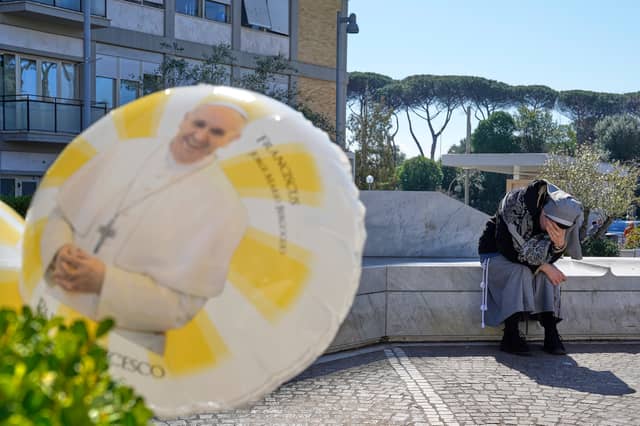

Pope Francis suffered two new acute respiratory crises and was put back on non-invasive mechanical ventilation in another setback to his battle to fight pneumonia, the Vatican said.
Doctors extracted “copious” amounts of mucus from his lungs during two bronchoscopies, in which a camera-tipped tube was sent down into his airways with a sucker at the tip to suction out fluid.
The Vatican on Monday said the mucus was his body’s reaction to the original pneumonia infection and not a new infection, given laboratory tests do not indicate any new bacteria.
Francis remained alert, oriented and co-operated with medical personnel. The prognosis remained guarded.
Doctors did not say if he remained in stable condition, but they referred to the crises in the past tense, suggesting they were over.
The crises were a new setback in what has become a more than two-week battle by the 88-year-old pope, who has chronic lung disease and had part of one lung removed, to overcome a complex respiratory infection.
Dr John Coleman, a pulmonary critical care doctor at Northwestern Medicine in Chicago, said the episodes were more concerning than the last one on Friday, in which Francis had a coughing fit, inhaled some vomit that needed to be extracted and then was put on the non-invasive mechanical ventilation for a day and then did not need it anymore.
The use of bronchoscopies reflects a worrying level of mucus and phlegm in the lungs, Dr Coleman said.
“The fact that they had to go in there and remove it manually is concerning, because it means that he is not clearing the secretions on his own,” he said.
“He’s taking little steps forward and then steps back,” said Dr Coleman, who is not involved in Francis’ care.
In a late update, the Vatican said the episodes were caused by a “significant accumulation” of mucus in his lungs and bronchial spasms.
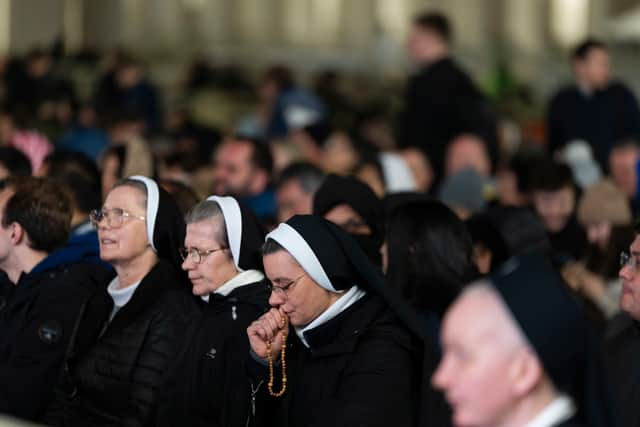
Francis, who is not physically active, uses a wheelchair and is overweight, had been undergoing respiratory physiotherapy to try to improve his lung function.
But the accumulation of the secretions in his lungs was a sign that he does not have the muscle tone to cough vigorously enough to expel the fluid.
The Vatican has not released any photos or videos of Francis since before he entered the hospital on February 14 with a complex lung infection.
This has become the longest absence of his 12-year papacy.
The Vatican has defended Francis’ decision to recover in peace and out of the public eye.
But on Monday one of Francis’ closest friends at the Vatican, Archbishop Vincenzo Paglia, urged him to let his voice be heard, saying the world needs to hear it.
“We need men like him who are truly universal and not only one-sided,” Archbishop Paglia said, speaking after a press conference to launch the annual assembly of his Pontifical Academy for Life, the Vatican’s bioethics academy, which has as this year’s theme “The End of the World?”.
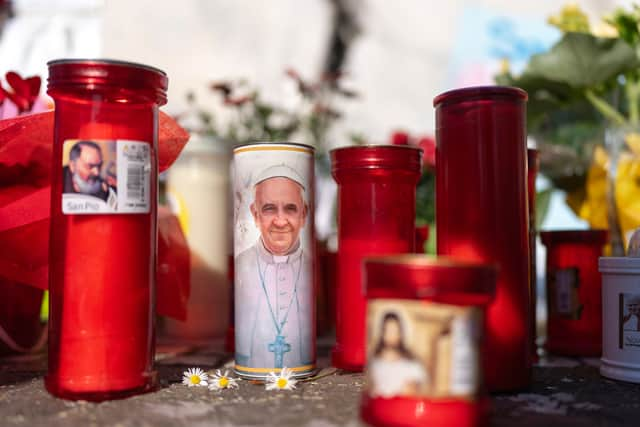
It was dated February 26 and signed “from Gemelli Polyclinic”.
Doctors often use non-invasive ventilation to stave off an intubation, or the use of invasive mechanical ventilation.
Francis has not been intubated during his stay in hospital.
It is not clear if he has provided any advance directives about the limits of his care if he declines or loses consciousness.
Archbishop Paglia, whose office helps articulate the Catholic Church’s position on end-of-life care, said Francis is like any other Catholic and would follow church teaching if it came to that.
“Today the pope is giving us an extraordinary teaching on fragility,” he added.
“Today the pope, not through words but with his body, is reminding all of us, we elderly people to begin with, that we are all fragile and therefore we need to take care of each other.”
Francis’ 17-night stay in hospital is by no means reaching the papal record that was set during St John Paul II’s numerous lengthy stays over a quarter century.
The longest single hospital stay occurred in 1981, when John Paul spent 55 days in Gemelli for a minor operation and then a long infection that followed.