
Portly company director with heart like a “ticking time bomb” becomes gym bunny with a six pack despite being told exercise could kill him
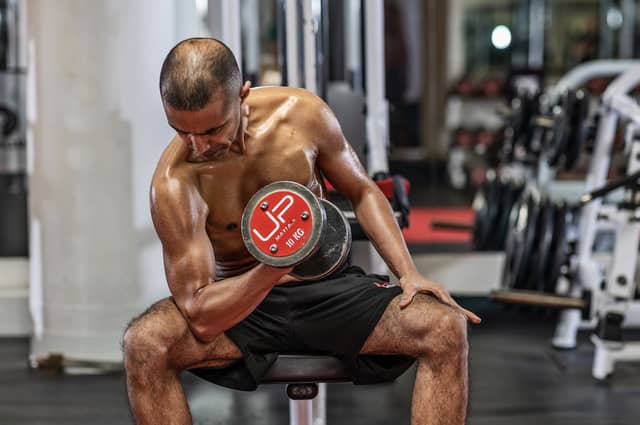

A portly company director who was told exercise could kill him as his heart was like a “ticking timebomb” defied doctors’ orders by becoming a gym bunny and honing an enviable six pack.
Dad of two Amir Ali, 43, was stunned to be diagnosed with the life-threatening heart condition arrhythmogenic right ventricular cardiomyopathy (ARVC) in October 2015, after suffering chest pains and palpitations that he had largely ignored for months.
Told ARVC, a disease of the heart muscle that causes interruptions to the normal electrical signals to the heart, could cause life threatening arrhythmia – an irregular heartbeat – and sudden death, he was advised to quit exercise.

He added: “Then, during the second lockdown, I put on so much weight. I’d never been heavy and I knew I needed professional help.
“I went in to see a personal trainer fully expecting they’d turn me away.
“I showed them my medical reports and everything.”

He said: “After my diagnosis, I was living in fear.
“I’ve got kids, a family, a life to lead. All of that could have stopped at any second.
“Since I started training, I have lost nearly 4st, I’ve stopped having heart palpitations and my six-monthly heart check-ups have been reduced to once a year.

Before his diagnosis, Amir had been super-fit. A karate black belt, he enjoyed frequent games of football, was a gym regular and walked for miles most days.
He had no idea he was facing such danger, saying: “I thought heart palpitations were entirely normal and assumed everyone got them.
“I thought it just happened in the same way your stomach rumbled. I got them daily for years.

Amir was then put through a series of tests that revealed scarring on his heart and led to a diagnosis of ARVC.
And his active lifestyle was “turned off overnight” when doctors warned him to take it easy and give up on strenuous exercise.
Doctors also put him onto medication for heart failure and high blood pressure and recommended an operation to fit an implantable cardioverter defribulator (ICD), an electronic device surgically implanted near his heart to regulate any abnormal rhythms.

But, during the Covid lockdowns, his sedentary lifestyle saw him piling on the pounds and, in consequence, suffering more frequent heart palpitations, as well as being out of breath and feeling that his life was “very fragile.”
He felt he was caught in a catch-22, as he was desperate to feel stronger and fitter, but had been told that strenuous exercise could be dangerous.
Amir’s doctor at London’s St Bartholomew’s Hospital warned him not to elevate his heart rate by more than 70 per cent and not to do any overhead weightlifting or anything that could cause tension across his pecs, because of his ICD device.
He said: “Before all this, I’d considered myself a very active guy.

But, despite the risks, Amir contacted global personal training business Ultimate Performance and was connected to PT Emma Kershaw in July 2021.
By then he weighed 13st at 5ft 6in, giving him a body mass index (BMI) used to gauge a healthy weight, of 29.3, making him borderline obese compared to the NHS healthy range of 18.5 to 24.9.
Pulling out all the stops, Emma established a relationship with Amir’s consultant, researched his heart condition and even sent videos of exercises to the hospital to check they were suitable for him before including them in his three times weekly workout regime.

Wearing a heart rate monitor throughout to ensure the beats per minute (BPM) stayed within a safe range, he incorporated gentle weightlifting and stretching.
Amir said: “Emma has been amazing. I call her my second mum as she has taken such good care of me.
“She’s monitored every single new exercise to see the stress it causes to my heart.

But, despite Emma’s care, working out has not been without its anxieties for Amir.
He said: “I did once joke with Emma that a lot of heart attacks happen in the gym. Of course, I was worried but I trust her and knew I had to do this.”
After eight months of regular sessions, Amir’s weight dropped to 9st 1lb, making his BMI 21.6 – well within the NHS’s healthy range.
More remarkable still, his resting heart rate has dropped from 84 bpm to just 48 bpm – akin to that of an athlete.
Still working out with Emma three times a week, he said: “I feel like RoboCop. Honestly, I’ve never felt better.
“I haven’t had a heart palpitation for months. If I lose my breath working out it only happens for seconds.
“I feel better than I ever have and my doctor said that since my last medical reports they now only need to see me once a year.”
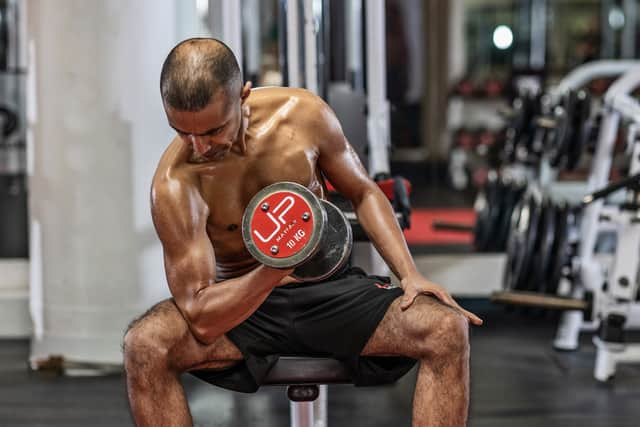
He said: “She has been amazing.
“I would never advise anyone with a heart condition to work out without making sure they are monitored by a proper trainer and have the approval of their doctors.
“But I do feel that exercise has done wonders for me.”
Cardiomyopathy is a disease of the heart muscle that affects its size, shape and structure.The condition is usually inherited.The three main types of cardiomyopathy are:
- Hypertrophic - heart wall is thickened
- Dilated - heart muscle becomes stretched and thin
- Arrhythmogenic right ventricular - heart muscle cells cannot be kept together
All of these types of cardiomyopathy affect the heart's ability to pump blood around the body efficiently.They can also impact the way electrical signals make the organ beat.There is no cure, however, in most cases people's quality or length of life is unaffected.Therapies may include medication, treatment to normalise heart rhythm, pacemakers and, in rare cases, heart surgery or transplants.
Emma has been incredibly impressed by Amir’s progress.
She said: “At U.P., we as trainers are all deeply invested in helping our clients achieve their fitness goals, and we all genuinely want to go the extra mile for them.
“Working with Amir meant we had to be extra judicious in that we needed to be incredibly careful in terms of exercise selection and working within specific heart rate zones.
“The team and I did a lot of research and liaised constantly with Amir’s consultant to make sure his personal training programme was appropriate, and monitored his heart rate in real-time throughout every session.
“It is an absolute privilege to train Amir and we are all so proud of everything he has achieved at Ultimate Performance. I look forward to many years of continuing to work together with Amir as a team, improving his physique and health even further.”
Dr Konstantinos Savvatis, Consultant Cardiologist at London Bridge Hospital (part of HCA UK) warned of the importance of taking medical advice before exercising after an ARVC diagnosis.
He said: “Exercise limitation plays an important role in the management of patients who have a diagnosis of ARVC and advice on exercise consists a central part of every consultation.
“Various studies have shown that exercise for a long duration and of high intensity can have a negative impact on the severity of the condition and the risk of dangerous ventricular arrhythmias and, even, cardiac arrest
“The current recommendation in patients with ARVC is to avoid endurance and high intensity exercise. Unfortunately, there is little evidence on how much and what type of exercise is safe in ARVC. It is recommended that all patients with ARVC discuss exercise advice with their cardiomyopathy doctor.”