
Robison supports changing council tax instead of ‘big bang’ replacement system

Changes could be made to Scotland’s council tax system rather than a “big bang massive replacement” of the charge, the Finance Secretary has said.
Shona Robison suggested that rather than have politicians argue about introducing a new system, it might be better to take “incremental steps” towards changing the current model.
Her comments came almost 20 years after the SNP initially pledged to scrap the “unfair” council tax – a commitment made in the run-up to the 2007 Holyrood election.
Now Ms Robison has said any changes to the existing model – which puts properties into bands based on their values in 1991 – will not “realistically” happen until after the 2026 Scottish elections.
But she told MSPs on Holyrood’s Local Government Committee that efforts towards “laying the ground work” for these to help build a “willingness to create some consensus to move forward” could happen before then.
The Finance Secretary told the committee that MSPs “could spend an eternity talking about a full replacement to the council tax”, adding this this would create “more areas of difference we end up just debating backwards and forwards”.
She added: “We kind of have over a number of years been in that position.
“And I guess I have just run out of patience for that, to be honest. I am a pragmatist by nature.
“If rather than make no progress we can just see if we can make some, and even if it is quite modest, it is better than nothing.”
While she said a “different landscape” in the future may mean there is “consensus around a complete replacement to the council tax”, Ms Robison added: “In the here and now I don’t think that’s what is on offer. I think there is just too much scope for division there.”
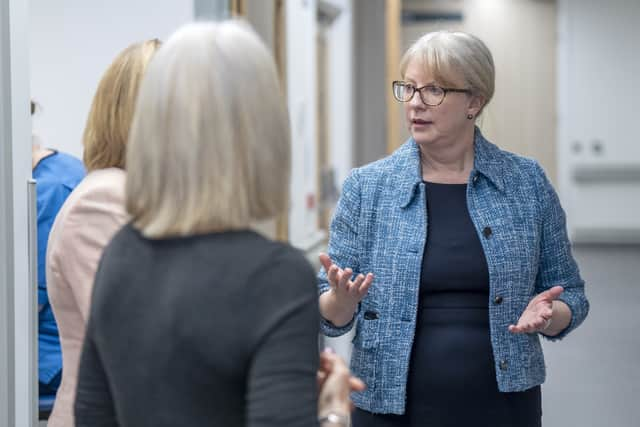
She said it would be “progress” if MSPs could “do something about 1991 property values”, as she told the committee that having more bands in the council tax system could make it more progressive.
“It’s a pretty modest change to be honest,” the Finance Secretary said.
“I would hope we would be able to agree that creating more bands within the system would help make the system a bit more progressive, and be part of a wider set of reforms.”
She also stressed to the committee that “very very strong” transitional schemes would need to be in place to help those who may end up losing out as a result of changes – with Ms Robison adding these could potentially be in place for years.
She told MSPs to win support for changes and to “land this in a positive space” there would have to be “very, very substantial transition schemes”.
Ms Robison said: “There will have to be some very, very strong transitional arrangements that smooth out that position, potentially over a number of years.”
Katie Hagmann, the resources spokesperson for the local government body Cosla, said council leaders are “very clear re-evaluation is something they want to see”.
But she also stressed the need to achieve consensus if changes are to happen, with Ms Hagmann telling MSPs: “In local government there is no one political party majority, so we need to bring all our councils, all our leaders, with us on this journey going forward.
“There is a feeling of: everybody wants this to move at pace, but in order for us to move at pace we do need to bring that consensus as well.”
She told how council leaders last week agreeed that Cosla’s Convention – which sets the strategic direction for the body – is to look at the issue.
Ms Hagmann told MSPs: “There is a piece of work that needs to be done but certainly we have got plans in place to do that, and the first stage will be at our Convention in March so all councillors can feel a part of this.”