Search


29 Mar 2026
Search
29 Mar 2026

Please allow ads as they help fund our trusted local news content.
Kindly add us to your ad blocker whitelist.
If you want further access to Ireland's best local journalism, consider contributing and/or subscribing to our free daily Newsletter .
Support our mission and join our community now.
To continue reading this article, you can subscribe for as little as €0.50 per week which will also give you access to all of our premium content and archived articles!
Alternatively, you can pay €0.50 per article, capped at €1 per day.
Thank you for supporting Ireland's best local journalism!


The European Union is resisting the Government’s demands for a cap on the number of people able to live and work in the UK under a new youth exchange scheme.
Brussels has proposed an alternative mechanism to control numbers involved in the planned scheme, which would allow Britons and citizens of EU states to live, work and study in each other’s territory.
But the UK remains committed to a hard annual cap on numbers – which would be in the tens of thousands – and the row risks souring a major summit meeting between Sir Keir Starmer and Brussels chiefs in the summer.
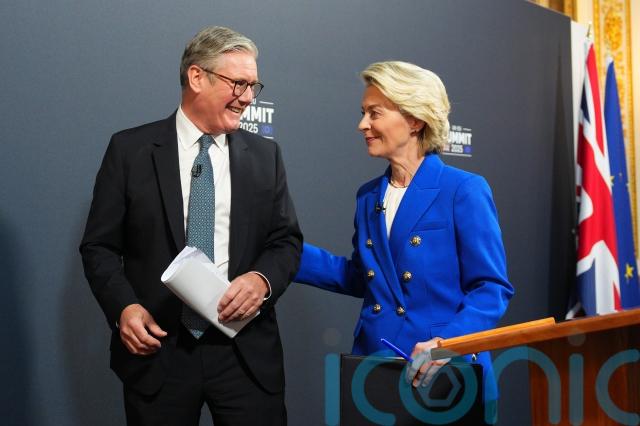
EU insiders view the proposed “youth experience scheme” for under-30s as a way to build bridges between younger Britons and Brussels after the Brexit vote almost a decade ago.
There is concern a restrictive cap would undermine a scheme intended to cement a positive relationship between the UK and EU.
An EU source said: “This is really a very strategic endeavour. The strategy is about ensuring that our societies keep linked, understand each other and see each other as part of the same family of nations. This is something that is really needed in these troubled times.
“If Europe has to stand together, it has to feel a common sense of purpose when it comes to international relations and democracy.
“Ensuring that our young people can travel to each other’s countries, work, study in each other’s countries is an important part of that.”
Sir Keir has insisted the scheme must have “appropriate time-limits, caps and visa requirements”.
Officials have compared the proposals to a similar programme in operation with Australia, which has a cap of 45,000.
But senior EU sources said the proposed measure is “not a migration scheme” and did not need a cap.
An EU official said there could be “a monitoring system to ensure both sides are equally satisfied with the way the scheme is operating” and “it’s about the management of flows rather than an upfront number”.
The proposed mechanism has been described in Westminster as an “emergency brake” which could be applied if numbers were too high, drawing comparisons with then-prime minister David Cameron’s attempts to control EU citizens’ access to benefits in the run-up to the 2016 referendum.
Whitehall sources said anything other than a firm cap would be unacceptable to the Home Office, responsible for migration policy, or the Foreign Office.

The EU and UK are also at odds over university tuition fees that would be charged to students from the bloc studying at British institutions.EU negotiators want students from the bloc to pay the same rate as their British counterparts, rather than the higher fees charged to international students.
The youth experience scheme is one of three areas where the Government and the EU hope to forge closer ties when they meet for a summit, which is expected in June or early July.
There is broad consensus on the other two areas, agreements on food safety and emissions trading.
A UK Government spokesperson said: “We will not give a running commentary on ongoing talks.
“We are working together with the EU to create a balanced youth experience scheme which will create new opportunities for young people to live, work, study and travel.
“Any final scheme must be time-limited, capped and will be based on our existing youth mobility schemes, which do not include access to home tuition fee status.”
But Labour MP Stella Creasy, chairwoman of the Labour Movement for Europe, said there should be less concern on the number of people involved in the scheme: “This is a deal that will bring back freedoms young Brits from all backgrounds lost with Brexit, as well as boosting growth.”

Subscribe or register today to discover more from DonegalLive.ie
Buy the e-paper of the Donegal Democrat, Donegal People's Press, Donegal Post and Inish Times here for instant access to Donegal's premier news titles.
Keep up with the latest news from Donegal with our daily newsletter featuring the most important stories of the day delivered to your inbox every evening at 5pm.

This publication supports the work of the Press Council of Ireland and Office of the Press Ombudsman, and our staff operate within the Code of Practice of the Press Council. You can obtain a copy of the Code, or contact the Council, at www.presscouncil.ie, Lo-call 1800 208 080 or email: info@presscouncil.ie.