Search


29 Mar 2026
Search
29 Mar 2026

Please allow ads as they help fund our trusted local news content.
Kindly add us to your ad blocker whitelist.
If you want further access to Ireland's best local journalism, consider contributing and/or subscribing to our free daily Newsletter .
Support our mission and join our community now.
To continue reading this article, you can subscribe for as little as €0.50 per week which will also give you access to all of our premium content and archived articles!
Alternatively, you can pay €0.50 per article, capped at €1 per day.
Thank you for supporting Ireland's best local journalism!


Top diplomats from key regional powers are meeting in Pakistan to discuss how to end the fighting in the Middle East, but there were few signs of progress as Israel and the US kept up strikes on Iran, and Tehran responded by firing missiles and drones across the region.
Pakistan said foreign ministers from Saudi Arabia, Turkey and Egypt are participating in the talks in Islamabad. Pakistani Prime Minister Shehbaz Sharif said he and Iranian President Masoud Pezeshkian held “extensive discussions” on regional hostilities.
More than 3,000 people have been killed throughout the month-long war that began with US and Israeli strikes on Iran, triggering Iran’s attacks on Israel and neighbouring Gulf Arab states.
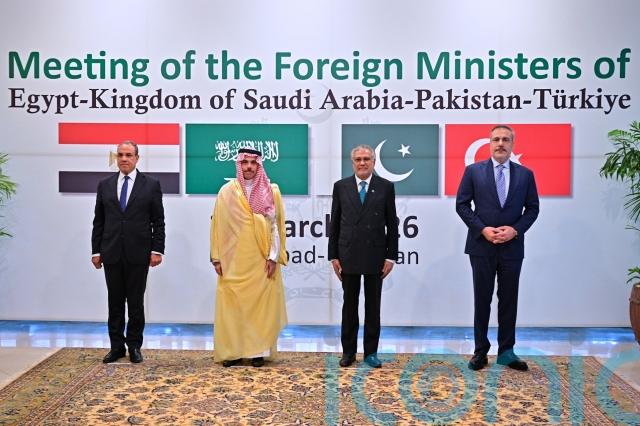
The US and Israel are not participating in the Islamabad talks.
Iran’s parliament speaker, Mohammad Bagher Qalibaf, dismissed the talks as a cover while the US sends additional troops to the Middle East.
He warned against any ground invasion and said Iran is ready to set American troops “on fire” and punish Washington’s regional allies, according to Iranian state media.
He added: “Our firing continues. Our missiles are in place. Our determination and faith have increased.”
The war has threatened oil and gas supplies with Iran’s grip on the strategic Strait of Hormuz shaking markets.
Meanwhile, Yemen’s Houthi rebels entered the fighting over the weekend, threatening to widen the war and further hurt global shipping if they again target vessels in the Bab el-Mandeb Strait off the Red Sea, through which about 12% of the world’s trade typically passes.
Israel announced waves of incoming strikes from Iran on Sunday and explosions could be heard throughout Tehran.
Air defences on Sunday intercepted Iranian missiles and drones across Gulf countries, including Saudi Arabia and Kuwait.
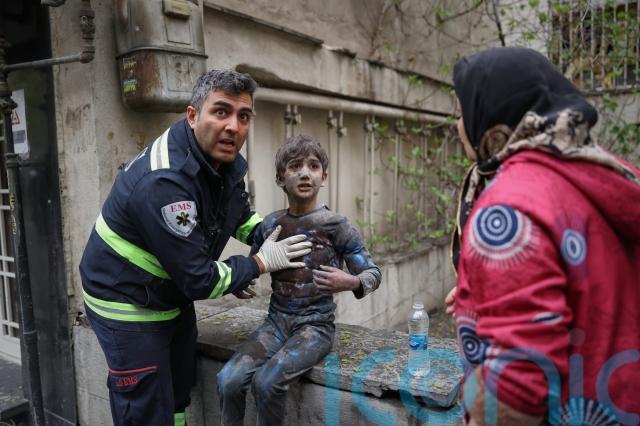
Israel’s military said a soldier had been killed and three others were injured in combat in southern Lebanon.
The death raised the total to five Israeli soldiers killed there since the conflict with Hezbollah reignited on March 2.
Houthi Brigadier General Yahya Saree said on the rebels’ Al-Masirah satellite television station that they launched missiles towards “sensitive Israeli military sites” in the south.
If the Houthis increase attacks on commercial shipping, as they have in the past, it would further push up oil prices and destabilise “all of maritime security”, said Ahmed Nagi, a senior Yemen analyst at the International Crisis Group. He warned: “The impact would not be limited to the energy market.”
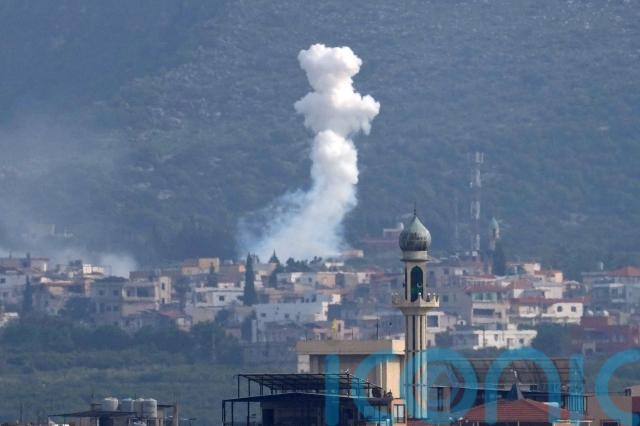
The Bab el-Mandeb, at the southern tip of the Arabian Peninsula, is crucial for vessels heading to the Suez Canal through the Red Sea. Saudi Arabia has been sending millions of barrels of crude oil a day through it because the Strait of Hormuz is effectively closed.
Houthi rebels attacked more than 100 merchant vessels with missiles and drones, sinking two vessels, between November 2023 and January 2025. The group said it acted in solidarity with Palestinians in Gaza during the Israel-Hamas war.
The Houthis’ latest involvement would complicate the deployment of the USS Gerald R. Ford, the aircraft carrier that arrived in Croatia on Saturday for maintenance.
Sending the ship to the Red Sea could draw attacks similar to those on the USS Dwight D. Eisenhower in 2024 and the USS Harry S. Truman in 2025.
The Houthis have held Yemen’s capital, Sanaa, since 2014. Saudi Arabia launched a war against the Houthis on behalf of Yemen’s exiled government in 2015 and they now have an uneasy ceasefire.

Subscribe or register today to discover more from DonegalLive.ie
Buy the e-paper of the Donegal Democrat, Donegal People's Press, Donegal Post and Inish Times here for instant access to Donegal's premier news titles.
Keep up with the latest news from Donegal with our daily newsletter featuring the most important stories of the day delivered to your inbox every evening at 5pm.

This publication supports the work of the Press Council of Ireland and Office of the Press Ombudsman, and our staff operate within the Code of Practice of the Press Council. You can obtain a copy of the Code, or contact the Council, at www.presscouncil.ie, Lo-call 1800 208 080 or email: info@presscouncil.ie.