Search


29 Mar 2026
Search
29 Mar 2026

Please allow ads as they help fund our trusted local news content.
Kindly add us to your ad blocker whitelist.
If you want further access to Ireland's best local journalism, consider contributing and/or subscribing to our free daily Newsletter .
Support our mission and join our community now.
To continue reading this article, you can subscribe for as little as €0.50 per week which will also give you access to all of our premium content and archived articles!
Alternatively, you can pay €0.50 per article, capped at €1 per day.
Thank you for supporting Ireland's best local journalism!


A top Iranian official warned the US against a ground invasion, saying its troops would be set “on fire”.
It comes as regional diplomats met in Pakistan on Sunday in the hopes of opening direct US-Iran talks and ending the month-long war.
Iran’s parliament speaker, Mohammad Bagher Qalibaf, said Iranian forces were “waiting for the arrival of American troops on the ground to set them on fire and punish their regional partners forever,” according to Iranian state media.
He also dismissed the talks as a cover after some 2,500 US Marines trained in amphibious landings arrived in the Middle East.
The war has threatened global supplies of oil, natural gas and fertiliser and disrupted air travel.
Iran’s grip on the strategic Strait of Hormuz has shaken markets and prices, and now the Iranian-backed Houthi rebels’ entry into the war could threaten shipping on another crucial waterway, the Bab el-Mandeb strait to the Red Sea.
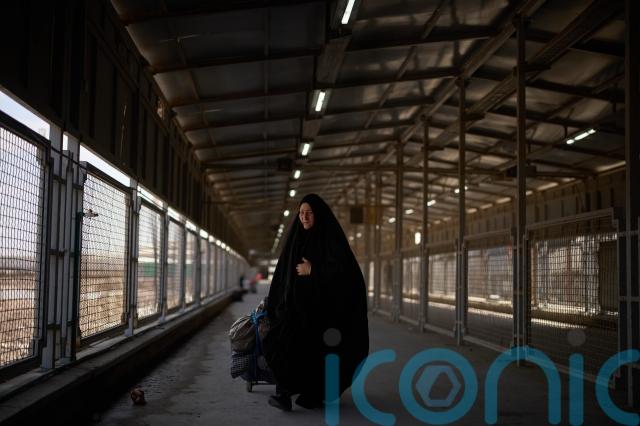
“We don’t know at what moment our homes could be targeted,” said Razzak Saghir al-Mousawi, 71, describing relentless airstrikes as Iranians crossing into Iraq urged the US to end the war.
“I am definitely afraid.”
More than 3,000 people have been killed in the war that began with US and Israeli strikes on Iran that triggered Iranian attacks on Israel and neighbouring Gulf Arab states.
Meanwhile, Israel has invaded Lebanon while targeting the Iranian-backed Hezbollah.
The war continues on the digital front as well.
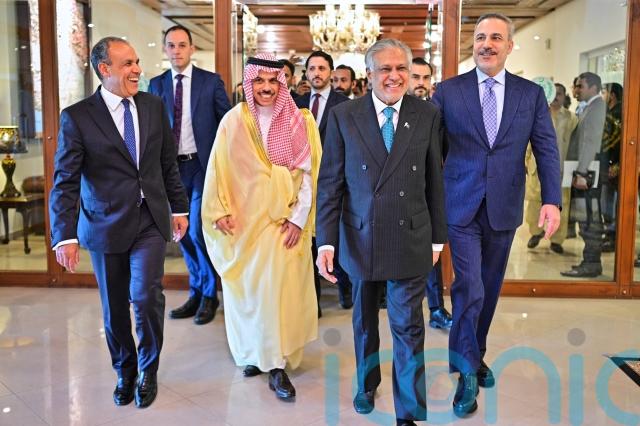
Pakistan said the foreign ministers of Saudi Arabia, Turkey and Egypt met in Islamabad without US or Israeli participation, days after the US offered Iran a 15-point “action list” as a framework for a possible peace deal.
The ministers are expected to meet again Monday.
Egypt’s Badr Abdelatty said the meetings are aimed at opening a “direct dialogue” between the US and Iran, which have largely communicated through mediators.
Both this war and last year’s 12-day war began during rounds of indirect talks.
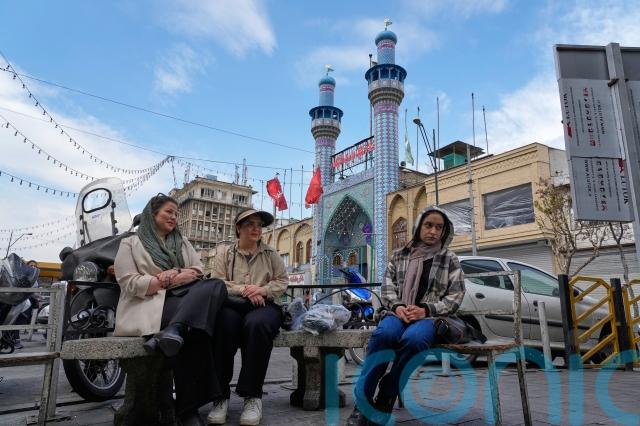
Iranian officials have rejected the US framework and publicly dismissed the idea of negotiating under pressure.
But Press TV, the English-language arm of Iran’s state broadcaster, reported last week that Tehran had drafted its own five-point proposal that reportedly called for a halt to killing Iranian officials, guarantees against future attacks, reparations and Iran’s “exercise of sovereignty over the Strait of Hormuz”.
Iran has eased some restrictions on commercial ships in the strait, agreeing late on Saturday to allow 20 more Pakistani-flagged vessels to pass through.
It “sends a clear signal that Iran remains open for business with the world, provided the United States abandons coercion,” said Asif Durrani, Pakistan’s former ambassador to Iran.
An adviser to the UAE, Anwar Gargash, called for any settlement to the war to include “clear guarantees” that Iranian attacks on neighbours will not be repeated.
Mr Gargash said Iran’s government has become “the main threat” to Persian Gulf security and called for compensation for attacks on civilian infrastructure.
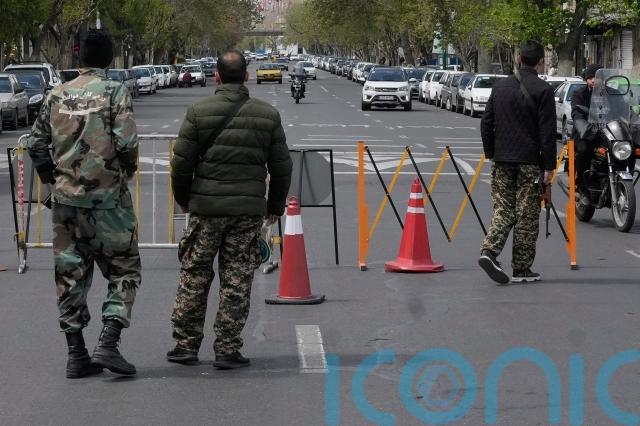
Iran on Sunday warned of escalation after Israeli airstrikes hit several universities, including ones that Israel claimed were used for nuclear research and development.
Concerns over Iran’s nuclear programme are at the heart of tensions.
The paramilitary Revolutionary Guard warned that Iran would consider Israeli universities and branches of US universities in the region “legitimate targets” unless offered safety assurances for Iranian universities, state media reported.
US colleges have campuses in Qatar and the UAE, including Georgetown, New York and Northwestern universities.
“If the US government wants its universities in the region spared, it should condemn the bombardment” of Iranian universities by midday on Monday, the Guard said in a statement.
Iranian Foreign Ministry spokesman Esmaeil Baqaei said on Saturday that dozens of universities and research centres have been hit, among them the Iran University of Science and Technology and Isfahan University of Technology.
Both sides in the war have threatened to attack civilian facilities, which critics have warned could be a war crime.
Iranian authorities say more than 1,900 people have been killed in the Islamic Republic, while 19 have been reported dead in Israel.
In Lebanon, officials said more than 1,100 people have been killed.
In Iraq, where Iranian-supported militia groups have entered the conflict, 80 members of the security forces have died.
In Gulf states, 20 people have been killed.
Four have been killed in the occupied West Bank.

Subscribe or register today to discover more from DonegalLive.ie
Buy the e-paper of the Donegal Democrat, Donegal People's Press, Donegal Post and Inish Times here for instant access to Donegal's premier news titles.
Keep up with the latest news from Donegal with our daily newsletter featuring the most important stories of the day delivered to your inbox every evening at 5pm.

This publication supports the work of the Press Council of Ireland and Office of the Press Ombudsman, and our staff operate within the Code of Practice of the Press Council. You can obtain a copy of the Code, or contact the Council, at www.presscouncil.ie, Lo-call 1800 208 080 or email: info@presscouncil.ie.