
Derry homeowners impacted by Donegal defective concrete campaigning for redress
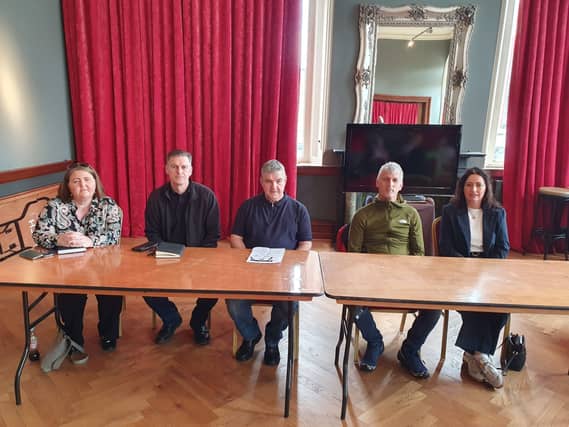

Stormont Housing Minister Gordon Lyons’ March comment there was no 'systemic issue' with defective concrete blocks in the North refuted by Cllr Shaun Harkin
Homeowners in Derry impacted by defective concrete blocks which originated in Inishowen in County Donegal have addressed a public meeting calling for remediation and redress.
Organised by Derry City and Strabane District councillor Shaun Harkin (People Before Profit), the meeting took place in the city’s St Columb’s Hall.
Danny Rafferty, whose Beragh Hill Road home in Derry was the first in the North confirmed to have been built with defective concrete blocks, was the main speaker on Tuesday afternoon.
He was joined by Donegal County councillor Joy Beard (100% Redress Party), Cllr Harkin, and Professor Paul Dunlop and Professor Karen Kirby (Ulster University).
Cllr Harkin strongly refuted Stormont Housing Minister Gordon Lyons’ March comment there was no “systemic issue” with defective concrete blocks in the North.
“I think if you have been somebody that has been forced to deal with this issue, it has been miserable and there has not been a lot of support. I think that is important to acknowledge for people like Danny [Rafferty] and Paul [Dunlop],” said Cllr Harkin.
“But if you were someone who suspected there could be defective blocks in your house, what the minister said would not have given you a lot of confidence there would be support there,” he added.
“What we are here to try and talk about is what we can do and if it is a larger problem, to try and have some plan of action to get it addressed,” said Cllr Harkin.
Telling the story of his wife, Kate, and himself, Mr Rafferty said they had built their house in Derry in 2006 using materials from both sides of the border.
“The first issue we really noticed was when we painted the house, 20 year paint was lasting about a year and a half. After that we were getting the classic spider cracks, which are different from settlement cracks,” he said.
“In 2022 I got fed up with people telling me it was settlement cracks and I called the structural engineer and asked him to come and have a look at the house and tell me what he thought,” added Mr Rafferty.
“[He later told me] I thought I would save you some money. There is no point me stopping by your house and charging you for a structural report, you have ‘mica’. I said, ‘How can you tell?’ and he said ‘I can tell from the top of the road’.
“I then got the house core tested to confirm that it was. I sent the concrete block off to [Petrolab] Cornwall to get tested, which confirmed [the blocks were defective].
“We contacted our house insurance who said our claim was invalid because we had used defective materials to build it. I did not know they were defective when I bought them, so how could my insurance be invalid?” said Mr Rafferty, who then began contacting Stormont and Westminster relentlessly and went public with his experience in an unsuccessful bid to secure redress.
Danny Rafferty subsequently re-built his home at his own expense, adding, “It will now be another 12 years until my [now second] mortgage is paid off.”
EXPAND TWITTER THREAD FOR VIDEOS OF PANEL SPEAKERS:
Cllr Joy Beard said the regulations on the concrete blocks manufactured in the Republic of Ireland had not been adequate.
“They are still not adequate. Those blocks and that concrete did not stop coming over the border. To be honest there could be a massive, massive problem here in Derry and further afield,” she added.
Explaining that blaming defective concrete blocks and concrete products on ‘mica’ was scientifically incorrect, Professor Dunlop highlighted the research carried out by himself and Dr Andreas Leemann [Swiss Federal Laboratories for Materials Science and Technology] and others.
Their paper, ‘The “mica crisis” in Donegal, Ireland – A case of internal sulfate attack?’ was published in June 2023 (https://www.sciencedirect.com/science/article/pii/S0008884623000613) and ‘Defective homes in Donegal, Ireland: Effect of exposure conditions and concrete quality on pyrrhotite oxidation and internal sulfate attack’ was published in December 2024 (https://www.sciencedirect.com/science/article/pii/S0008884624002655).
The latter was a project financed by the Department of Housing, local Government and Heritage and the Geological Survey of Ireland, an international research consortium has been investigating three affected homes and one undamaged reference home located in County Donegal.
Professor Dunlop, who has lost his own home in Buncrana due to defective concrete blocks and concrete products said: “‘Mica’ does not cause problems in hardened concrete.
“We looked at the concrete from scratch again. Re-assessed it and found out there are another geological mineral called pyrrhotite there and pyrrhotite is regulated by the European Union standards for concrete manufacturing that Ireland also must comply with. It came into [effect] in 2002, so anyone who has bought concrete after 2002 and has pyrrhotite in the concrete has the potential for cause to complain to Europe,” he said, “particularly if the sulphur level is high.
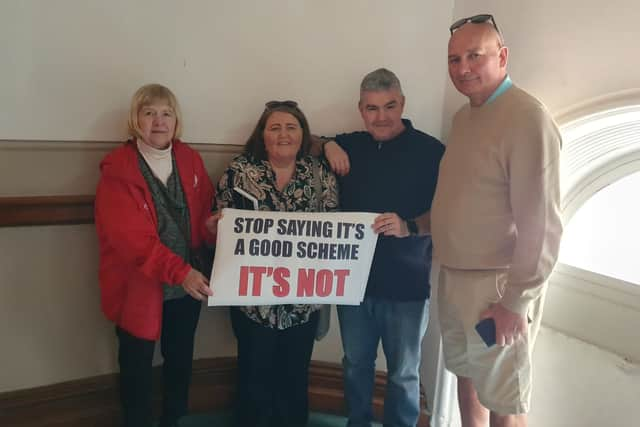
Members of the 100% Redress Party attending the public meeting on Derry & Strabane's Defective Block Crisis: From left: Mary Connors, Cllr Joy Beard, Danny Rafferty (Derry homeowner) and Cllr Ali Farren.
The damaging psychological effect of living in a crumbling home was outlined by Professor Kirby whose research found there were very high rates of depression and anxiety and PTSD (post traumatic stress disorder) and complex PTSD among those affected.
“We compared those rates to existing data - the Irish national mental health prevalence rates - and people who were in the middle of this, their rates were two to three times higher.”
A follow-up meeting to discuss taking forward a campaign around defective concrete blocks and concrete products will take place in St Columb’s Hall, on Tuesday, May 19, at 7.00pm.