
Donegal man shares his inspirational battle with Alcoholism - "Drink nearly killed me, but now I'm finally free"

One night I came into the bedroom I shared with my wife Dympna. As usual, she’d gone up before me while I’d stayed downstairs and had a sneaky nightcap or two. A typical night.
When I came up to bed I would always lean over and gave her a kiss on the cheek, but this particular night she said ‘you’d a drink down the stairs’, and I could feel her tightening up in the bed. I’ll never forget it. That tightness was fear, and it wasn’t that I was going to hurt her, or hit her or anything like that. The fear in her was ‘where’s this going to end?’
My thought at that time was ‘ah, cop yourself on, it’s only a nightcap.’ But Dympna was right. Because, though I didn’t see it at the time, I was in the grip of an alcohol addiction that, in the end, nearly killed me.
Drink was never an issue in my teenage years growing up in Carrigans. I had my first drink at the age of 16, on summer holidays with my family, but it was no big deal.
Sport was a big part of my life at that time. Naomh Baithin - it’s Naomh Colmcille now - came about in the early eighties. My late father Maurice was one of the founders. I started playing GAA there at U14 level, and my game really developed at St Eunan’s College, where I was a boarder. I was a keen soccer player too, and enjoyed a lot of success with Killea FC and Newton FC since I started playing at the age of 17.
In 1990 I went to Jordanstown to study quantity surveying, and that’s where things changed for me.
Myself and a friend from St Eunan’s, Dennis Curran, went to a meeting to see about joining the GAA team.
We were sitting in that room with some brilliant players. Gary Mason of Down, Mark Gallagher of Fermanagh and many more, and I remember saying ‘there’s no room for us here, Dennis’, but that’s not how it was, and we started playing with these boys.
We weren’t the cream of the crop, but we’d plenty of heart and determination and guts, and I ended up winning an All-Ireland medal with Jordanstown in 1994.
Things were going well with my playing career back home too. Naomh Baithin won the county final in ’93 and I got man of the match, and I was doing well in the soccer with Newton, who were in the Inishowen League at that time.
But then I busted my cruciate ligament, and I never really got back to myself after that. They talk about developing an addiction from knockbacks, and looking back now I can see a few things that really dented my confidence.
I would have been seen as one of the smartest locally growing up, but when I did the entrance exam for St Eunan’s I finished bottom in that exam, and that really threw me.
And the other was after the cruciate, when I was working my way back to fitness. Newton had just been promoted to the Ulster Senior League, and though I was told I’d be part of the set up, I was indirectly being told I wouldn’t be featuring much in the first team, and that was hard to take having played a good part in that promotion.
I’m not saying these are the reasons I drank. I drank because I was an alcoholic. But addiction is driven by fear, and I think the fear with me was ‘I’m not good enough’.
Anyway, Jordanstown is where my drinking really took off. With those guys in the Gaelic team it was play hard, but drink hard, and that’s how it was. Our match each week was always finalised by a big session afterwards.
But apart from those sessions on the day of the match, drink still wasn’t a big thing. I was lodging with a wee woman in Whiteabbey, and I cycled to college every morning and came back each night at nine where she’d have my dinner on the table, and I never abused that.
Then, in my final year, I moved into a student house in Belfast, and that opened me up to a whole new situation.
I started drinking more regularly, and in hindsight now I can see there were wee subtle warning signs starting to creep in.
I remember playing in Inishowen on Sunday afternoons, having a couple pints in Buncrana or Alice’s Bar in Killea, then getting on the bus at seven for Belfast. And all I could think of was that I had to make sure I got there before the pub where I always drank stopped serving.
I had started to feel a need for drink, a compulsion. Each night during the week I would have to have a can of beer or two. I didn’t think it was an issue at the time, but in hindsight I can see a pattern was developing.
I had graduated and got a job by this stage, in East Belfast, but there was a lot of trouble up there at that time, Drumree and all the rest of it, and I was starting to feel uncomfortable.
So I got a job in Derry, and in 1996 I came back home to live in Carrigans.
My family business is a pub, and the house is directly above it, and I remember coming back from my first day’s work in Derry and going in the front door of the pub that evening and stopping to have a drink with the locals. That day was the start of me drinking seven days a week.
I probably had two beers that day, and I repeated that every day. But somewhere along the line those two drinks turned into three, then four, and mammy would have my dinner on the table while I would stay on downstairs drinking.
Eventually my father said to me ‘you know Murray, you’re getting a bit fond of that drink’, but I didn’t think a lot of it.
By then I was dating Dympna, who would eventually become my wife. We always went out a couple of nights a week, and one was the cinema. I deliberately took her to the early showing so that I would get her home and have time to get a nightcap in the pub before closing.
Dympna wasn’t a drinker, so when we went clubbing on Saturday nights I knew she’d want us out dancing most of the night. But for me this meant I wouldn’t get a chance to go to the bar, so I’d always have to get a good charge of drink in me before we headed out.
My life revolved around drink. Me and Dympna were dating for 11 years and she eventually said ‘are you going to marry me or am I moving on here?’ The day she said that to me I froze, because all I could think was ‘how will I get drinking if we’re living under the same roof?’
We eventually got married in 2003 and moved into a house together in Killea, but nothing was more important to me than my relationship with drink.
I’d come up with silly excuses, ‘do you want anything in the shop, Dympna?’, and I’d nip over to Alice’s for two or three or buy a bottle of wine in the off licence and have the bottle finished, the empty thrown over the hedge, before I got back to the house.
Dympna always went to bed before me, and most nights had a shower. As soon as I heard that shower going, I went and got myself a whiskey and had it sitting under the cushion at my elbow in case she came down unexpectedly.
Drink was at the end of everything. I wouldn’t get a garden shed, because it would mean not having to borrow the brother’s lawnmower any more, and this was another excuse every week to get offsides from Dympna for an hour and get a few drinks in the pub.
When she brought up having children, I was terrified. All I could think was ‘kids? I’ll never get out the door’.
It was affecting my marriage and I was starting to make Dympna unhappy. I used to tell her I was working late when I was actually in the bar, and I’d come home and give her a hug and she would smell drink off me.
She tried to confront me a few times, but I didn’t want to hear it. One day she said to me ‘if I knew you drank as much as you did, I wouldn’t have married you’.
Dympna had a condition called auto immune hepatitis, where her own immune system attacked her liver. She’d had two liver transplants, in 1998 and 1999, and everything was good for her for several years.
But in 2008 her health took a turn for the worse. The liver wasn’t functioning properly and she spent two months in a special unit in Birmingham while the doctors tried to get her better.
It was a terrible time for her, but in those eight weeks I was very comfortable. I was staying in a wee room across the street from the hospital, and I was able to play the good boy during the day, getting Dympna whatever she needed, safe in the knowledge that when the bell rang at half eight each night clearing everyone out of the ward, I would be free to go drinking.
On the day we were leaving to go back home, the consultant told Dympna she would need another transplant.
I had to be strong on the outside, but all I could think was ‘I don’t think Dympna will get through this. Is this the beginning of the end?’
When we got home my drinking reached a whole new level. I’m not blaming that. I was bound to be an alcoholic from an early stage and it had absolutely nothing to do with that, it just happened to escalate it.
We came home and Dympna spent a lot of time with her mother. ‘That’s grand, that’s where she needs to be,’ was my excuse again for drinking time.
She got the call in March 2009 for the transplant. It was a beeper thing, where you basically had to drop everything and go. But I was drunk. I couldn’t go, so her mother and father went with her.
I went the next day and by the time I got to Birmingham she’d had her transplant. I wasn’t too popular with her mum and dad, but things had gone well so I decided that evening I would show the brother, Liam, where I drank.
I don’t remember what happened that night because I got so drunk, but in the morning Liam had taken my money and cash cards off me and said ‘you’re no good to Dympna here, you’re going home’. I asked him for a pound for a bottle of water, but he said no and bought it for me himself. I couldn’t even be trusted with a pound.
I came home to my house in Killea in April 2009 and at that stage I’d stopped going to my work. I was getting sick lines and the doctor was writing ‘alcohol dependant’ and I was saying ‘gone write something else on them’ because I still couldn’t face up to things. Eventually I was made redundant.
Dympna was still in hospital in Birmingham and I was free to drink. I drank and drank. I got to know a few cellar men in Derry and drank in the bar before the staff even arrived, moved on to another bar before I made a nuisance of myself, and ended up back home with a bottle of gin. Every morning I woke up and did it all over again.
I stopped going to mass and began to forget what day of the week it was. Some people think alcoholics are the boys standing on street corners with a bottle in their hand, but I was in the gutter right there in my own home.
I may have stopped going to mass, but even in the depths of my addiction, faith played a part in my life.
Every afternoon, in the middle of the drinking, I would go over to the Long Tower for an hour, and my prayer every day was nothing more than ‘please God help Dympna to get better’.
I was in a very low place. In late July, Liam came to me and said ‘you need to get your act together, Dympna’s coming home for a few weeks.
Dympna came home in August for ten days. She was staying with her mother. I remember getting up that first morning with the full intention of going to see her, but I took that first drink and immediately I was making excuses in my head about why I couldn’t go to see her.
I did the same thing the next day and the day after that. Dympna was home for ten days and then went back to Birmingham. I never saw her.
I just carried on drinking, and by November of that year I had reached the stage where I physically couldn’t lift the glass to my mouth because my body had become so ravaged with drink.
One morning I was lying in bed, paralysed. I was too weak to move. I could hear movement round the side of the house but I couldn’t get up to answer the door and eventually they broke the door down.
My cousin came up the stairs and he shouted ‘he’s here’ to my sister, and she burst out crying and said ‘is he alive?’
They talk about rock bottoms and I was firmly there. I was taken to Altnagelvin and the doctors said to my mother ‘we’ll try and turn him around, but things don’t look good’.
My liver function test was reading 2760. The normaI is somewhere between 0 and 50. I was there for three weeks, and I was very lucky to get away with my life. The doctor said to me ‘on the scale of hope and no hope, the needle was at no hope for you’.
On the night I came home, the only thing I wanted to do was have a drink. I’d come that close to losing my life, but the addiction was so rife in me. But thank God the right person was there when I went downstairs to the bar. It was a close family friend, and he said ‘Murray, don't do it - you’re about to kill yourself’.
So I didn’t drink, and the following week my mother arranged for me to go into White Oaks rehab centre. When I was in there, the counsellors arranged for me to talk to Dympna on the phone. It was December 6. We told each other how much we loved one another, and I told her that I’d be over to see her when my treatment finished in January. We would both get better, we said, and we could get our life together back on track.
But we never got that chance; later that week Dympna died. She died, and I hadn’t seen her.
Drink had done so much damage to me that I didn’t even feel the pain of Dympna’s death at that time. I got through the funeral and people would still tell me to this day ‘you were in a daze’.
I was due to stay in White Oaks until January, but I came out for one day to spend Christmas at home.
It was the toughest Christmas day I ever had in my life. The whole family was there and my nieces and nephews were playing. I couldn’t hack it. There was no Dympna, no drink. I needed to get away so I lifted my coat and went out through the kitchen. On the sideboard there were two bottles of wine not completely finished and I went over and lifted one, pulled the cork off it put it to my mouth. I could taste it on my lips, but at that moment I banged it back down on the counter and said to myself ‘this is not what Dympna would want for me’.
I went out and I walked and walked in the dark and the rain, and I begged Dympna to help me and I begged for her forgiveness. And then I asked God to help me. And I believe to this day that was the start of where things started to take a turn for me.
I came back in and started playing with the kids and I felt completely different.
I went back to White Oaks, and in those early days in recovery, I believed I was just the dirt in the ground, a good for nothing, useless alcoholic But I came to understand that I had a disease called alcoholism.
When Dympna was dying, I was sitting drinking. I put drink above absolutely everything and everyone. But I learned that addiction makes you do bad things. It didn’t mean I was a bad person, and finally realising that allowed me to forgive myself.
As the days passed, I stayed sober, and I thought to myself ‘maybe you can do it’. I dug in at AA and went to White Oaks for regular counselling.
I also kept going to visit Dympna’s parents. I wasn’t very popular, as you can imagine, but I persisted. We talked a lot about Dympna and there was a lot of pain and crying, and then one day her mother said ‘you know, Murray, there was no betterness left for Dympna in this world’.
And it was then I realised that the prayer I’d said every day in the Long Tower for all those months had been answered – God had taken her to a better place. Looking back, part of me thinks Dympna was able to let herself go that week in December when we talked on the phone because she finally knew I was going to be ok.
It’s coming up for eight years since I last took a drink, and Dympna has never left my side the entire time. She is doing for me today what I could not do for her when she was alive.
They say in AA you have to find a power greater than yourself or the booze. For me it’s God, and God has allowed Dympna to work for me.
My whole family has forgiven me for what I put them through. They don’t talk about it, they don’t say it, but I can feel it from their actions.
I believe Dympna’s family have forgiven me. When I was six months sober, her sister Catriona rang me and said ‘you remember two years ago you and Dympna were going to stand for Keelan? I still want you to be the godfather’. That absolutely blew me away, such a huge act of forgiveness. Her other sister, Gloria, was getting married and said to me ‘make sure you’re around, I need someone I can trust to help me out if I need anything done’. She trusts me. After everything. Words can’t do justice to what that means to me.
On August 2 2013 – my birthday – I got a phone call from a guy I hadn’t heard from in ages. It was the week after the flood at Letterkenny hospital, and he told me they needed a quantity surveyor for a month. I’m still working there to this day, and nobody can tell me that wasn’t a birthday present from Dympna.
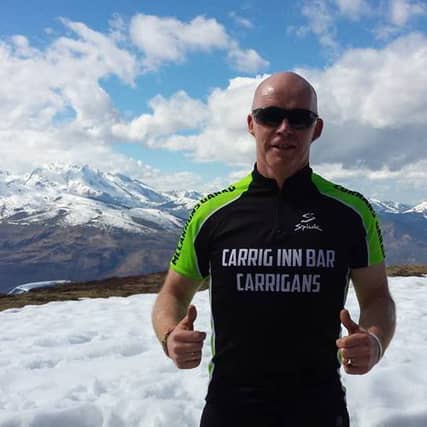
Nowadays, I get my highs naturally. I do a lot of cycling and adventure races, and I go to the gym regularly. People might think it’s overkill, but it really helps clear my head and I would recommend it to any young men or women who find they are struggling for one reason or another.
I don’t try to hide my addiction. I never tried to hide it because I can imagine that would be very stifling. If anybody reading this is maybe at that stage where they think they might have a problem, then speak to someone. The minute you get the words out, the relief will be immense. There’s no shame in being an addict; the shame is doing nothing about it once you really know you have a problem.
I go to mass again now, and my faith has been a vital part of my recovery. I’m so thankful that I’ve been given a second chance, and every Easter I go to Lourdes with an organisation called Irish Children’s Pilgrimage Trust and that has been very good for me.
They’re children with special needs. I did it when I was younger, with Dympna, and then in 2012 I was asked to go back. You see these kids, some of them not even able to walk or feed themselves, and it makes me realise how thankful I am.
For 17 years, I thought freedom was getting offsides from Dympna or my family or the ones at work so I could get drinking. But what I realise now is that I was in prison. Every day all I could think about was my next drink. I was trapped in a vicious circle of stress and guilt and self-loathing.
I’m living upstairs over the bar now. I walk past rows and rows of alcohol every day but the urge to drink it has been removed from me, thank God.
I feel as if the world’s at my feet now. I have my self esteem back and can do things to the best of my ability without fear. It’s been a long road, but finally I’m free.