
Garbhan Downey's Election Diary: Alliance ambition could cost Remainers dear
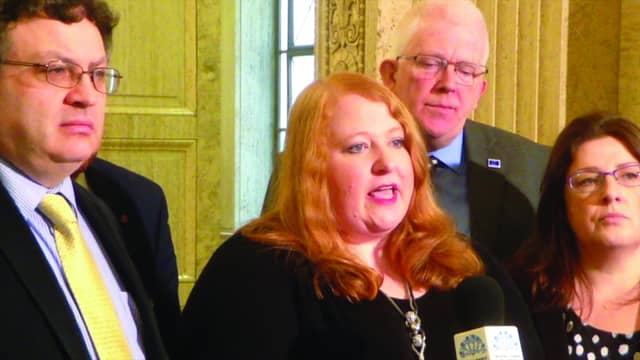

The DUP must be rubbing their hands in sectarian delight at how the Alliance Party spiked the prospects of a Remain pact this week.
Naomi Long is so scared of offending liberal unionists, who might support her in East Belfast, that she has decided to run candidates in all 18 constituencies here to prove that she’s not in the pocket of Sinn Fein.
Her actions could cost the Remain camp up to three seats on a bad day – and might even scupper her own chances in East Belfast to boot.
On one level, the Alliance decision not to enter a formal pro-EU pact is understandable. It is a survivalist decision, hidden inside a Gordian knot of pseudo-democracy, but it’s not a completely unreasonable one.
In fairness, Ms Long does indeed have a chance of retaking East Belfast from the DUP under her own steam.
And yes, any perceived connection with Sinn Fein, under the auspices of a pro-EU consortium, could tip the balance away from the AP in that nip-and-tuck, anti-republican constituency.
While most nationalists wouldn’t view Ms Long’s decision to go it alone as a particularly courageous or principled one, ultimately they could live with it. This is her party’s only possibility of winning a seat. And she also is the only Remain candidate in with a realistic shout of capturing a constituency, which voted by just 52 percent to support Brexit.
The AP’s insistence, however, in running in 17 other constituencies, where they have no chance of making any inroads whatsoever, is contemptuous of the broader Remain campaign. And it could also put Alliance in conflict with their own base.
In the best-case scenario, on June 8, AP voters will strategically desert the party for candidates who have a chance of defeating Brexiteers. In the worst case, their minority votes could wreck the chances of Remain candidates in swing constituencies such North Belfast, South Belfast and Fermanagh/South Tyrone.
But their tactic might come back to bite them.
It would be surprising if SF ran a candidate against Ms Long in East Belfast, in case they could be held responsible for letting Gavin Robinson, a DUP Brexiteer, back in. And the SDLP, if they decide to stand, traditionally garner no more than a couple of hundred votes.
But the nationalist parties’ combined vote of 1,200 to 1,500 in the constituency could be enough to give Ms Long the nose in a photo-finish.
And Alliance should be mindful that it will be a lot more difficult to convince these voters to come out and vote for Long, if she herself is going to be to holding the Westminster door open for Nigel Dodds, Emma Pengelly and Tom Elliot.
There are only two possible outcomes from this referendum masquerading as an election: the North will (once again) back European unity, or it will vote for Little Britain.
It is time for the Alliance Party to decide which side they want to win.
No Greens for the Doctor
The Green Party’s loss-of-nerve, after the AP’s inspired bout of sanctimony, was perhaps predictable.
But the main stumbling block to their entering a pro-EU pact wasn’t so much fear of pan-nationalism as it was the damage they would do to their own credibility by backing the SDLP’s Alisdair McDonnell in South Belfast.
Despite the fact he is the sitting MP, the Greens could not countenance endorsing the good doctor under any circumstances, largely because of his uncompromising pro-life/anti-choice views. And the confirmation of his selection by the SDLP became the main deal-breaker.
Alliance had also been adamant that McDonnell could not be an agreed candidate in any pact. But Sinn Fein, interestingly, would have been prepared to thole McDonnell - a bête noire right up there with Alex Attwood in Shinner circles - if the right deal had been struck in other constituencies.
Doubtful dealings
It now looks highly unlikely that any substantive deal can be reached among the Remain parties.
SDLP leader Colum Eastwood will be disappointed as he argued the case for a broad pro-EU coalition very convincingly in an Irish News op-ed on Monday. And he also made a further last ditch appeal for common sense on the front page of the same paper yesterday.
But ultimately, the Derry man inherited an undisciplined and fragmented party, and it would be difficult for him to force through any arrangement now, particularly without the support of MPs McDonnell and Ritchie.
Young Eastwood will need to consider some serious internal restructuring after this election, if the party is to survive as something other than a disparate collection of fiefdoms. McDonnell could be a particular issue for the new leadership going forward, that is if the doctor manages to hold onto his seat, which is looking less likely by the day.
Sinn Fein, meanwhile, are already moving on. The party postponed their selection conventions last weekend to allow for pact talks, but they have now reconvened these meetings for later this week.
That’s not to say that there isn’t a little room for manoeuvre. And determined Remainers from all camps are still exploring the possibility of fielding an agreed, non-aligned candidate in East Derry, if only to put manners on Gregory. But they’re quickly running out of time and options.
In all, this has been a bad week for the Remain camp. As things stand, pro-EU candidates will do well to take eight seats from 18: North Down (Ind Unionist Sylvia Hermon), South Down, Foyle, West Belfast, West Tyrone, Newry & Mourne, Mid-Ulster, and Fermanagh & South Tyrone (which Sinn Fein could well retake without a pact). South Belfast will fall to a unionist pact.
Long may just feasibly capture East Belfast to bring the number back up to nine, but as yet she doesn’t have the momentum she had when she knocked Peter Robinson into the ha’penny stalls. Nor is there the same sense of anger at the sitting MP as there was in 2010.
And, unless some determined people start knocking heads together, the pro-European constituencies of East Derry and North Belfast will undoubtedly go the way of the Brexiteers.
McCann right to sit it out
Word on the street is that Eamonn McCann won’t now stand in this election.
On one level, it’s a real loss, as his presence always guarantees colour, passion and articulate debate.
And, of course, it’s endlessly entertaining for the neutral to watch the frissons of fear passing through his opponents as they realise they’re totally out of their intellectual depth in his company.
But while McCann still has a lot to contribute, for the moment he can have a lot more impact as a journalist than he could straightjacketed in the naughty corner on a backbench somewhere.
Some smart mind in the BBC should find a commentator’s job for him and quickly. After all, if our licence dollars can pay for Nelson McCausland and Robbie Savage, surely there’s a few bob left for people who won’t cause us to hurl our radios at the nearest kitchen sink?
McCann’s absence from the ballot will benefit the SDLP’s Mark Durkan, who can expect to pick up the lion’s share of the veteran’s10.7% of the poll.
And the SDLP man will certainly need this, as his party managed just 31.8% to SF’s 36.6% a few weeks ago - as compared to the 47.8% the Durkan scored in 2015.
Elisha McCallion’s star is rising and she could well record Sinn Fein’s highest Westminster vote here to date. But she would need another major surge in support to carry her over the line on June 8, and it’s hard to see where this will come from.
The sitting SDLP MP, however, tends to perform significantly better than his party in Foyle, suggesting that he has a strong personal vote and is capitalising from unionists crossing the aisles to keep SF out.