
Garbhan Downey's Election Diary: Time to table the Derry Agenda

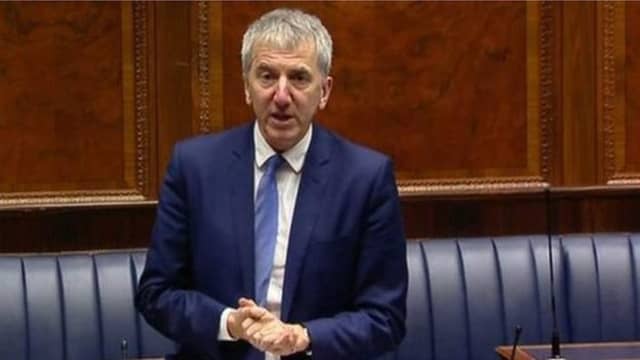

A few weeks after he was appointed Finance Minister last year, Máirtín Ó Muilleoir met a small group of business and community leaders in Derry to discuss their vision for the North West.
They all told him the same thing: the immediate priority was to sort out transport links and the university. The rest could follow.
An tAire Ó Muilleoir was reportedly a little taken back at what he regarded as a very modest pitch. There was no garnish on the order; no-one was looking for a cherry on top, not even a few extra wood-burners for the back sheds.
There was no talk of the hugely comprehensive 2011 One Plan for North West Regeneration. The Minister’s hosts instead outlined a basic, pragmatic strategy and gave him a completely deliverable bottom line.
This was in stark contrast to five years previously, when there was genuine excitement here that the Stormont Programme for Government had, seemingly, adopted the One Plan. There was a sense of expectation right across the North West region. Even hardened skeptics believed that we would avail of at least some of the targets laid out in the plan, such as a university build, infrastructural development (roads, railway, port) and 12,500 jobs in new industries.
Had all gone properly, Derry could now have upwards of 7,000 third-level students heading towards 10,000 by 2020 (instead of 3,000 heading to 3,500), and we would be connected to both Dublin and Belfast by motorway. We would also no longer be the unemployment capital of these islands.
The challenge for O’Neill
It would be easy to blame our own public representatives for the One Plan’s failure to launch. But it has become increasingly apparent in recent weeks that the economic throttling of the North West is down to one major factor and one major factor alone – the incessant refusal by hardline unionists to abide by the Equality Agenda they committed themselves to in the Good Friday Agreement.
This is the biggest single challenge facing the North’s next Deputy First Minister (or possibly even First Minister) Michelle O’Neill.
Not only have the DUP spent their time in government promoting their own selfish party interests, worse again they have been colluding directly against virtually all non-hardline unionist (and non-UDA) projects.
Their approach has been anti-partnership; de facto minority rule, copper-fastened by their preferred new Fenian-beating stick, the Petition of Concern – and made bulletproof by the abject failure of the two governments to live up to their responsibilities as guarantors of the Good Friday Agreement.
This has led to Derry being written out of (or, at best, into the margins of) the North’s Regional Development Strategy, Economic Development Strategy and any measures to promote employment equality.
You can dress it up anyway you want, or offer as many ‘alternative facts’ as you can muster, but the refusal to deliver for the North West is both sectarian and iniquitous.
We lost the last round of funding for the A5 Highway to the unionist heartland of North Antrim. And the university development has been stymied by the DUP for so long it is now a matter of inter-generational pride to them.
Nationalists have no option but to seek substantial assurances before returning to any power-sharing arrangement Stormont. We have spent ten years waiting patiently on the DUP to do the right thing. And now, unfortunately, the right thing will have to be forced upon them.
Any new administration will need to give ironclad guarantees supporting equality, partnership, an end to discrimination, and honest government.
But crucially, the new Programme for Government (PfG) will have to get back to the principles of the Good Friday Agreement and its commitment to ‘Rights, Safeguards and Equality of Opportunity’.
Fluff, bluff and waffle
The Executive’s most recent PfG Consultation Document is enlightening in what it fails to say. It promises to deliver economic opportunities across the region, to work to reduce educational inequalities, and to foster innovation in the economy. It also notes that Derry & Strabane Council has the lowest employment rate in the North (just 59.6% compared to 74.2% in North Down).
But the issue, as ever, is that they cannot complete the circle and give a specific commitment to tackle the area of greatest need, i.e. Derry. It’s just not there. Or at least, I couldn’t identify it in any of the 173 pages of fluff, bluff, waffle and civil-service speak I forced myself to read.
Derry cannot allow itself to be relegated to the footnotes by the DUP any longer. The equality/anti-discrimination safeguards of the Agreement absolutely depend on it. A new university of 10,000 students, motorways to Dublin and Belfast, a fit-for-purpose rail link, and inward investment for jobs for the North West must be written specifically, and particularly, into the next Programme for Government. And they must be fiscally underwritten as a matter of priority – and delivered by the end of the next term. That’s the bare minimum, a baseline. We’ll table the new road bridge and the next phase, in the first annual review.
The institutions will only work if there is regional as well as religious equality.
The £1 billion ‘Belfast Agenda’, which intends to create 50,000 jobs for the capital, has been already presented for consultation by the council there and will be rubber-stamped by March. This will definitely, and definitively, be the Executive’s number one priority for the next five years, unless Derry speaks up quickly and speaks up strongly.
Derry cannot allow itself to be passed over again. We either write ourselves into the new Stormont plan, and do it now, or we sit back and trust that Belfast remembers we are here. And we all know how that strategy has worked in the past.
Even in the unlikely event of the more conscientious and conciliatory Paisley wing gaining control of the DUP again, it is still going to take at least six months to a year to put Stormont back together again.
It is essential that Derry is ready with its agenda when that happens. There is absolutely no point in turning up if we aren’t going to make our voices count.
What’s my line…?
Back in the early noughties, Martin McGuinness paid an official ministerial visit to the Derry News. He held the Education brief at the time, and the paper was a major supporter of his campaign to abolish the 11-Plus.
While the Sinn Fein man was talking to the staff upstairs, a window-cleaner appeared out of nowhere and began soaping the glass outside our offices.
McGuinness looked around, grinned at the chamois-wielder whom he recognised, (Willie Edgar, possibly?), and ace photographer Tom Heaney instantly stepped forward to catch the moment for posterity.
A couple of hours later, Tom and I were at his computer looking at the picture with a view to putting it on page one or three of the following day’s paper. But try all we knew, we couldn’t come up with a decent heading for it.
We wrestled forever with about a dozen titles and were about to go with a straightforward ‘Ronseal’ one (i.e. it does exactly what it says on the tin), like ‘Martin waves at window-cleaner’. But then one of the finest headline-writers the paper has ever known ambled over for a juke.
‘Two men at the top of the ladder,’ he said with a big cocky grin. And, no matter how much we tried to hate it, it was perfect.
That same reporter, incidentally, not only went on to become editor of the Derry News but after that, Martin McGuinness’s Special Adviser.
Step forward and take a bow, King of Captions, and the sharpest man in Stormont, Mark Mullan. Whatever you do next, they’ll be lucky to have you.
Lá breithe shona duit, a Mháistir
It is easy to forget, given that he’s now retired nearly 15 years, just how lucky Derry (and, indeed, Ireland) was to have a statesman of John Hume’s calibre at its helm through the latter part of the last century.
His 80th birthday last week was feted by international statesmen and poets. And it was fitting that he got to share it, in a lasting peace he helped build, with his wife Pat, herself one of the greatest women this city has ever known.
There’s an old Irish expression I remember from my St Columb’s days, though, ‘Ní bhíonn saoi gan locht.’ There is no expert without fault. And Hume, who had himself taught at the College, had a big one: he could never forget he’d been a schoolteacher.
Any time I met him, he would always feel the need to scold me or, failing that, any other passing journalist or civilian.
Not that we didn’t ask for it, mind. Indeed, it became a point of pride for him to scold you – it meant you were on his radar.
On at least three separate occasions, the SDLP man rang to tell me that that day’s lead story, which obviously did not reflect his current understanding of events, was categorically the worst piece of journalism he had ever come across. Which again - given everywhere he had visited, everyone he’d met, and everything he’d read - was quite a compliment in itself.
Anyhow, shortly before he got ill, Hume was being widely talked about as possible contender for the Irish presidency.
And this particular day, he was due in the Radio Foyle newsroom for an interview in which he was going to be grilled about his intentions.
Typically, he had been giving nothing away. Truth is, he would have romped it. But back then, it would have been a big step back from the work he was doing in Derry, Belfast, Boston and Brussels.
Three or four of us were busy at our terminals getting the programme ready, when I spotted the SDLP leader entering the room quietly. So, for devilment I loudly announced in rusty Irish: ‘Ladies and gentlemen, please stand now for the President.’
My colleagues, who loved nothing better than a bit of mischief, laughed, but our sitting MP and MEP was not impressed.
He glared down at me over his glasses and made me hold his gaze for about five seconds. The master turning the screws on the little gurrier who should have bitten back the last remark.
After what seemed like an age, he spoke. ‘You’re wrong, you know,’ he said. ‘In fact you’re dead wrong.’
I took a big breath. Had the Nobel Laureate just admitted he wasn’t running? This could be leading the bulletins for the rest of the day. Probably all over the country.
But no. This was not my day. Mr Hume was about to hand me my backside.
‘You really need to check your facts,’ he said. “And specifically, you need to check your Irish. It should have been, “A dhaoine uasile, seasaigí anois le bhur dtoil don Uachtarán.” Not whatever nonsense you said. Now, go home and ask your father for a decent grammar book.’
I genuinely have no recollection of anything that happened or anything that was said after that.
But suggestions that I crawled under the desk and stayed there until our guest was led away to a studio are probably not that far wide of the mark.
If you’re looking for stubble
I’ve been going back and forth on the Eastwood beard more times than a county councillor at an open bar.
But, despite the fact that I feel the urge to colour-in the SDLP leader’s toothpaste splash every time I see it in a newspaper, I think his old boss Seamus Mallon was wrong to tell him to shave it. It’s a good fit.
There’s a deadliness to Eastwood that his youth can belie, as evidenced by the brutally effective way he reinstated John Dallat into East Derry this week.
Dallat, besides being a big name, is the most seasoned scrapper in the constituency and his presence certainly improves the SDLP’s chance of retaining its seat (though by no means guarantees it).
It wasn’t the first time the new SDLP leader has signalled his ruthless streak either. A beardless Eastwood carried out a very effective cull of his dissidents in West Tyrone last year to ensure Daniel McCrossan got the nomination there. And the electorate proved his instincts right.
Mark Durkan while SDLP leader had many talents, but when it came to dealing with the troops, he could be far too kind. This led to ridiculous fights at selection meetings, walkouts and people threatening all sorts of things to get their names on the ticket.
Eastwood has clearly learned a lot with regard to internal discipline, and if the beard reminds people that he’s more than a ‘young, fresh face’, then maybe it should stay.
Ultimately, like the rest of us, he’ll soon learn that his new family will be the ultimate arbiters on how long he can keep the fuzz anyway. (Congratulations on the next one, by the way.)