
The Undertones: From a cubs' hall in Creggan to Top of the Pops

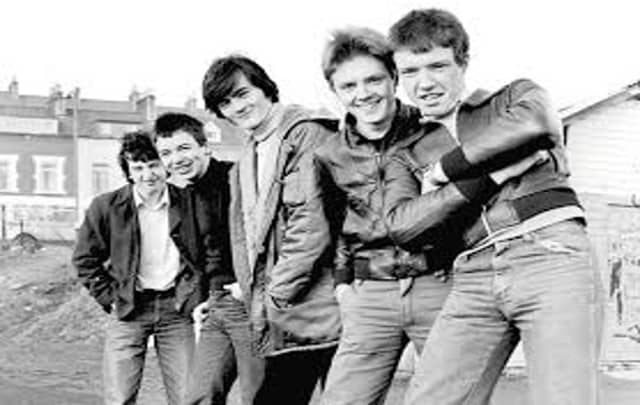

The year was 1976, the month was February and the venue was a cubs’ hall in Creggan.
A group of five nervous teenagers got up on a small stage to entertain their even younger audience.
This marked the first ever performance of The Undertones. It ended in a stage invasion.
However, 40 years later and Derry’s most successful ever band is still going strong.
Four of the original members, Mickey Bradley, Billy Doherty and brothers Damian and John O’Neill, now perform with singer Paul McCloone who has replaced original frontman Fergal Sharkey.
In the run-up to their St Columb’s Hall gig, Mickey Bradley spoke to the Derry News’ Ciaran O’Neill about the eventful journey the band has been on over the last four decades. CON - It’s 40 years since the Undertones were formed courtesy of a loan from the Provident company. Have you paid back the loan? MB - We paid the loan through the proceeds of appearing in the Casbah but before that we used to pay £2 a week each before the Provident loan.
The Provident loan was our sign that we were taking it seriously because we got Fergal (Sharkey) to join us.
Before that we were always putting in a couple of pound a week into this band.
So we were always paying out. In fact, we were playing in the Casbah for a year and a half from the start of 77 right up until we got the deal with Sire and we never ever paid ourselves at that time.
All the money always went in to paying off loans.
We eventually did pay off the Provident but with huge interest. CON - Your first ever concert was in February 1976 at a cubs meeting in Creggan. What’s your memories of the gig and do you ever meet anyone who says they were there?
MB - My memory of it was that it was almost like a rehearsal in front of an audience because Fergal was the leader of the scouts and it was down in what we still call the boys club.
We used to rehearse and practice in the next building which was like an aul barn. My memory of it was that in the early stages it was a matter of getting through the songs without making a mistake.
We played cover versions.
There would have been a couple of Doctor Feelgood songs and the Rolling Stones and R’nB stuff.
So we played about six songs and I remember there was a stage invasion.
I remember there was a wee fella who lived down the street from us called Owens. He was one of the cubs and he was running on and I think I kicked him off the stage which was only about ten inches high.
But I remember because I went to school with his brother and I remember thinking his brother is going to hit me.
But I was talking to someone a couple of years ago who said they had been on a course or something with a guy called Owens who told him that he had been at the Undertones concert.
I asked him if he had remembered me kicking him off the stage, and he said aye he did. CON - You were called ‘The Hot Rods’ at that gig. Any regrets in changing the band’s name?
MB - The thing was that we never had a name.
We were playing a variety concert at St Joseph’s school in March 1976 and it never occurred to us that Pat McNabb the MC would have to announce the name of the band.
It was literally when we were on stage and he was introducing us and he turned around and said the Fergal, ‘what do you call the band?’ and Fergal said ‘The Hot Rods’.
We were like, ‘You can’t call us The Hot Rods’.
Eddie and the Hot Rods were a band that we liked. So we didn’t even have a chance to say anything before Pat said, ‘Right boys, here’s a band called The Hot Rods’.
Later on, Fergal then wanted to call us ‘Little Feat’ but we told him that we couldn’t call ourselves ‘Little Feat’ as there was already a band with that name. We didn’t have a name and then Billy found the name
The Undertones in a book and we liked it because first of all it rhymed with The Ramones and and it also sounded kind of corny and I think that kind of always suited us. CON - It was the Casbah club where the Undertones made their name. History has turned the Casbah into some sort of a mythical place in Derry’s musical history, but was it as big a dump as many people remember?
MB - It was both. The Casbah was just a rectangle. Apparently, it was port-a-cabin which had replaced a building which had been bombed and it had been plastered over.
It was right at the corner of Bridge Street and Orchard Street.
There were a couple of steps in and you were right in it.
The bar was on the right hand side and the bands played on the other side.
But it was good because they would have got bands that didn’t do pop stuff.
They didn’t do the Top 20. The Casbah, people went there to hear the music, to hear bands whereas in other places the bands would have just been a distraction. CON - When the Undertones signed their first record deal, you certainly drove a hard bargain. Do you think you got a fair deal?
MB - The story was that we made the record (Teenage Kicks) with Terri Hooley but that wasn’t a record deal.
So we sent the record to John Peel and then suddenly (after Peel famously played the record twice in a row) wanted to sign us.
A guy called Seymour Stein who owned Sire records, who had signed the Ramones and Talking Heads, was in England at the time and he said to his one-man operation in London, a fella called Paul McNally, ‘go over there and get this band’.
So Paul McNally came over. Some of the other record companies got in touch and asked would we come over to London but Paul came over and he brought a record contract.
It was a really bad record contract but we didn’t know.
We thought we were smart in that we would get three of the band to sign it and then me and Fergal would go over to London to talk to Seymour Stein and hammer out a better deal.
No we didn’t. We did go over there but we didn’t have clue what we were talking about. So we signed this really, really bad deal but we didn’t care because it was like we signed it and a couple of weeks later we were on Top of the Pops.
Eventually, we got a manager who sorted it all out but we basically signed a bit of paper. CON - When was the moment that you first released you were a rock star?
MB - We never have because we would never say that but the first time we thought that this is brilliant was when we got the phone call to say that Top of the Pops wanted us.
They phoned O’Neills, we didn’t have a phone so Damian had to run up to our house.
I was out the town and when I came back I was told ‘Damian O’Neill was up, youse have to go to London, youse are going on Top of the Pops’.
The song (Teenage Kicks) had been released on Sire Records in London and it got to number 38 obviously on the back of John Peel playing it twice. You had grown up watching Top of the Pops. What was it like performing on the show for the first time?
MB - It was brilliant. Do you know what was good about it and this only sort of occurred to me afterwards, it was brilliant because we hadn’t been trying.
We hadn’t done what other bands from here would go; go over to London and you slog around and you try and make contacts. We didn’t. We had never left Derry and were still playing at the Casbah.
To get the call to go straight over there was brilliant. We recording the backing track and them mimed the song and we got the chance to meet Elvis Costello and see how small the studio.
Suddenly, we were part of that thing we used to watch every week. CON - Although it seems very old fashioned now, do you think the bands of today miss out on performing on Top of the Pops?
MB - I think so. There is definitely something different, whether it’s better or worse I don’t know.
I am now in my fifties and how bands make it now is a mystery to me. We had the advantage in that it was a very structured thing.
Top of the Pops was the only show really. Now there’s internet. In that sense you can see what you want.
If you hear the name of a band you can now hear it within ten seconds.
Obviously, you couldn’t do that in our day to be part of that system where this is a really special thing, where Top of the Pops was a gateway to people’s front rooms.
That was just brilliant and everybody knew what Top of the Pops was and to be on it was just incredible. CON - So it’s the late 1970s and 1980s and the Undertones are at the height of your powers. Your dreams had turned into reality, but was being in a successful band all that it was cracked up to be?
MB - I think it was. You always have to put it into perspective. This isn’t false modesty, we were successful but we weren’t huge.
We were successful in that we were professional for about three or four years and we were able to function as a band and you made records and some of these would get on Top of the Pops.
But we never ever thought about it as a career which I think in one way that kind of saved us because whenever we did break up we were kind of ok with it.
So we always kind of saw, well I always saw it as, a short term thing. From the first day we never thought we want to be a huge success.
You want to make records and all that but your mind was not on, we’re going to be rich and famous.
We were getting good wages for not doing anything which was success in my mind.
Myself and Damian used to always say that, whenever we were in Derry ‘we don’t have to go to work, we don’t have to go to the Tech, mon we’ll go down the town and buy records’. So we were kind of famous.
We weren’t ever rich but we were alright.
We got £30 a week which then went up to £100 when somebody got married which was brilliant.
It was great and I don’t want to poor mouth it but on own terms this was absolutely brilliant. CON - What was life like on tour? What was the favourite concert?
MB - Touring, we were always very, not sceptical, but we never wanted to tour for long because we had girlfriends in Derry so that kind of came in to it as well.
But also it was up to us. It wasn’t like our manager was telling us what to do or our record company was telling us what to do.
It was kind of up to us and we came to the conclusion that we content to do a tour of four weeks and then go home.
So it was great. I don’t think we ever got completely fed up with going on tour because we always kept them short.
We went to America and we knew that if you really want to be a success in America you had to base yourself there for two or three months at the very minimum to play everywhere because it is such a huge country but we just said ‘nah, four weeks with do us’.
We did two main tours of America.
In September ’79 we supported The Clash on a tour of America which was absolutely brilliant because The Clash were at their height.
Then we did a couple of shows on our own in New York and then the following year we went back and did a tour of our own. CON - You once phoned a music magazine anonymously and told them that Billy Doherty had been knocked down and killed. His death was announced on Radio 1. Why was it Billy that had died?
MB - I don’t know why it was Billy. It was a story that concerned a paper.
We were in Derry at the time, me and Billy and Damian and we were in O’Neills house where we always hung out. I think Billy said we should get some publicity.
We had a PR boy in London who was doing great work but we said ‘mon we’ll go down to the Journal to see if they want to interview us’.
So the three of us walked from Beechwood Avenue down to the Journal at Buncrana Road and we said ‘We’re The Undertones, would you like to interview us?’
A reporter called Peter Doran came out and asked us a couple of questions but after we left we sad that was a bad idea and wasn’t very good.
So on the way home we were walking up the Rock Road and somebody said, it might have been Billy, said we should make up a story that one of us has been killed.
We thought this was great and decided that Billy had been knocked down by a bus. So we went up to O’Neills and phoned the NME (New Musical Express) which was the main music paper at the time.
I think it might have been me that made the call and I put on a terrible English accent and said that it was Mick Hughton, who was our press man at the time, and told them that Billy Doherty from The Undertones had been hit by a bus and killed.
Two or three minutes later we were watching the TV and our manager from England rang up and said ‘who did that?’
We were like ‘oh shit’. He told us to say nothing and deny everything. So, it very quickly spread and it was on Radio One and the Belfast Telegraph.
But very quickly our management in England, trying to clear up the damage, said we had been the victims of a vicious hoax.
It was kind of embarrassing a few months later because myself and Fergal were over at Radio One doing a review show which was hosted by Kid Jenson who had been the DJ who had announced on air that Billy had died.
He apologised to us which was terrible because I couldn’t tell him that it was us that did it. I just told him, ‘don’t worry about it Kid’.