
Tragic passing of Professor Patrick Johnston: Lifelong friend of the Derry man said he 'truly made a difference in this world'

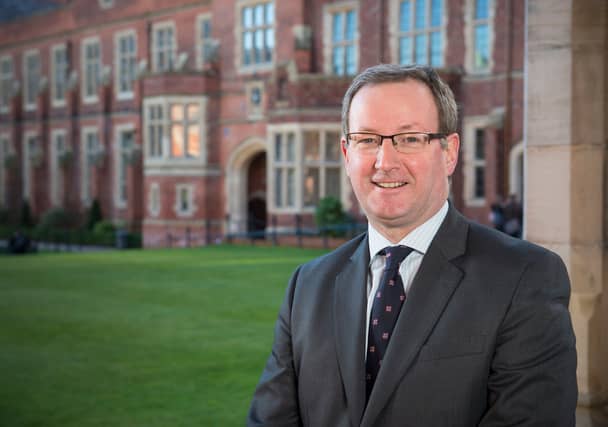

A lifelong friend of the Derry-born Vice Chancellor of Queen’s University, Professor Patrick Johnston, has spoken of his heartbreak at his death.
Professor Johnston, regarded as one of the world’s foremost cancer research specialists, died suddenly on Sunday during a visit to Donegal.
He was 58.
Professor Johnston’s death was met with shock in educational and medical circles.
He has been praised widely for his impact on cutting cancer death rates.
Professor Johnston was buried in Belfast yesterday.
His family have asked that anyone wishing to make a donation in lieu of flowers should do so to Cancer Research UK or to Cancer Focus Northern Ireland.
One of Professor Johnston’s oldest friends was well-known businessman Peter Casey who was one of the judges on the RTE version of Dragon’s Den.
The Derry man, who is chief executive officer of Claddagh Resource, an international recruitment company, said he had Professor Johnston had been classmates for seven years at St Columb’s College.
Mr Casey said their families had been close for more than 50 years.
“It is an understatement that to say that Paddy was a truly amazing person,” he said.
Mr Casey said his friend had pioneered leading research into innovation in cancer research.
“He truly made a difference in this world we live in. Something we all aspire to do. He did it. He made a difference,” he said.
“He led the way and others will hopefully follow.
“He and his wonderful family stayed with us in Atlanta and I always popped in to see him on my regular trips through Belfast to spend time with Paddy and Iseult, his amazing wife.
“This is such a sad day for Derry, for Ireland and certainly one of the saddest days of my life. We have all lost a very special person.”
Tributes were also paid to Professor Johnston by Foyle MP Mark Durkan.
Mr Durkan said he was a ‘proven leader who brought drive, inspiration and effective collaboration to all his work’.
“His return to the North in the mid-90s saw him spearhead the case for a regional cancer strategy that could transform treatment, research and outcomes here,” he said.
“Paddy was a world-class oncologist who wanted world-class services and performance here.
“He let me know of his frustration that the cancer strategy was not being translated into reality because of what he saw as bureaucratic blockage.
“He told me in Joe Hendron’s house in 2001 that he was losing patience and confidence in his dealings with the Department of Health and that he would return to the States where he had many job offers if a path wasn’t found to deliver the Cancer Centre and the rest of the cancer strategy that was to follow it.
“At that time, I was Minister of Finance and had been asking and encouraging the Health Department to bring forward budgetary proposals for the overall cancer strategy.
“Paddy and his colleague got a promise from me that I would devise an Executive budgetary answer to the problems they were experiencing. Not long after that (in November 2001) I became Deputy First Minister and began work on what became the Reinvestment and Reform Initiative (RRI) with an annual borrowing power of £200m for capital spend.
“When we were negotiating the initiative with Downing Street and the Treasury I told both Tony Blair and Gordon Brown that my first priority in the first tranche of £200m would be for the Cancer Centre, otherwise we would lose Paddy Johnston and the cancer strategy with him.
“When the Treasury tried to steer us towards a public-private partnership (or PFI model) for delivering the centre I bluntly said ‘No way! Paddy Johnston will be on a plane to the States if this overdue project is messed about like that.’
“So when the RRI was announced in May 2002 by Tony Blair, Gordon Brown, David Trimble and myself the Cancer Centre was the number one project and the Health Minister (Barbara DeBruin) was able to make a formal announcement the very next day.”
Mr Durkan said that the centre has since revolutionised cancer treatment in the North and has ‘worked marvels every day’.
“Indeed, Paddy’s vision truly saved lives.
“When he was guest speaker at the Cancer Research UK dinner in the City Hotel, Derry, last autumn, he recalled this experience and paid tribute to my role in helping him to achieve his vision. That was another example of the powerful decency of this great man.
“Over the years, I continued to engage with Paddy on a range of issues and challenges, including his concern for better prioritisation of higher education in the North, opportunities for better North-South co-operation, the worrying implications of Brexit, our differing attitude to the case for a Medical School in Derry, and his personal commitment to enhancing Queens University’s engagement with the city on other fronts.
“I extend my deepest sympathies and condolences to Paddy’s wife Iseult, his four sons and wider family circle and friends at this very sad time.”