
Barrtalk: When words get themselves into a bit of a rut

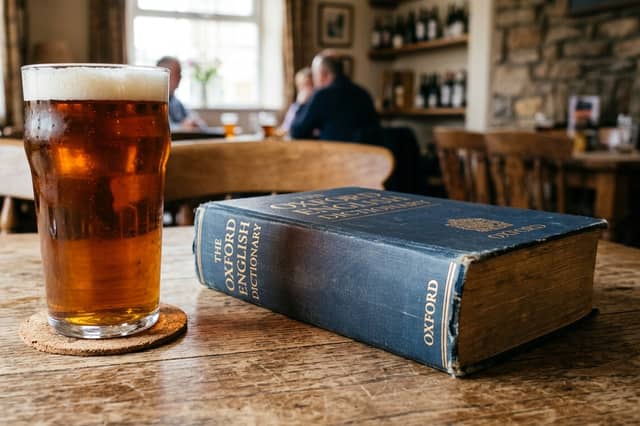

Moville journalist Caoimhinn Barr writes a weekly column which has been running in the Inishowen Independent newspaper since 2010
Why are there some words that only seem to be used in the same specific scenario? It’s got me thinking for this week’s Barrtalk. Racking my brain, you might say.
Which raises another question. Do we ever rack anything else? Do we rack our minds? Rack our memories? No. Apparently, we rack our brains, and that’s it.
A.I. tells me this sort of thing can be called ‘semantic narrowing’ – when a word that once had a broad range of meanings gradually becomes associated with a much narrower one. There are examples everywhere.
My mother was in for surgery recently and, thankfully, everything went exceptionally well, thanks to the skill of the amazing doctors at Letterkenny University Hospital.
There is one word you definitely do not want appearing anywhere near a story about your operation, however: botch.
A botch means to do something badly, or to repair, patch or mend something clumsily. But when do you ever hear about somebody botching the boiling of an egg? Or botching the painting of the sitting room ceiling? No, it’s surgery that always gets botched. Thankfully, my mother’s surgery most certainly wasn’t.
Then there is underwent. You never seem to undergo an exam, undergo a meeting or undergo a trip to the shops. You undergo surgery. You undergo treatment. You undergo a procedure. And you are admitted to hospital. Not the cinema. Not the pub. Not even McDonald’s, despite the fact that you have technically been admitted through the doors.
And when things go wrong medically, you are specifically rushed to hospital. Never hurried. Never sped. Never hastened.
There is another term for what I’m describing which sounds suspiciously like a surgical procedure itself: collocational narrowing. That’s when a word becomes strongly associated with particular words around it or a particular context.
Politicians, for example, make blunders. They are then hauled before committees and grilled by journalists. And when they emerge from this ordeal, they slam whatever it is they don’t agree with. They never seem to slam a door.
Hybrid is another one. Once upon a time, hybrid meant a mixture of two different things. A hybrid animal, a hybrid plant, a hybrid anything.
Now, say “I’ve got a hybrid” and most people immediately picture a car which looks slightly unusual at the front and somehow manages to squeeze more miles from every gallon – or litre – than its fully petrol-guzzling cousin.
The digital world has hijacked quite a few words in this fashion. A platform used to be a raised surface, a railway structure or a political programme. Now, tell someone you’re looking for a platform, and there’s a good chance they’ll assume you mean a website or app. Viral once had us thinking about viruses and disease. Now it is more likely to have us thinking about how many million views somebody’s video has accumulated on YouTube, which is itself a platform.
And the cloud is increasingly something floating above a data centre rather than the cumulus or nimbus above our heads.
Then there’s organic. Organic can mean relating to living things or occurring naturally, but walk into a supermarket and it has become almost inseparable from food produced according to organic standards.
Craft is another one that’s suffered a similar fate. Craft can mean any skilled activity, but put the word on a drinks menu and suddenly we’re talking about beer. [Don’t mention craft fairs, which I hate].
Then there’s fled. The driver fled the scene. The suspect fled the country. The robber fled on foot. You rarely hear that someone simply fled the supermarket because they realised they had forgotten their wallet.
Pledged, meanwhile, seems to have become permanently attached to money. The Government pledged €5 million. A charity was pledged €20,000. A business pledged its support. You can apparently pledge many things, but increasingly it’s money, funding or support that gets all the pledging.
There is even a term for the mental process behind all this: lexical priming. Basically, the more often we encounter words beside particular words, the more strongly our brains associate them.
Which explains why, when I hear “rushed”, I don’t picture somebody sprinting towards the bakery. I picture an ambulance.
It’s fascinating [I hope]. Words don’t necessarily change their dictionary definitions; sometimes one particular context simply hijacks them.
So if you ever find yourself racking your brain, undergoing surgery, being admitted to hospital, getting rushed somewhere, watching something go viral on a platform from the cloud, or buying a hybrid after passing the craft beer aisle, spare a thought for the poor English language.
It’s a remarkably flexible thing – Even if some of its words seem to have got themselves into a bit of a rut.
And that’s another one: people are always getting stuck in ruts . . . but I think I’ve made my point at this stage!
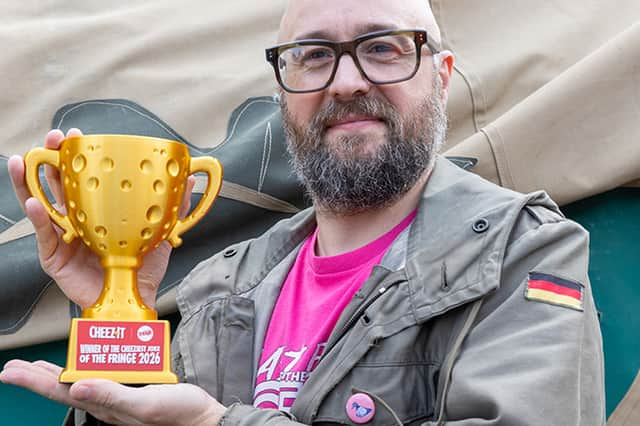
Three cracking jokes to finish
And staying on the subject of words, the Edinburgh Fringe has just produced not one but two contenders for the title of funniest joke of 2026 – because apparently even comedy can no longer agree on who is officially in charge.
The revived (Some Guy Called) Dave Joke of the Fringe was won by comedian Olaf Falafel, whose winning one-liner was: “I remember thinking, as I taped a piranha to my boomerang, this could come back to bite me.” Cracker.
There was also the ISH Edinburgh Comedy Award for Best Joke, which went to Matthew Gallagher. His [very dark] winning gag was: “Here’s a fact about the Anne Frank diary – they brought out an audiobook version of it – here’s my review – it was sh*t – she was whispering, I couldn’t hear anything that was going on.” It won him a £1,000.01 prize.
So which is the funniest? I’ll leave that to you. In fact for my money it’s neither… I’d plump instead for the shamelessly brilliant dad joke, by Fil Milton, which one Cheeziest Joke of the Fringe.
“My brother convinced me to go halves on a used funeral car – I can't believe I was so easily co-hearsed.”