
'Joe’s own story could have filled a week in Glenties all on its own'

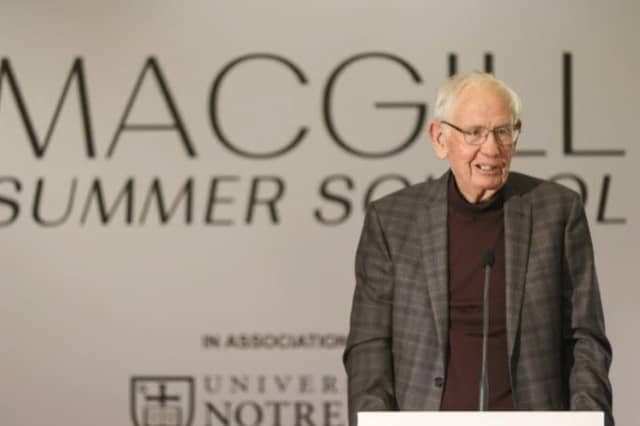

Tánaiste Simon Harris was among those paying tribute in first MacGill Summer School since the death of its founder earlier this year
In the first MacGill Summer School to take place since its founder Dr Joe Mulholland passed away, the Stranorlar native has been remembered for his dedication to open, honest debate and public service broadcasting.
Dr Mulholland was also remembered for his courage, kindness, commitment to equality, and as a man who never forgot his humble beginnings despite his rise to the highest ranks of RTÉ television.
As the MacGill Summer School got underway in the Highlands Hotel, Glenties on July 23, the late Dr Mulholland was very much in the thoughts of those present. Having founded the school more than four decades ago, Dr Mulholland died on January 31.
Assistant Director of the MacGill Summer School Vincent McCarthy outlined plans to honour Dr Mulholland, including a Fellowship in his name.
Mr McCarthy told those gathered: “We want to celebrate his life, his work, his legacy and everything he has done, especially here at McGill Summer School.”
He recalled first meeting Dr Mulholland at the Hugh Lane Gallery in 2019 for a chat about the MacGill Summer School.
“For me, he was an artist, he was a creative,” said Mr McCarthy. “He talked about what he wanted McGill to be. My role really was like scaffolding around him to allow him to express his art that he created on stage. That allowed him and me to work really well together over a number of years. And it allowed him to enjoy himself and hopefully to love McGill Summer School again.”
The Covid-19 pandemic brought the best laid plans of many people to a halt, and the MacGill Summer School was no exception.
Mr McCarthy recalled: “Joe was concerned. Could McGill even take place in 2020?
“It is hard to put ourselves back into that time where everyone didn’t really understand Zoom or digital calls. I remember saying to him, ‘We can do it, we’ll do it in October. It will be a bit different but we’ll try it.’
“He wasn’t sure about doing it. I was trying to show him the technology at the time, Zoom and things like that, and I said, ‘Just think of it as like television’ and his face just clicked and he went, ‘I love television, I know television, I can do television.’
“The MacGill that year had Mike Ryan from the WHO giving us the lowdown at what was happening with Covid. He was quoted in the Washington Post the next day.”
Other high profile guests contributed from around the world, and this international flavour was to continue in future summer schools.
“Chatting to Joe afterward, he said it was like his vision for a global MacGill in a national context had come to life,” said Mr McCarthy.
What we tried to do over the next number of years was to bring it into physical reality. All the ideas we took from Covid, we wanted to bring here.
“I think we definitely succeeded. It reinvigorated his love for McGill.”
While Mr McCarthy had only come to know Dr Mulholland through the MacGill Summer School, he is very much aware of the love and support for the Stranorlar man, particularly through the many tributes paid following his death.
In reflecting on Dr Mulholland’s legacy, Mr McCarthy said: “His love for public sector broadcasting freely expressed through his time in RTÉ. His work in MacGill has created an institution and a lasting impact. And he is going to have an institution set up with the Brian Friel Trust as well.
“So for a man who hated organisations, he built enduring, lasting institutions, and that is what we see our role to be here in MacGill, to build something that lasts and has impact.
“Our job is to continue that legacy.”
Mr McCarthy outlined one particular way in which that legacy will be honoured and continued.
“We were thinking of ways to continue on his legacy and his impact,” he said. “We are announcing today - but it will be launched in September - a Dr JOe Mulholland Fellowship. What we are going to do in MacGill every year is to work with a young person to develop and build the institution that is MacGill Summer School.”
Chair of the MacGill Summer School Michael Gallagher recalled the early days of the event, and the impression Dr Mulholland had made on those involved.
“Joe was a very kind and considerate man,” said Mr Gallgher. “He arrived in Glenties in 1981 to tell the story of Patrick MacGill’s life. He did this over a period of three years in what came to be known as the MacGill Festival.
“At the time he was a rising executive in RTÉ, he was fluent in French, with a French-style beard, married to the beautiful Annie. He was a stylish dresser, he had a taste for good French wine and the finer things of life.
“To us locals, he was exotic!
“But there was a more serious side to Joe. He was possessed of a strong interest in public service broadcasting, to inform, to explain, and to educate. The MacGill was an extension of this belief in public service broadcasting, and the MacGill Festival of the first three years transformed into the MacGill Summer School.”
Mr Gallagher recalled that one of the early summer schools was devoted to Peadar O’Donnell, the Donegal Irish republican - at which Peadar O’Donnell attended.
“That was unusual,” said Mr Gallagher. “We usually talked about people who were dead.
The events of the past and people who were passed were discussed, and Peadar would stand up and say from time to time, ‘Well, that’s not exactly what happened’ and he went on to explain.
“Joe was very proud of this clarifying of the past, indeed this making of history. He realised that we needed to record these events at MacGill and so he introduced us to Charlie Byrne, an RTÉ sound engineer, who came to the school and made audio recordings and later, video recordings of the McGill Summer School.”
Over time, the number of sessions at the summer school increased, and the event moved from the comprehensive school to the Highlands Hotel. Dr Mulholland also ensured that books were produced outlining the discussions at those early years.
Speaking of the founder’s kind nature, Mr Gallagher recalled how on one occasion in very warm weather, Dr Mulholland left the ballroom and a short time later, staff arrived with bottled water for everyone. Next morning he gave two bottles of chilled water to Pat Rabbitte for the long journey home.
Dr Mulholland also had a deep appreciation for the arts.
Mr Gallagher said: “Joe’s love of the arts and drama was reflected in his interest in Brian Friel. This led to two summer schools devoted to Brian Friel.
“One of those featured a performance of Dancing at Lughnasa.
Unable to get the full cast of either the London version or the New York version, Joe brought together a group made up of some from New York and some from London, and provided us with such a memorable evening.
“Today we think of Joe fondly, and we miss him. We remember his love for Annie and his family, we remember his love of his native Donegal and his devotion to McGill and to Glenties.”
Among the many politicians who paid tribute to Dr Mulholland at the time of his death was Tánaiste Simon Harris (FG). He recorded a video to be played at the MacGill Summer School.
“I am sorry that I can’t be with you today but I could not let this year’s MacGill pass without saying a few words about the very man who built it,” said Deputy Harris.
“This is the first Summer School without Joe Mulholland. It feels strange to even say it.
“Joe’s own story could have filled a week in Glenties all on its own. A boy from Stranorlar, raised in a cottage with no running water, who went on to run RTÉ television. He shaped Irish current affairs for a generation.
“He believed that journalism should hold power to account, and he lived that belief. But I do think his proudest creation was this one.
“In 1981, his love of Patrick McGill brought the country to Glenties, and for more than four decades, Taoisigh, ministers, economists and journalists, commentators, and so many, made the journey because Joe asked them to. I saw it first hand on a number of occasions. I spoke here as Taoiseach in the summer of 2024, Joe’s final year as director.
“What I remember was his welcome, his standards, and his absolute belief that debate done properly makes a country better. That is more important than ever. He never wanted an easy conversation; he wanted an honest one, a real one.”
The Tánaiste thanked Dr Mulholland’s family for generously ‘sharing Joe’ with the rest of the world.
He continued: “The best tribute we can pay to Joe is what is happening here in this room. So let’s keep gathering, let’s keep questioning, let’s keep the conversation going, let’s always stand up for real, honest debate.
“Rest in peace Joe. Ar dheis Dé go raibh a anam uasal.”
A TV package compiled by Bradas O’Donnell included archive clips of Dr Mulholland, as well as commentary recalling how he showed by example that a poor start in life is no barrier to success. It reflected on his early years in Stranorlar where he almost died of diphtheria, his early education in Stranorlar, his journey to England and France where Dr Mulholland met and married his wife Annie, and his return to Ireland where he rose through the ranks of RTÉ to become head of television.
Dr Mulholland retired from RTÉ at 60 but continued to remain busy, putting a lot of energy into the continued development of the MacGill Summer School.
He was recalled as kind, sensitive, courageous, knowledgeable - Donegal’s Renaissance man.
The piece included a clip showing Dr Mulholland’s own reflection on the role of the MacGill Summer School.
He said: “By examining what has happened in the past, we hope to learn what is happening in the present and what may happen in the future.”
The MacGill Summer School continues in the Highlands Hotel, Glenties until July 25. This year’s theme is The New World Disorder. Among the topics being discussed and debated are: The Case For and Against Neutrality; The Future of Europe: Can it Compete, Defend and Lead?; and Ireland’s Economic Edge in a Fractured World.
The full programme and list of speakers can be found at macgillsummerschool.com