
New dolphin calf in Donegal Bay highlights urgent need for marine protection
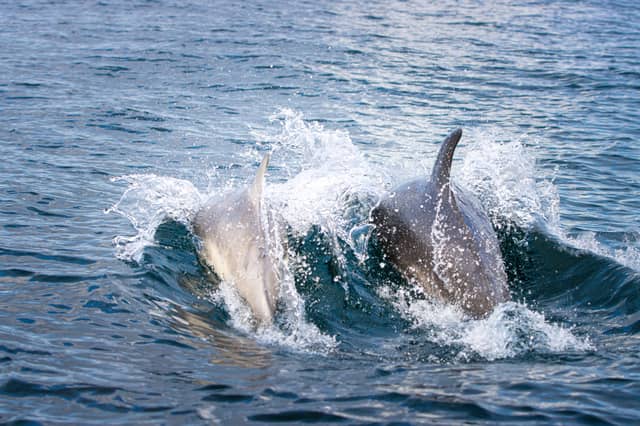

Known affectionately as Bawn, named after the nearby Classie Bawn Castle, the bottlenose dolphin has become a symbol of the rich, but vulnerable, marine life in the area
Bottlenose dolphins have become a familiar sight in the waters of Donegal Bay, particularly off Mullaghmore in Co Sligo.
But one female and her calf have captured the imagination of locals and visitors alike. Known affectionately as Bawn, named after the nearby Classie Bawn Castle, she has become a symbol of the rich, but vulnerable, marine life in the area. Her repeated appearances since April have prompted a renewed push for official protection of the bay and its fragile inshore ecosystems.
Campaigners are now calling for urgent action to safeguard these waters, including the expansion of the proposed Donegal Bay Special Protection Area, science-based management of forage fish such as sprat, and distance limits to keep industrial fishing vessels away from the shoreline.
They are also urging members of the public to report sightings of dolphins, whales, and other marine wildlife to the Irish Whale and Dolphin Group, whose website features a simple tool for submitting information that helps guide national conservation efforts.
Bawn is easily recognised thanks to a small notch on her dorsal fin, and she has been spotted frequently across the Mullaghmore headland and throughout Donegal Bay. Her regular appearances with her calf suggest she has chosen this location as a nursery ground, which would make Mullaghmore a critical habitat for rearing young. Marine scientists and local advocates believe this could point to the existence of a resident population of bottlenose dolphins in the bay, a fact which, if confirmed, would significantly strengthen the case for granting the area formal protection under Irish and EU law.
Despite its ecological richness, Mullaghmore currently sits outside existing Marine Protected Areas. The region is home to a variety of marine species including humpback, minke and fin whales, basking sharks, and several priority seabird species, all of which rely on a healthy ecosystem to thrive. The Irish Whale and Dolphin Group and the National Parks and Wildlife Service have both identified Donegal Bay as a conservation priority, and recent scientific findings underscore its growing international importance.
In 2024, the bay recorded a sighting of a North Atlantic Right Whale—the first confirmed presence of the critically endangered species in Irish waters in over 100 years. With only around 350 of these whales believed to remain globally, their appearance in Donegal Bay signals the potential value of this habitat as a migratory and feeding ground for marine megafauna.
Central to this ecosystem is the availability of forage fish like sprat, a small but essential species that supports the entire marine food web. Sprat are a key prey item for dolphins, whales, seabirds, and commercially important fish such as cod. Yet, in Irish waters, they remain completely unregulated—there are no quotas, no limits on catch, and no restrictions on how close to shore vessels can fish. This has led to intense concern from marine scientists, conservationists, and local fishermen.
Marine ecologist Siún Ní Cheallaigh has warned of the consequences.
“Sprat are being unsustainably targeted by a small number of Irish-owned vessels at a time when they are coming close to shore to spawn,” she said.
“If we continue to fish a significant portion of the spawning population at this critical time in their life cycle, we are going to lose an important forage fish that feeds our dolphins, whales, seabirds and commercially important fish stocks like cod. It’s bad for our inshore fishermen, it’s bad for our fast-growing eco-tourism industry, and it’s bad for Ireland’s wonderful marine wildlife, including Bawn and her young calf.”
The ripple effects of these pressures are already being felt. In recent months, three different cetacean species have washed up dead near Mullaghmore. A Risso’s dolphin found in May had a cleanly severed tail, indicating likely bycatch in fishing gear.
A pilot whale followed in June, and most recently, a minke whale was discovered on June 25 with deep tail injuries that suggest fatal entanglement. All three animals showed minimal decomposition, suggesting the incidents happened close to shore. These events have raised serious alarms about the cumulative impacts of unregulated fishing, bycatch, and vessel traffic in Donegal Bay.
Tourism operators who run wildlife tours from Mullaghmore are also concerned. Declan Kilgannon, skipper of the eco-tourism boat Kiwi Girl Mullaghmore, said: “There’s a growing appetite from the general public to connect with our local marine environment—whether it’s dolphins riding the bow waves or humpbacks breaching. But the future of these experiences is far from guaranteed. Unregulated fishing, especially the pressure on forage fish like sprat, poses a serious risk to the long-term survival of these species and to the future of sustainable marine tourism here.”
As public awareness grows, citizen science is playing an increasingly important role. Mark O’Connor, founder of Field Studies Ireland, said that almost all species data from Mullaghmore and Donegal Bay has come from reports by ordinary people.
“Citizen science empowers coastal communities and visitors to contribute directly to marine conservation,” he said. “There is great value in simply taking notice, whether from Mullaghmore Head on a walk or aboard local tour vessels.”
The recent Citizens’ Assembly on Biodiversity Loss and the National Parks and Wildlife Service have both recognised citizen science as essential to halting biodiversity decline. Campaigners are urging the government to increase support for public monitoring and conservation education initiatives, as well as to establish robust, science-backed marine management policies.
For Bawn and her calf, and the countless other marine species in Donegal Bay, the next steps taken by local and national authorities could determine whether these rich coastal waters remain a thriving sanctuary or become yet another cautionary tale of lost opportunity.