
Traffic and planning concerns lead to the refusal of Clonmany glamping retreat
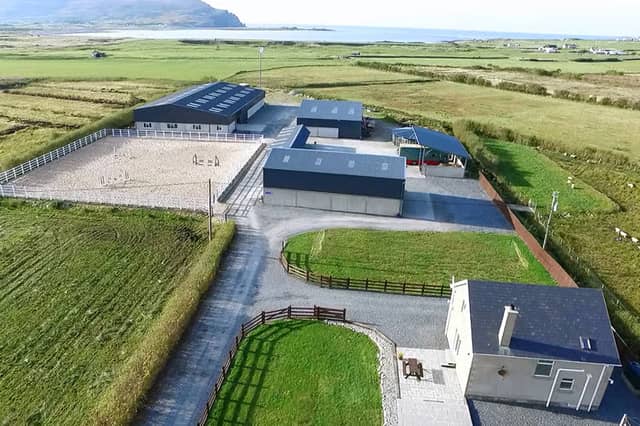

Proposed Rockstown retreat featuring seaweed baths, a sauna and yoga decks falls foul of rural planning rules.
Donegal County Council has refused planning permission for a proposed glamping and outdoor wellness retreat at Rockstown, Clonmany, citing concerns over planning policy, the nature of the proposed accommodation and potential traffic hazards.
The application, submitted by Bernard and Catherine Devlin, sought permission to develop 10 eco-friendly glamping units, a wellness centre, an on-site wastewater treatment system and associated site works on lands approximately 1.8 miles from the family's existing Tullagh Bay Equestrian and Wild Atlantic Adventure Centre.
The proposed development was intended to expand the family's tourism business by combining outdoor adventure activities with health and wellness experiences.
Plans included a semi-outdoor wellness centre featuring seaweed baths, a sauna, and outdoor meditation and yoga decks overlooking the sea and surrounding hills.
According to documents lodged with the application, visitors would have been able to stay at the site while enjoying a range of activities, including hill and coastal walking, wild sea swimming, birdwatching, cycling and water sports.
The proposal attracted objections from residents Janet Doherty and Mary Diver, who raised concerns about the potential impact of the development on the rural character and tranquillity of Rockstown.
Ms Doherty questioned the scale and commercial nature of the proposed retreat, describing the development as “fundamentally unsuitable for the tranquil and scenic townland of Rockstown”.
She also raised concerns about road safety, arguing that the local road network would struggle to accommodate the additional traffic generated by guests, staff, deliveries and service vehicles.
“The serving rural road network consists of narrow, sometimes single-track local roads - lacking footpaths, public lighting or passing bays,” she stated.
Ms Doherty also expressed concern about the potential impact of lighting on the area's dark skies and local wildlife.
She warned that external lighting, security floodlights, illuminated accommodation pods and vehicle headlights could “destroy” the area's dark-sky environment and potentially affect the nocturnal habits and habitats of local birds and other wildlife.
The objection highlighted the benefit of the area's naturally dark nights and unpolluted views of the stars, which could be affected by increased activity at the site.
A separate objection from Ms Diver raised concerns over noise pollution, particularly during the evening and night-time hours.
She feared that the development could disturb the currently quiet rural setting through “outdoor conversations, classes, guests gathering around the accommodation pods, vehicle movements, deliveries, waste collection and mechanical equipment, and any amplified instruction or music.”
In its decision, Donegal County Council gave three reasons for refusing planning permission, relating to the proposed accommodation's compliance with development plan policy, the wellness centre and concerns about traffic safety.
The first reason centred on the County Donegal Development Plan 2024-2030, and its policies governing standalone tourism accommodation in rural areas.
The council stated that the proposed units did not meet the plan's definition of glamping, particularly because of the absence of communal toilet and shower facilities.
Instead, the planning authority considered the units more akin to modular holiday units, self-contained accommodation incorporating facilities such as a shower, bath, toilet and kitchen.
According to the council, this type of accommodation is not permissible in rural areas, while they also warned that approval could establish an undesirable precedent for similar holiday accommodation developments in scenic coastal rural areas.
The second reason for refusal concerned the proposed wellness centre. The planning authority acknowledged the Council’s objective of supporting appropriately scaled rural economic projects that are functionally related to the countryside, as well as its policy supporting resource-related and activity-based tourism throughout the county.
However, it concluded that the wellness centre did not fall within the relevant categories of development supported under Policy ED-P-4 and was not functionally dependent on the natural resource or activity-based tourism envisaged under Policy TOU-P-5.
Instead, the council considered the centre to be functionally linked to the proposed glamping accommodation.
As the glamping pods themselves were deemed unacceptable in planning terms, the authority concluded that the wellness centre could not be justified independently and that its consideration was premature until permission had been granted for the associated accommodation units.
The council said the development, as proposed, would therefore materially contravene the relevant policies and would be contrary to the proper planning and sustainable development of the area.
The third and final reason for refusal related to traffic and parking.
The planning authority stated that it was not satisfied, based on the information submitted with the application, that the proposed development would avoid parking and traffic problems.
It concluded that the development could “endanger public safety” by creating a traffic hazard and that permission would therefore be contrary to the relevant planning policies and the proper planning and sustainable development of the area.