
‘Stark contrast’ between Irish and Canadian governments on defective concrete


Ulster University academics Dr Eileen Doherty and Professor Paul Dunlop visited Quebec to meet experts who have studied the problem of pyrrhotite and also victims impacted by it
Defective concrete block campaigners from Donegal who have visited Canada on an academic research trip say there is a stark difference in the speed that the Canadian Government reacted to homes affected by defective concrete compared to the reaction of the Irish Government.
Around 8,000 homes around Trois-Rivieres, a town between Montreal and Quebec City, were damaged after they were built with low-quality concrete that contained the mineral pyrrhotite, which expands when it comes into contact with water and air.
Experts in the crisis from Quebec visited Donegal as part of the international conference on defective blocks that was held in Letterkenny last November.
Dr Eileen Doherty and Professor Paul Dunlop from Ulster University visited Quebec earlier this month to meet academics who have studied the problem and also victims impacted by it.
The academics hailed the research trip, which was funded by Knowledge Acquisition and Foresight Activities (KAFA) through the Connected NI project at Ulster University, a huge success and say they are very optimistic for further research collaborations arising from it.
Dr Doherty said their meeting with the group who represent victims of the pyrrhotite issue in the Trois-Rivières area of Canada, Le Coalition D’aide aux Victimes de la Pyrrhotite, was “incredibly insightful”.
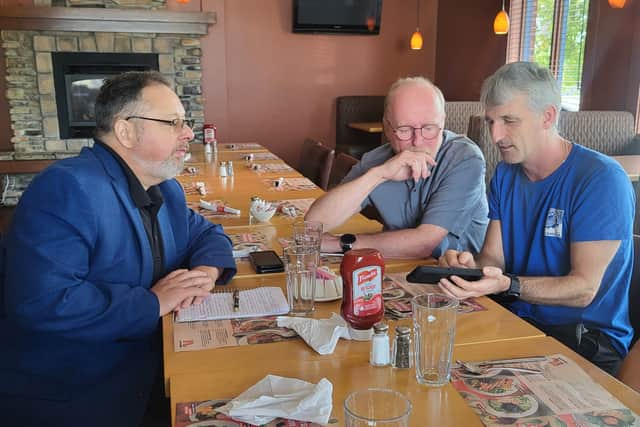
Professor Paul Dunlop meeting with members of Le Coalition D’aide aux Victimes de la Pyrrhotite
She said they have invited members of the coalition to visit Ireland to share their experience in the near future.
“We are hopeful that we can learn from what they did and encourage those with responsibility for dealing with this crisis here in Ireland to take similar expedient action”.
Professor Dunlop was one of an international team that published research earlier this year that found that defective concrete blocks in Donegal are failing because of pyrrhotite and not mica.
“We can’t thank Professor Benoit Fournier, Professor Josèe Duchesne and the wider research team from the Department of Geology and Geological Engineering at Laval University for hosting us and for organising meetings and site visits to ensure we got the most out of our knowledge exchange visit,” he said.

Professor Josèe Duchesne, Professor Michel Pigeon and Dr Eileen Doherty at Laval University in Quebec
“Additionally, we went on a field visit to Trois-Rivières, a city between Quebec City and Montreal where 8,000 homes have been destroyed by pyrrhotite that was in the aggregates used to make their concrete foundations. These aggregates came from the Askimo quarry near the city and full access to the quarry was facilitated by the owner and their expert geologist who was happy to show us around the various quarry sections and provide us with as many samples as we wanted to take with us. We learnt about the long history of research collaboration between the quarry owner and the Laval research team to try and better understand the problem that occurred in the Trois-Rivières, and this research is now helping to underpin the Canadian standards for concrete production to try and ensure another pyrrhotite disaster does not occur elsewhere in Canada. This is very different to what is happening here in Ireland where access is hard to get or is not allowed by the operator”
Dr Doherty said the trip gave the opportunity to meet with a number of stakeholders who have significant experience and knowledge of how the crisis unfolded in Canada.
“Some of these lessons are of significant value to our ongoing research here in Ireland. Of note was the meeting and detailed discussions we had with Professor Michel Pigeon, former chancellor of Laval University and former elected member of the Canadian parliament.
“Michel has significant knowledge and experience of this issue. He is one of the foremost scientists in the area of ‘freeze/thaw’ in concrete and has written and published extensively on this issue. He has also recently completed his second doctorate in sociology so has a keen interest on how this crisis is impacting upon both Canadian and Irish society. A number of areas of research were identified for potential research collaboration and discussions will continue over the next few weeks and months.