
'If you think you're in trouble, stop and call for help': Sligo Leitrim Mountain Rescue

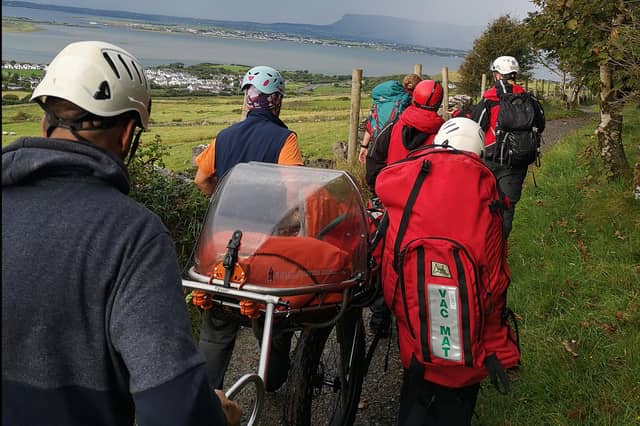

From rescuing stranded hikers and injured climbers to responding to callouts across Leitrim, Sligo and the wider North West, Sligo Leitrim Mountain Rescue volunteer Ciarán Davis explains what happens when people get into difficulty — and why no one should hesitate to call for help
Leitrim and Sligo are home to some of the most beautiful landscapes in the country, with serene mountains, sweeping valleys and a wealth of outdoor amenities drawing visitors from far and wide.
Hiking, hill walking and climbing are understandably among the most popular activities in the North West, thanks to the spectacular scenery right on our doorstep. But when things go wrong in the mountains, there is one entirely voluntary organisation that stands ready to help, 24 hours a day, 365 days a year.
Sligo Leitrim Mountain Rescue Team was established in 1990. Before then, members of Sligo Mountaineering Club volunteered to assist people on local mountains from 1974 until the rescue team was officially formed.
Ciarán Davis, is an archaeologist from Sligo and has volunteered as a responder with Sligo Leitrim Mountain Rescue since 2010. Inspired to join after seeing the team’s float in a St Patrick’s Day parade, he has since taken part in countless rescue operations and witnessed a remarkable range of situations during his years on the team.
The role is undoubtedly demanding, both physically and emotionally, but for Ciarán, it also brings an immense sense of pride. “It’s the sense of satisfaction of being able to assist someone who has gotten into trouble in some sort of way,” he explains. “To be able to be there, to join the team and go and help out somebody in trouble in the best way I can.”
Before responders can embark on rescue missions, extensive training is essential. That training is also ongoing, with the team meeting every second Tuesday for most of the year to develop and maintain skills in navigation, first aid, patient care, stretcher bearing and technical rope work.
Mobilising the team for a callout is a highly organised process. They use incident management apps that allow the team’s 22 responders to register whether they are available or unavailable, while WhatsApp groups keep everyone in constant communication.
“We usually organise for available responders to go to our base or else directly to the area where the callout is occurring. Once we’re there we deploy an operations leader,” he explains.
From there, the response depends on the nature of the incident. A hasty party, which includes a highly medically trained responder, is sent directly to the casualty to assess and secure them. Once they report back to the main group at the roadside, whatever equipment or additional personnel are required are then deployed.
“If it’s somebody with a lower leg injury like a broken ankle they’ll bring a stretcher and all the equipment needed to stabilise that,” he says. Ambulances also wait at the roadside if further medical treatment is required.
Responders locate casualties using GPS coordinates from mobile phones or, in some cases, by spotting them visually. Among the locations they are most frequently called to are Benbulben, Knocknarea and the Gleniff Horseshoe.
“After Covid, people got out and about and one of our hotspots was the Gleniff Horseshoe, particularly Diarmuid and Gráinne’s Cave,” he says. “We had quite a number of instances where people were trying to get up to the cave and then finding themselves cragfast.”
Cragfast, Ciarán explains, describes someone who has climbed so high that, after turning around and seeing just how steep the descent is, they become completely frozen and unable to continue. In those situations, responders climb up to safely guide the individual back down.
Of course, some callouts involve far more difficult circumstances.
“On occasion we have attended fatalities and that’s a matter of locating the victim and recovering them to the roadside,” he explains.
One such incident occurred at the Gleniff Horseshoe five years ago following a fatal fall.
“Everyone was deployed including the coast guard helicopter because there were two people together and one of the individuals was stuck on the side of the mountain. It was a matter of rescuing that individual first and then recovering the body afterwards.”
Teamwork is vital in every rescue, but especially during incidents involving fatalities. Ciarán describes a strong sense of camaraderie within the group, with members supporting one another emotionally as well as throughout the practical aspects of each operation.
The Coast Guard helicopter also plays an important role depending on the circumstances. In time-sensitive incidents, such as the fatality at Gleniff Horseshoe, responders may be airlifted directly to the summit. At other times, particularly during winter nights, the helicopter is used to illuminate search areas from above.
There are several preventative measures hikers and climbers can take to improve their safety in the mountains. Wearing appropriate footwear such as hiking boots, dressing properly for rapidly changing weather conditions, checking multiple weather forecasts before setting out and carrying enough food and water can all make a significant difference.
“Usually when someone is on the summit they’re safe enough but on the ascent or descent it depends where they are, they could get themselves into considerable trouble,” explains Ciarán. “We did have an incident a couple of years ago where four lads took the train from somewhere in the midlands to specifically climb Benbulben. When they got to the mountain, the weather had closed down but they kept going and got up into the cloud cover,” he says.
The climbers soon realised they had become lost, so they stopped and called for help.
“The weather turned particularly bad and wet and they weren’t very well clothed, so hypothermia had started to set in,” he recalls.
No two callouts are ever the same. The team has even found itself rescuing animals.
“We had an interesting call on Knocknarea a few years ago, a dog had gone over a ledge and injured itself and he was a service dog so the owners were very concerned. They called the gardaí for assistance and the gardaí deployed us.
“We were able to get to where the dog was and patch him up in our stretcher and get him back to the roadside. He was very good!” he recalls.
Ciarán says the response from those they rescue is overwhelmingly one of relief.
“More often than not we’re met with relief from the person that help has come. Particularly if someone is lost rather than injured,” he says.
“If someone is injured it’s rare they’re on their own. Someone will come upon them. It is usually a relief and to some degree apologies for the ‘hassle’ of calling us out. Which we always say, that is what we’re here for,” he adds.
The team’s work extends well beyond mountains, hills and caves. They have also responded to incidents in lowland areas, including in Leitrim.
“We’ve had call outs during poor weather on lowlands. We had one occasion where two people were out walking in Leitrim and it was a lowland area and they ended up going off path and got themselves turned around,” Ciarán says. “The weather turned considerably as well and that stretched into early morning. I think we finally found them at around 4am or 5am.”
The job really is exactly what it says on the tin: 24 hours a day, 365 days a year. It is an extraordinary commitment that many people may never stop to consider, made all the more remarkable by the fact that every responder gives their time voluntarily.
Their work is not confined to Sligo and Leitrim either. The team is available to assist mountain rescue groups across the country whenever required.
“We’ve been regularly called by Mayo Mountain Rescue and Donegal Mountain Rescue because they’re our flanking teams,” he explains.
Sligo Leitrim Mountain Rescue is funded largely through public donations, alongside a small grant from the Coast Guard.
“Through public donations we have managed. We’ve never gotten into an occasion where we’re stuck for equipment. We maintain our equipment 100 per cent and when something starts getting worn out it’s immediately replaced,” says Ciarán.
One of the most important things Ciarán wants the public to understand is that the team is available every day of the year, at any hour, whenever they are needed. He also stresses the importance of taking sensible precautions before heading into the hills.
“Anyone who takes to the hills is susceptible to getting themselves in trouble if they’re not careful,” he says. “Be aware of weather conditions, personal clothing and footwear,” he says, as well as carrying enough food and water, and letting someone know when you expect to return.
The work carried out by Ciarán and his teammates is extraordinary under any circumstances, made even more remarkable by the fact that it is entirely voluntary. For them, it is unquestionably a job worth doing.
When embarking on a climb or hike across the dramatic landscapes of Leitrim and Sligo, it is worth taking a moment to think about the people who voluntarily put themselves on the mountain in all weather conditions to save others.
“Don’t be afraid to ever call us if you need us. Even if you think it’s not relevant. If you think you’re in trouble, stop and call for help. Call 999 and ask for mountain rescue,” he concludes.