
‘The industry is there’: Leitrim group pushes for hemp revolution


Eoin Gallagher reports on how Manorhamilton’s Future Cast innovation hub has brought farmers, academics and international companies before an Oireachtas committee to highlight the potential of hemp, willow and sheep’s wool as the building materials of the future
A Leitrim innovation centre has told an Oireachtas committee that Ireland could develop a biological construction materials industry using materials including hemp, willow and sheep’s wool.
Future Cast, an Innovation Hub based in a restored 200-year-old church in Manorhamilton, led a group of international companies, farmers and academics from around the country that addressed a joint meeting of the Oireachtas Joint Committee on Agriculture in July.
The group outlined the potential of biomaterials and called for greater support for the development of the sector.
Future Cast CEO J.J. O’Hara said that while there was significant discussion around biomaterials, further scientific development was required.
“There’s great talk about biomaterials, but it’s talk. What we’re doing is to push it forward, and anything to do with biomaterials needs science.
“That’s what we spend €3.2 million on in Manorhamilton on a new science centre,” he said.
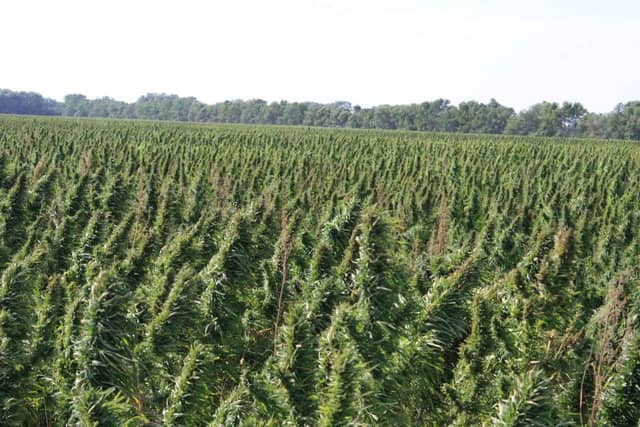
One of the key areas discussed was hemp, a crop that can be used in products including concrete, plywood and insulation.
The crop is also of interest because it can grow on poor-quality land, can act as a break crop for tillage farmers, is naturally pest-resistant and grows quickly.
According to the European Commission, hemp can sequester between nine and 15 tonnes of CO2 per hectare, similar to a young forest, while taking approximately five months to grow.
However, hemp cultivation in Ireland requires a licence from the Department of Health and is strictly controlled as it is a form of cannabis.
South Leitrim entrepreneur and engineer Padraig Corby began growing hemp in 2016 to produce CBD oil and later hempcrete, a type of certifiable concrete made from the plant.
He planted around 90 acres of hemp in South Leitrim and developed machinery for small farmers to extract hemp, investing around €2 million in the project over approximately five years.
Mr Corby said his engineering background helped him develop equipment that was not available on the market.
“I did a lot of research, and my engineering skills had been very, very useful to me at that time. And I was able to design equipment that was not on the market, nor has it ever been put on the market.”
By 2021, he said he felt he could not continue with the project due to restrictions around licences, a lack of a path to market and a lack of government support.
“This has been around since the beginning of time, and now it was sidelined because there were more modern ways of doing things, and now if it was revisited there might be opportunities.”
Ireland’s hemp planting peaked in 2019, with 314 hectares planted, while the Health Products Regulatory Authority reported 547 hectares were licensed that year.
Since then, interest in the crop has reduced as an industrial hemp sector has not developed in Ireland.
Under Ireland’s Misuse of Drugs Act 1977, cannabis is classified as a Schedule I drug. Hemp grown for fibre or seed must contain less than 0.2% THC, the psychoactive component in cannabis, and is subject to controls.
In 2021, the European Union designated hemp as a CAP crop eligible for agricultural subsidies.
Future Cast CEO J.J. O’Hara said other European countries had developed hemp industries.
“We’re in Europe; the model is already there, just going right across Europe and different viable products have been made there,” he said.
“You see an industry in France; there’s 45,000 hectares they’re growing, and it’s an industry, and they don’t even need certification for their fields.
“They’re using certified seed. So if you’re using certified seed, why do you need certification on the land?
“These are the questions that we’re asking.”
The committee was told that while companies in Ireland are using hemp-based products, there is currently no industrial processing capacity in the country.
The meeting heard that companies, including Kingspan, are importing hemp-based materials, and that companies were willing to expand into Ireland if a supply chain was developed.
Deputy Michael Fitzmaurice, who is a member of the Joint Committee on Agriculture, said he believed there were opportunities if legislative issues could be addressed.
“I think what needs to be done is simplified legislation as well, for industrial hemp,” he said.
He said there had been caution around hemp and that several departments were involved in the area.
“You have a lot of departments with their fingers in the pie, and this sort of myth in their head, that you’ll be growing cannabis, like, the industry is never going to be for that,” he said.
“What needs to happen first is that a few departments need to bang their heads together and one take it by the scruff of the neck.”
Deputy Fitzmaurice said he would work with the Minister to examine how legislation could be simplified.
“I will be looking with the Minister to see how we can streamline this or simplify legislation for the simple reason that we have the market, we have the person that’s willing to set up, and we have farmers that are willing to do it.”