
Valentine's Day 164 years ago


Historian Fiona Slevin looks back on the history of Valentine's Day
Valentine’s Day origins
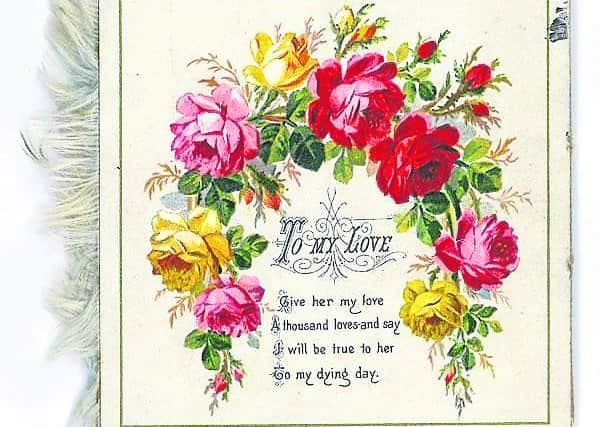
Valentine’s Day became associated with romantic love in 15th century France, but it was not until the 1790s that lovers sent pre-printed Valentine cards to each other. By the mid-1800s, printed Valentine cards were hugely popular, and became more so with the introduction of the Penny Black stamp and more affordable postage. In 1841, some 400,000 valentines were posted throughout England.
What may be more surprising is that they were also popular in Ireland.
Valentine’s Day in Ireland in the mid-19th century
The mid-1800s in Ireland was dominated by the Great Famine, and counties like Leitrim were decimated. Through the 1850s, thousands continued to emigrate and the majority of those who remained eked out a living as labourers and servants, with low wages, little security and few prospects.
Despite this, the county was transformed and a new middle class middle class of tenant farmers, landholders, professionals and traders emerged.
Local newspapers carried advertisements for goods like coffee, whiskey, dentistry, coats, perfumes, clocks and watches.
In January and February each year, ads would appear for Valentine cards.
An ad in the Leitrim Gazette, published in Mohill through January and early February 1858 offers a 'beautiful assortment' of Valentines for sale in Robert Turner's shop. They range in price from one penny to five shillings.
VALENTINES!

Who sent cards in 1858?
So who bought them? We may never know. Men labouring at work like spreading manure or planting potatoes might earn 8 or 10d a day, so would have to work an hour to buy the cheapest card; they would have to hand over a week’s wages to buy a 5 shilling card.
They would certainly have been more affordable for a schoolmaster or schoolmistress, or a carpenter or nurse, or of course the few doctors, attorneys, and gentry who lived in the area.
The ad on 30 January appears on the front page of the newspaper alongside articles about tenant rights and a ‘great meeting at Milford’ between Lord Leitrim and his tenants.
The front pages also report prices at Mohill Market, with oatmeal at 12s3d, beef 6d, bacon 7d, hides 3d, and butter at 7d per pound.
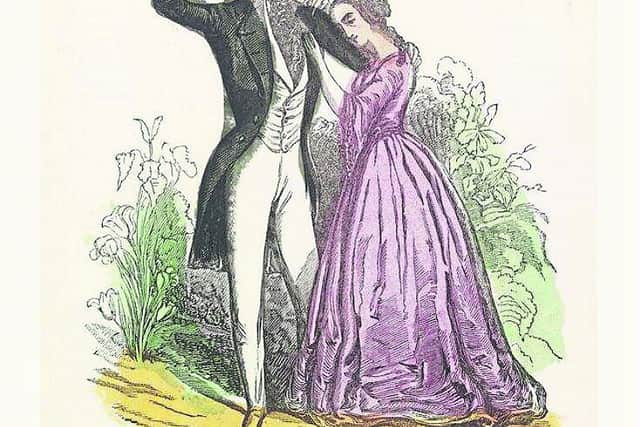
Some cards
What did these cards look like? We cannot tell. We can only assume that they were similar to the cards that were on sale in Britain.
The simple ones, and presumably the cheaper ones, were printed cards with messages that would not be unfamiliar today.
Some were humorous, some were rude. The more expensive ones might have been handmade lace confections with appliqué flowers, or hand-painted images. We can only hope the recipients enjoyed them.
Get in touch
There has been little research on towns like Mohill and little is known about how they turned into thriving towns in the latter half of the 19th century.
If anyone has original records that relate to shops, trades and professions from 1850-1875, especially ledgers, sales and order books, letters, photos, etc, please get in touch directly at [email protected].
To read some of Fiona’s previous research on the Famine era and Lord Leitrim, see www.loughrynn.net.
Fiona Slevin grew up and went to school in Mohill and currently lives in Dublin. It is available at www.loughrynn.net