
Boutcher: PSNI is success story of peace process but needs full political buy-in
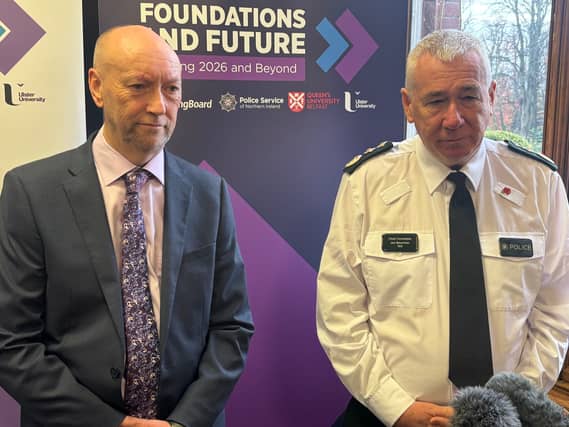

Chief constable Jon Boutcher also said the force needs more funding to deliver the required level of service.
Policing is the success story of Northern Ireland’s peace process – but still needs full political buy-in, the chief constable has said.
Jon Boutcher said further progress is needed on recruiting a representative workforce and pressed that the Police Service of Northern Ireland (PSNI) remains underfunded, emphasising they cannot keep society safe unless they are supported to do so.
He was speaking at the start of a major two-day conference on the future of policing on the 25th anniversary of the formation of the PSNI in 2001.
Mr Boutcher said policing has “repeatedly been there to pick-up where society has collapsed”.
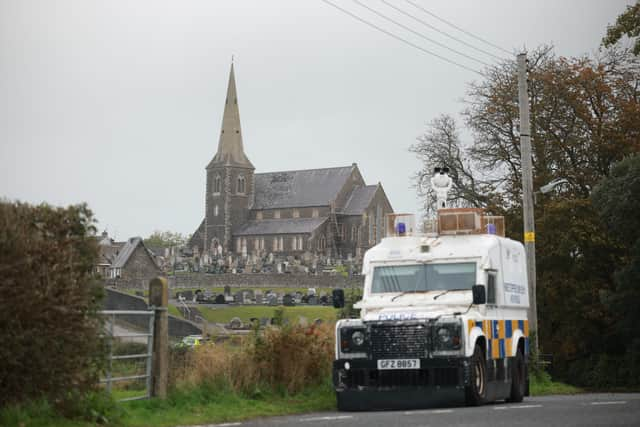
He said: “In my three years here, I can tell you I have never seen the like of policing as I have witnessed here – human rights-focused approach, the way Drumcree has been dealt with in recent weeks at every level is completely different to how policing would have dealt with such challenges many years ago.
“In the 25 years of the PSNI, we have not been supported in the way I expect policing to be supported, in the way policing is supported elsewhere on the island of Ireland, with An Garda Síochána getting their biggest ever number of officers they have ever had, the way policing is supported in Great Britain with regards to increases in numbers.
“Broadly since 2010 when policing was first devolved, we have not seen any budgetary increase, policing needs investment, and it has the challenges here, which are unique, of a society still emerging from conflict, the disorder we have seen in the last three years has not been seen anywhere else on the island of Ireland or United Kingdom.
“The men and women of this organisation cannot continue to keep society safe unless they are supported and we get the backing we need.
“We’re doing our bit, my plea is the institutions and political leadership does their bit to support the PSNI, and that’s overdue.”
Mr Boutcher quoted Chris Patten, whose review of policing in the 1990s led to the creation of the PSNI, as saying the success story of the peace process and Belfast/Good Friday Agreement is the PSNI.
He said: “Can I say when the PSNI will be truly representative? No, I can’t. Are other police services elsewhere truly representative? No, they are not.
“Have we made progress from 2001 to now when we had 8% from the nationalist and catholic community, to 32%, women we had about 14%, we’ve now got well over 30%, and in the current recruitment process, the figures are looking encouraging for moving those numbers upwards, but it’s incumbent for all of us to help with that.”
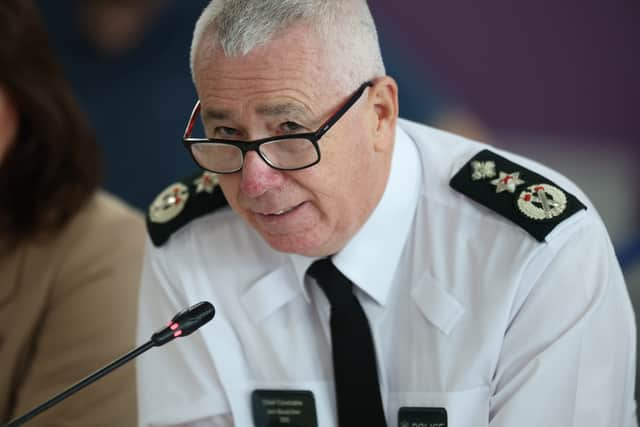
Asked whether he would support a return of 50/50 recruitment, Mr Boutcher said not enough has been done in the last 25 years to “move the dial”, but he hailed more recent progress, reaching out to schools and sports authorities, as well as the Blue Light television programme and podcasts.
“Let’s get our shoulder behind that wheel, and then if we’re still not making the progress we need, we’ll look at other options, but we need to do more in supporting policing around recruitment across the board that is not yet being done,” he said.
Northern Ireland Policing Board chairman Brendan Mullan said 50/50 recruitment was “of its time when you are starting from well behind the line”.
He added: “Patten envisaged the PSNI operating in a normalised society, society is not normalised, we still have paramilitaries, we still have the dissident threat and that is a signal that while policing has moved forward, we have lacked the political leadership for reconciliation, so we do now need our political leaders to stand up and support policing, and to lead us into reconciliation.”
Mr Boutcher added: “Policing is, in any environment, wickedly difficult, here it is more uniquely challenging than anywhere else I have know in 43 years of policing, and we come on the backs of people from the Royal Ulster Constabulary, so many of whom lost their lives, so many of whom suffered life-changing injuries, and we should never, ever forget that.”