
Goatsbridge Trout: Inside growth and sustainability at Ireland's largest freshwater fish farm
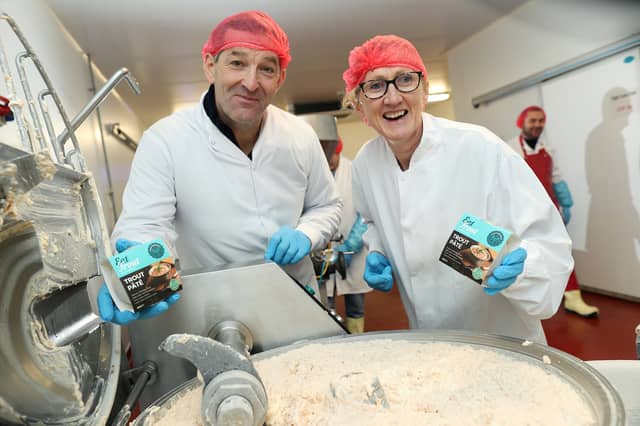

The family-owned business in south Kilkenny has been at the forefront of aquaculture production since 1962
“People have said to me: ‘gosh if your mother and father came back now and saw the place, what would they think?” says Ger Kirwan, owner of Goatsbridge Trout Farm.
From humble beginnings in 1962, Ger’s parents Rita and Padraig could scarcely have imagined the operation they were setting in motion and the expansion it would see in the coming decades.
“It’s probably always the way isn’t it?,” ponders Ger. “If you’re not going forward, you’re going backwards. In a sense, your business carries you to the places.”
And carry them it has.
Just a few minutes outside Thomastown, beside the Little Arrigle River, Goatsbridge has evolved into Ireland’s largest freshwater aquaculture business, producing 600 tonnes of trout a year while also being at the forefront of product innovation like developing the country’s first caviar.
Originally started as an alternative agricultural enterprise, a mill stream ran through the farm controlled by a weir which passed water through a series of trout ponds before being directed back to the river.
Today the same principle remains, although the technology has become more advanced, with modern habitats sitting alongside the remnants of the original pools.
Padraig and Rita began by selling whole trout to local hotels and restaurants, but demand grew for more variation as customers began seeking the fish gutted and filleted.
Ger and his wife Mag, became owners in 1990, and the growth of Goatsbridge has scarcely slowed down during the second generation of the Kirwan family’s stewardship.
Though the sale of whole fish is still a key part of the business, the brand has grown through the development of specialised products like smoked darnes, trout caviar and their renowned rainbow trout pate.
“In the last 20 years we’ve taken ourselves out of the commodity space where we’re producing just a raw material, into trying to identify the excellence and to tie in that whole marketing and branding piece and we’re doing a wider range of processing now,” Ger outlines.
“The business now consists of a production base; a primary processing facility where we go to fillet and portion all the fish and then a secondary processing facility where we smoke the fish, produce the caviar and that’s how it's evolved,” he adds.
The long, dark pools full of busy trout are striking to witness while the breach of a dorsal fin over the water’s surface every few seconds serves to remind visitors of their presence at all times.
Just a short walk up the hill lies Goatsbridge's state of the art packaging and processing facility where the fish from below are taken along with those from three alternate production sites in Kilkenny and two in Wicklow.
The second of six children, Ger was involved in the farm with his siblings from a young age, though when asked if it was always his ambition to take over eventually, he doesn’t recall it as being set in stone.
“I’m not sure that the life plan was as clear cut,” he reflects. “In that generation, for sure, we were the labour unit in our youth and teens on the farm.”
“The extension of that was when I went to college and studied engineering. During that period my brother and I would have come home on weekends and organised the farm for the following week.”
“We would have had a good, hands-on active part in it. My parents often said: ‘did you come home or did we ask you to come home?’”, he continues.
It was during his time at university in Dublin that Ger met his wife Mag, a biochemist from Goresbridge who would eventually join him in running the farm.
With Mag having also grown up around a family business and armed with expertise on all things living organisms, the pair were the perfect match in spearheading Goatsbridge after Padraig and Rita’s retirement.
“It just seemed like there was so much work to do and I literally finished work and came straight home,” says Ger, describing his return to the farm after completing his degree.
“My parents had worked together side-by-side in the business here. Mag’s parents had another Kilkenny business, the Goresbridge Horse Sales, so we both came from family business backgrounds where our parents worked side-by-side so it just seemed that sensibly or logically, we should do the same,” he adds.
Nowhere is Ger and Mag’s development of Goatsbridge more visible than the cutting-edge processing facility at the heart of the current operation.
Complex machines of myriad shapes and sizes are placed around the various rooms, for everything from filleting and gutting to perfectly cutting trout into two 140g portions.
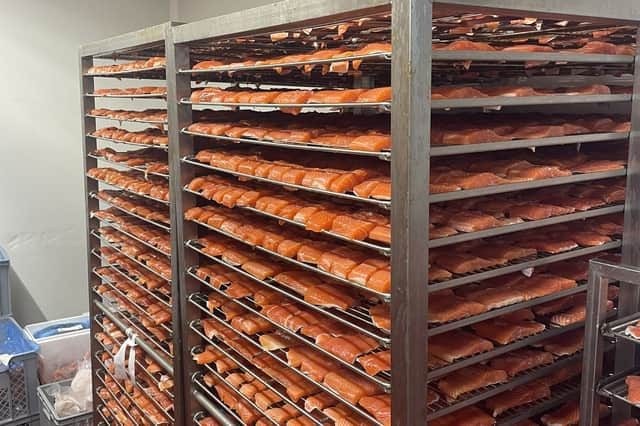
Other side rooms contain racks upon racks of colorful darnes ready for smoking and curing while a surprising lack of piscine odors permeate the facility.
Yet more doors open to reveal cold and freezer rooms brimming with packaged products ready for dispatch to loading bays dotted on all sides of the plant.
Despite the expansion in the scale of operations, sustainability remains a core tenet of the Goatsbridge philosophy.
With weather patterns and climate change becoming ever more difficult to predict, Ger emphasises that striving for stability is key in coping with these changes.
“Anyone that’s making their living off a resource like a river or fresh water or the land for that matter, of course they notice subtle changes in different things,” he says.
“I suppose the extremities are becoming more extreme. We’re getting higher temperatures; we’re probably getting the same amount of rainfall, but the pulses are not quite as regular. We’re getting flooding and intense stuff, the extremes in that space.”
“I suppose what we’re trying to do from the point of view of the farms now is that we have an innate knowledge of our site and location, so then we’re trying to come up with a production model that’s constant all year round,” he outlines.
Running the largest enterprise of its kind in Ireland, Mag and Ger are keenly aware of the responsibility they have to act as a leader in sustainable practices and multiple initiatives at the farm reflect this.
Goatsbridge are among the first fish processors to be involved with Bord Bia’s Origin Green programme to support sustainable schemes and have built a small solar farm on the property.
This extends to the use of plastics and packaging with the farm using almost entirely recycled materials while they are well on the way to fulfilling a pledge to become carbon neutral by 2030.
“The three pillars that we’ve pitched our tent to are quality, service and price, but never one of those on their own, it’s always a combination,” Ger highlights.
“For the sustainability one, in Ireland I suppose in a sense, the perception and otherwise is that we’ve got an almost organic product in lots of different ways.”
“We lean then on trying to look at all the different things coming under that banner and try to emphasise them and improve that.”
After 64 years of trout farming in Kilkenny, Goatsbridge is looking towards the future with millions of euros in grants and investments put towards equipping it to deal with the challenges to come.
There’s no clear succession plan in place currently, but with four children of their own, it’s possible that a third generation of Kirwans may take over the running of the farm, although Ger and Mag have no intention of putting their feet up just yet.
The desire to keep innovating and developing remains as strong as ever with Goatsbridge set to continue leading the way in national fish farming for a long time to come.
“Luckily we had a business that was able to carry us,” reflects Ger. “Of course you’d be proud of the achievement but with that comes a big responsibility.”
“Every day you’re pushing forward and trying to get better. There’s a clear progression and there’ll be more, it’s not finished, it never finishes.”
“I don’t think either of us rest on our laurels really, it’s still as infectious for us in terms of enthusiasm for trying to get better.”