
Mud, spikes and chutes - a guide to cross-country running
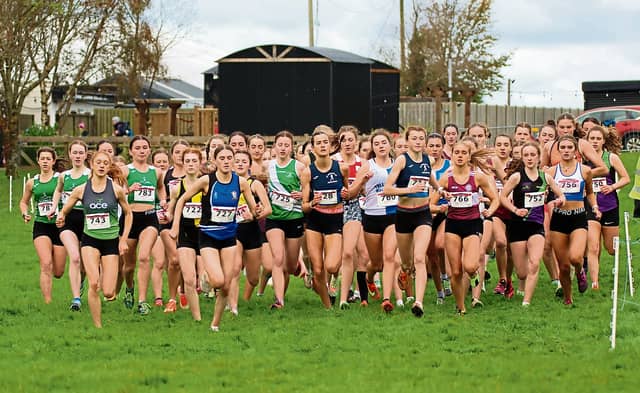

With the season pushed back a week through weather warnings, Perri Williams dives in to let people know what they can look forward to at this year’s cross-country scene
The weather-delayed cross-country championship seasons will get up and running this weekend. Over the next few months championship races will be run for juveniles, seniors, novices and all sorts of other categories.
If you are new to cross-country, you may look upon the whole set-up with complete bewilderment and get confused with information that many take for granted. Ready to learn more? Read on and unravel the mysteries of cross-country running in Ireland.
Cross-country is fun
Cross-country is a fun team sport run over grassy terrain. Children love to run in fields and get mucky - some adults do too!- so encourage your child or loved one to take part. The purest form of strength and conditioning, for masters runners, running on grass is far better for your body than running on the roads.
Teams are an important element of cross-country running. Club teams have four members to score (except under-19, which has three). Scores are based on finishing positions. Usually first gets one point, second gets two points and so on. Everyone gets a point, so if you finish in 79th place you get 79 points. It is the lowest scoring team that wins.
Contrary to popular myth, cross-country running is not always held in cold, wet and usually very muddy conditions. In fact there’s a huge amount of variety - courses can be flat, hilly, muddy, firm, twisty, short and long.
Different runners are suited to different courses, so there should be something for everyone. There are probably more dry days than wet days too. The real benefit is the day’s activities are also over relatively quickly – in a few hours in fact, so parents, loved ones and athletes don’t have to hang around all day waiting for heats and finals.
While the rigours of the race might seem tortuous while you are running, the memories of the achievements far outweigh those temporary moments. It is one of those things that is a rite of passage from one season to the next with enormous benefits in terms of strength and stamina.
Specific advice to parents and coaches
Parents, please leave your kids to their coach. At the younger ages, this is the best policy. They will be fine.
Coaches, you won’t be starting the race, so keep away from the action at the start line and leave the kids to the starter. There is plenty of action at the start and you do not need to be part of it. Your job has already been done.
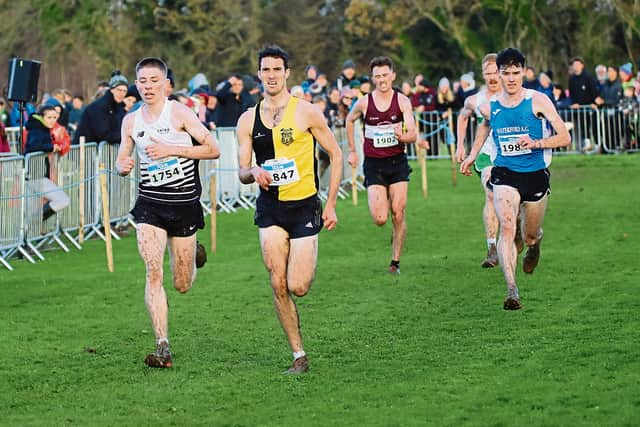
Eoin Everard (Kilkenny CIty Harriers) in action in the Senior Men’s 2023 All-Ireland
The season
The season runs through to Christmas. There will be some races from January to March, typically the secondary schools competitions, juvenile B championships and All-Ireland intermediate.
What are the race distances?
Under-11: 1,500m (B All-Irelands 1,000m).
Under-12: 2,000m.
Under-13: 2,500m (1,500m).
Under-14: 3,000m.
Under-15: 3,500m (2,500m).
Under-16: 4,000m.
Under-17: 4,500m (3,000m).
Under-18: 5,000m.
Under-19: 5,000m.
Under-20: 5,000m.
Under-23: 9,000m.
Senior: 9,000m.
Novice: 6,000m men, 4,000m women.
Intermediate: 8,000m men, 5,000m women.
Masters (35-50+): 7,000m men, 4,000m women.
This year at the All-Irelands some distances will be reduced to match those of the European Cross-Country.
Age Groups
The official championship age groups begin at under-11 and run right through to under-19 for juveniles, though counties and some provinces also run competitions for under-nines and under-10s. Athletes run in their own age group and can move up one age.
What if I am new to cross-country?
This is the beauty of cross-country running, abilities of all kinds run in one race. For juveniles there is a qualification system.
Over 19 there is direct entry.
As with all Athletics Ireland based competitions it is important that athletes of all ages wear their club singlet. County GAA jerseys are not club singlets, no matter how similar their colours are.
Do remember to bring warm clothes for afterwards. It is essential to keep warm in the autumn or winter months. Wellies and raincoats are also an essential part of cross-country attire - don’t leave home without them.

Cross-country running is great for athletes of all ages with courses of all types to take on
Qualification
The ultimate aim is to get to the All-Ireland championships. Juvenile athletes have to go through a series of qualification races, from counties and provincial to national (All-Irelands). Athletes from under-20 upwards do not have to go through this qualification ladder and can simply enter any race they want.
At the base of the championship ladder is the county championships. Most counties run these and they are an ideal way to give your race form some test. For juveniles, especially the younger ones, it is a good idea to start here. For many this may be as far as they go. In theory you do not have to qualify for the provincial Championships (of which there are five; Munster, Leinster, Connacht, Ulster and Dublin).
Clubs can enter athletes either as individuals or teams straight into these. Thus, if you happen to be sick or injured or miss the counties for one reason or another, you can still move onto the next stage, unless your club happens to have a rule that restricts you.
To get from the provincial championships to the All-Irelands, you must qualify. The top 12 individuals from each province will go through automatically. They will race the All-Irelands as part of the provincial team. The first four club teams in the 11-19 age group, all must qualify from the regional cross-country championships. Three teams each from Munster, Ulster, Connacht, four from Leinster and one team from the region of Dublin qualify for county teams. Between individual, club and county, this allows for a vast array of possible qualification avenues.
In the 17-19 age groups individual open entry will apply provided the athlete has entered in the regional cross-country championships. There is no open entry for club or county juvenile teams.
Terminology
The cross-country dictionary consists of just a few small terms. Firstly, there are the simple terms ‘evens’ and ‘unevens’, which refer to juvenile age groups. The even ages are held on one day and consist traditionally of under-12, 14, 16 and 18. The uneven ages refer to under-11, 13, 15, 17 and 19.
Unlike track, where athletes start from the lines marked on the track, cross-country athletes start in pens or chutes.
Action from the 2023 boys’ under-11 Leinster race
These are small linear spaces where they line up, possibly two abreast and shove and push to keep their places. It is bedlam, but designed to help keep kids on their feet and safe.
Be tough and strong and stand your ground. Usually the faster athletes head to the front.
Athletes also run into a chute at the finish. This helps preserve their finishing positions. There can be over 200 athletes in some races, so you can understand why this efficiency was created.