
Shock discovery made in old property in Kilkenny


Rare 19th Century Irish music manuscript discovered in attic near Johnstown and Crosspatrick, North Kilkenny
A manuscript containing a large hand-written collection of traditional Irish tunes from the North Kilkenny/Laois border area was discovered back in 2002 in an attic in Bayswell House, Crosspatrick, Johnstown, County Kilkenny.
It bears the names of the family of John and Ellen Delany and notably of Eliza Delany who may have been the person who notated much of the music.
The oldest of the family, she was born in Bayswell in 1843 and died in 1916 leaving a reputation as a musician of note who was a collector and composer of music.
READ MORE: ‘All the children were raised as if they were my own’: Kilkenny foster carer shares emotional story
The pieces of music are mainly traditional Irish with classical and military influences some of which are known tunes and others lesser known or previously unknown.
The manuscript lay hidden in an attic and can be dated to the post famine years 1850s and 60s.
Its antiquity along with its place of origin makes the discovery very significant in the world of Irish traditional music.
A number of these tunes which would have been played in local houses, at house dances and local halls, were unknown or have been forgotten.
Some of the tunes obviously travelled along fair-day trails, or with itinerant musicians from the west or the north. Some are tunes from the area which have been long lost. Much of the music would be pre-famine melodies.
It would also have been written for the purpose of recording and preserving this music for posterity given the quality of the writing, the attention to detail and the professional standard of the musical notation.
The manuscript itself comprises some 100 pages sown together into three sections or books. There is no cover surviving nor is there an index.
However, the high state of preservation has facilitated research and detailed analysis of the material which has been ongoing since 2002. This study has opened up a number of interesting angles on the significance of the material.
Firstly, it throws light on the cultural life of a specific area. It also shows the place of traditional Irish music in an area not strongly associated with its preservation.
Secondly, the fact that Eliza Delany and her sisters were daughters of a small farmer in this area at this time and that they learned fluency in music transcription and skill in playing. This highlights a number of social issues, among them the status of women in this society.
Thirdly, consideration must be given to the significance of this manuscript in the history of Irish music, its seeming independence from the known collections which were made around the same time in the 19th Century.
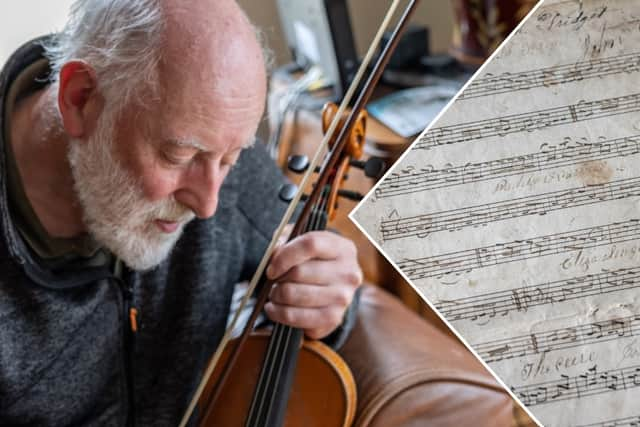
Dan Delaney (left) and a picture of a page of the manuscript (right) / PICTURES: Karen Cox
Dan is an active musician in the Westport area. He describes researching the music and how it was recorded and written down by his grand aunt, Eliza Delany and her siblings nearly two centuries ago.
The book tells their story and also contains all the transcribed tunes from the manuscript with extensive research notes.
"When I play these tunes, I feel my ancestors dance around me," Dan says.