
Britons having less sex than they used to, major study finds


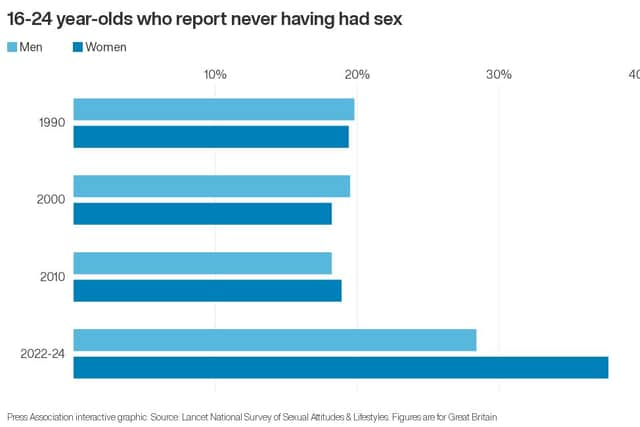
Declines in the youngest groups are largely driven by the one in three 16 to 24-year-olds who have never had sex.
People in Britain are having less sex than they used to, with younger age groups mainly driving the trend, according to a major report.
Adults aged under 45 are having sex twice a month on average, compared with four times a month in 1990-91 and three in 2010-12, research papers published in The Lancet medical journal found.
Overall, 77% of people aged 16 to 59 have had sex at least once in the last year, with women having sex once per month on average and men twice monthly, researchers found.
Declines in the youngest groups are largely driven by the one in three 16 to 24-year-olds who have never had sex, up from around one in five between 1990 and 2010.
Even among those aged 35 to 44, frequency of sex has continued to decline in the past decade, from three times a month to twice.
For those aged 45 to 59, women on average reported no sex in the previous month while men reported having had sex twice.
This includes people who have never had sex and those who have not had sex in the past year.
Online sexual behaviours are widespread, the studies found, especially among young people.
Half of young women and almost nine in 10 young men report watching pornography in the past year. Among all ages from 16 to 59, 37% of women and 81% of men had watched porn.
Just under half of young men and women have sent or received a sexual image, according to the studies.
The researchers said they found “widespread engagement with pornography and sexting across age groups and genders, in line with evidence from other countries”.
They added: “Together with declines in in-person sex, this might signal a shift away from partnered physical intimacy, towards more solo and online sexual behaviour.”
However, they said it was not clear that online behaviour was substituting for real-life sex.
For example, pornography use and masturbation is less common among people who had never had sex, meaning more research is needed.
Dr Wendy Macdowall, one of the study authors and associate professor from the London School of Hygiene and Tropical Medicine (LSHTM), said: “Surveys like Natsal (National Survey of Sexual Attitudes and Lifestyles) can document changes, but can’t tell us what’s driving these shifts and, although it may be tempting to blame a single factor such as the online environment, it’s likely there are multiple complex factors at play, especially for young people.
“On the one hand, more open discussion of consent may mean young people feel better able to decide whether and when to have sex.
“On the other, these findings coincide with broader changes in young people’s lives, including rising rates of mental health conditions, declines in drinking alcohol, more time spent online and a greater proportion living at home with their parents.”
Soazig Clifton, honorary senior research fellow at University College London and one of the study authors, said the decline in sex is being seen in other countries, where researchers have been looking at the link with digital technology.
“But there are other theories as well,” she said. “It’s quite possible that housing and economic factors are playing a role, plus changes in how people socialise more broadly, less going out for example, and also the higher rates of mental health problems we’re seeing might be playing a role.
“We all want to reach for one factor, but it’s it’s likely to be a mixture of those factors.”
The studies found that double the number of women say they definitely do not want children compared with over a decade ago, rising from 8% in 2010 to 17% in 2022/2024.
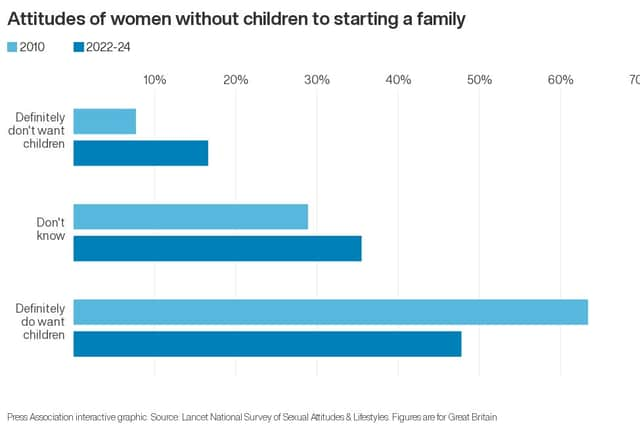
This trend was most obvious among young women, quadrupling among those aged 25 to 34 from 4% to 17%.
There was an increase in the proportion of women aged 16 to 44 without children who said they “don’t know” if they want children (from 29% to 36%).
Dr Laura Oakley, associate professor of epidemiology at LSHTM, said: “Our survey didn’t look at the reasons behind the increase in women saying they definitely don’t want children.
“Understanding what’s driving this – whether economic insecurity, climate anxiety or changing life priorities – should now be a priority for future research and policy, as it has real implications for planning health, care and family services.”
The new data comes from Natsal, which is one of the largest studies of sexual health and behaviour in the world.
It happens every decade across England, Scotland and Wales and more than 60,000 people have taken part to date, with around 6,700 in the most recent round.
The proportion of 16 to 44-year-olds who report ever having had sex with a partner of the same sex doubled among women (from 7% to 14%) and tripled among men (from 4% to 12%) over the past decade, with increases across all age groups.
For women, this continues a trend seen since 1990 but for men, it marks a new shift, researchers said.
Ms Clifton said: “The increase in reporting same-sex experience has been observed in similar countries to Britain.
“However, the size of the increase may be somewhat overestimated in our study because people who identify as lesbian, gay or bisexual appear to have been slightly more likely to take part in this latest survey than in earlier ones.”
Looking at the reports as a whole, Ms Clifton said: “Britain’s sex lives are changing.
“While most adults are having sex, people are having sex less often and more young people have never had sex.
“There is also a higher proportion of people reporting same-sex experiences, and online sexual activity is now part of everyday life for many.”
The papers found that use of hormonal contraception has declined among women aged 16 to 24 (from 65% to 50% over the past decade), while use of the hormonal coil rose from 4% to 10% across all age groups.
The human papillomavirus (HPV) vaccine given in schools has led to an 86% drop in young women in the two HPV types that cause most cervical cancer.
The proportion of women aged 16 to 54 who have had an abortion rose from one in six (16%) to one in five (21%) over the past decade.
Feelings of sexual wellbeing were measured for the first time, with low scores common among young people, as well as those in sexual and gender minorities and people on lower incomes.
One in seven women (14%) reported ongoing upset with others about things done to them in their sexual past, and one in seven men (14%) reported feeling shame about some of their sexual thoughts and desires.
Helena Wells, senior research manager at Wellcome, which has co-funded Natsal since its inception in 1990, said: “Natsal is uniquely placed to tell us about sexual behaviour across the British population and crucially what it means for people’s health.
“For more than 30 years, evidence from Natsal has helped inform national public health policy, shaping vital services from HPV vaccination to HIV prevention.”
She said the study “helps researchers in the UK and around the world to understand what drives sexual health outcomes that can ultimately lead to scientific breakthroughs”.