
Burnham pays tribute to Aberfan victims ahead of 60th anniversary

An entire generation was almost wiped out when 150,000 tonnes of coal waste slid down the hillside before engulfing Pantglas Junior School in 1966.
Prime Minister Andy Burnham has visited Aberfan and spoken to survivors and families ahead of the 60th anniversary of the disaster which killed 116 children and 28 adults.
An entire generation was almost wiped out when 150,000 tonnes of coal waste slid down the hillside before engulfing Pantglas Junior School on October 21 1966.
The disaster unfolded, following days of heavy rain, when excavated mining debris from the Merthyr Vale Colliery was dislodged and came thundering down the hillside.
The waste material had been piled high on the side of Mynydd Merthyr – above Aberfan – for years, even though there were numerous underground springs below.
Children in Pantglas Junior School were just getting ready for lessons when 1.5 million cubic feet of liquefied slurry crashed into the school and a number of nearby houses.
About half the children from the junior school died in the tragedy, which happened on the last day before half-term.
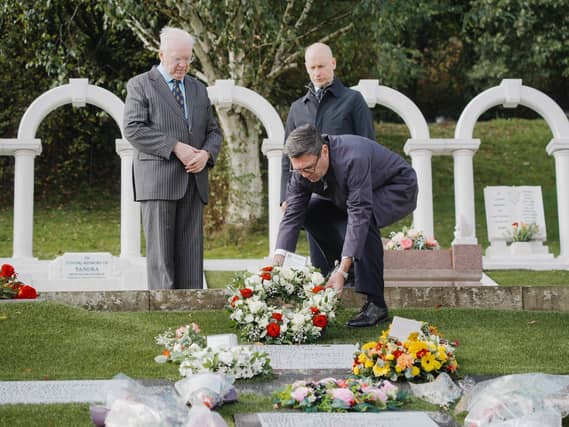
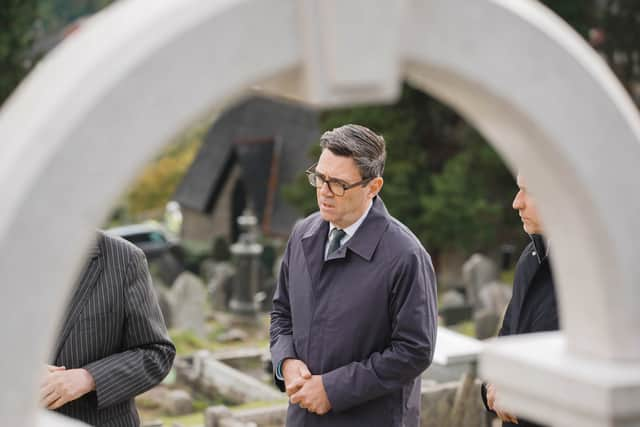
The Prime Minister visited Aberfan cemetery to see the area dedicated to those that died.
Accompanied by Stephen Kinnock, the Secretary of State for Wales, he met Jeff Edwards, who was the last survivor to be rescued from the wreckage of the school.
After seeing the distinctive white limestone and granite arch monuments, the Prime Minister laid a floral wreath, with a card that said: “We will forever hold the memory of Aberfan and its children in our hearts.”
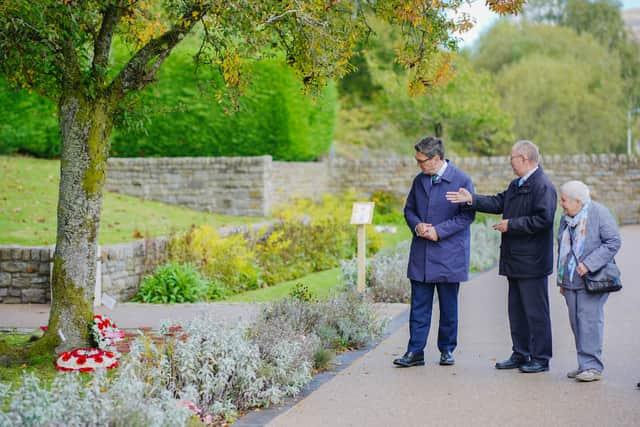
He then visited the Aberfan Disaster Memorial Garden, which is on the site of the former school.
There he spoke to David Davies, chairman of the Aberfan Memorial Charity, and Mair Morgan, the last surviving teacher from the school.
Mr Burnham then walked to the nearby community centre and met survivors and families of those who died.
He told one group: “It’s great honestly to be with you.
“I wanted to be here.
“It’s really important.
“I remember my mum and dad talked to me a lot about it.
“I was born just after.
“It impacted everyone in a very profound way.”
Coal bosses had been warned about “flowslides” prior to the disaster and, despite a 76-day public inquiry, no-one faced prosecution or lost their job.
Local residents were left with no choice but to take £150,000 from a memorial fund to pay for the clean-up bill.
This was eventually returned after decades of campaigning.
Speaking afterwards to broadcasters, Mr Burnham explained why he had decided to come to Aberfan.
“I felt it was very important to mark the significance of the anniversary on Wednesday,” the Prime Minister said.
“It’s been 60 years since one of the most horrifying tragedies this country has ever seen.
“All of those children lost.
“It was something that my mum and dad spoke to me about as I was growing up.
“So here to recognise the community, what the community has been through, but just in the community centre to thank them for being there for each other.
“The strength of the community today is something to see and something to feel.
“To say also to them, I don’t think Aberfan was treated properly by the authorities and that also needs to be recognised.
“Because at a moment like this, I think all of those things need to be said and it’s right that the Prime Minister is here to say that to them.”
The Prime Minister also said coal tip safety, particularly in former mining communities in South Wales, was of “critical importance”.

Landslips at Tylorstown in 2020 and Cwmtillery in 2024 have highlighted the risks associated with Wales’s 2,600 disused coal tips and the need for their continued management.
“Obviously, it’s of critical importance that we make sure that all of the remaining tips around Wales are safe, indeed across the country,” Mr Burnham said.
“I represent a former mining community myself, so I fully understand the importance of these issues.
“The UK Government is providing around £140 million to the Welsh Government and they are adding some extra funding themselves.
“The funding is there.
“There’s an organisation that is being set up to manage all of these ongoing risks.
“I can give you that commitment that, of course, we will make sure that all the right things are done to make all communities across Wales safe.”