
Galway East drainage scheme must be ‘hot on the heels’ of Ring Road go-ahead says Chief Executive


The Galway East Main Drainage Scheme must be “hot on the heels” of the N6 Galway Ring Road in order to open up land for housing and future development.
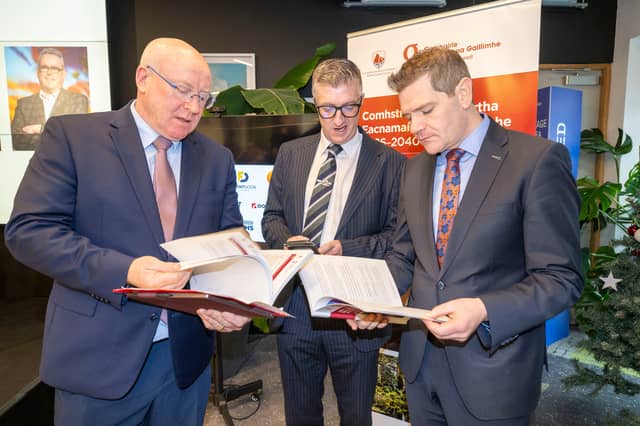
That’s according to Galway County Council Chief Executive Liam Conneally, who made the remarks at the launch of the first joint Economic Development Strategy by Galway City and County Councils, held at the PorterShed on Market Street.
While Mr Conneally welcomed progress on the N6 Galway City Ring Road, he said the Galway East Main Drainage Scheme was coming “hot on its heels”.
The scheme will provide a major upgrade to the city's wastewater network, creating much-needed capacity for new homes and businesses across Galway's eastern suburbs.
Led by Uisce Éireann, the project has been identified as vital to meeting the region's future development needs.
Addressing an audience that included Minister Peter Burke and Minister of State Noel Grealish, Mr Conneally said “significant lands” needed to be opened up for development.
“We need immediate activation measures,” he said. “Zoning land is one thing, the expensive piece is servicing.”
The importance of the Galway East Main Drainage Scheme is recognised in the Regional Spatial and Economic Strategy (RSES) for the Northern and Western Region.
It forms part of the Greater Galway Area Drainage Study, with Galway County Council previously stating that its delivery “would be a potential catalyst for the future development and expansion of the settlements (MASP) on the eastern environs of Galway city”.
Mr Conneally said the council would continue to press the Government on the project.
“We will be back to the Government in relation to the ask on that,” he said. “The ask will stand up from a business case point of view.”
Meanwhile, Mr Conneally said that, once the Ring Road is complete, it will define areas “inside and outside” the 18km route from Doughiska to Bearna, which features a mix of dual and single carriageway, two tunnels and a bridge over the River Corrib.
He also described the Galway City and County Joint Economic Development Strategy 2040 as a “collaborative document” that would be incorporated into the city and county development plans.
Joking that there was “no such thing as a free lunch”, he said he would “chase down” those responsible for delivering the actions listed beside their names in the strategy.
In a statement from Galway City Council, they said the “overarching vision of the strategy is that Galway will be a connected, competitive and sustainable economy that combines high-value enterprise, knowledge, innovation and a distinctive identity to support long-term prosperity across the city, county and wider region.”
“It treats Galway as one functional economy that links a growing city, its suburbs, county towns, and rural communities including the Gaeltacht areas. Galway is the main economic anchor for the wider area, so the strategy, whilst focused on Galway, will also be central for the wider Western region,” the statement read.
At the launch, Galway City Council Chief Executive Leonard Cleary described the strategy as a shared vision for the city and county.
He highlighted Galway's strong and diverse economic base and vibrant indigenous business community. He said the two councils “need to be deliberate” in developing a strategy that “reflects how Galway really is”.
Describing Galway city as the “driver of the economy in the west”, Mr Cleary said the city and county had a combined economy worth €16.4 billion.
He described the strategy as “very clear, well founded with a strong vision” to “maximise value creation”.
The strategy identifies infrastructure as a key condition for future growth.
It sets out plans to create more jobs and support Galway's economic growth up to 2040, covering both the city and county, including rural and Gaeltacht communities.
Galway is now home to almost 300,000 people, with its population growing by 16.8 per cent since 2017, ahead of the national average of 14.9 per cent.
Around 161,000 people are employed across the city and county, an increase of 42 per cent since 2014.
The strategy also highlights Galway's young and highly educated workforce, with 37 per cent of the population under 30 and almost half of adults holding a third-level qualification.
The strategy is built around five strategic themes to deliver the ambition, each with a clear set of actions and measures for tracking progress:
- A Distinctive and Connected City Region
- Infrastructure-Led and Investment-Ready Growth
- . A High-Value, Competitive Economy
- . Strategic Opportunities and Future Industries
- . Talent, Skills and Workforce Development
It identifies infrastructure as a key condition for future growth.
Speaking during a panel discussion, Professor Alan Ahearne, Head of Economics at the J.E. Cairnes School of Business and Economics at the University of Galway, said infrastructure was critical to attracting and retaining talent.
“There is a global battle for talent,” he said.
“Talented people want nice places to live and high incomes generate fund to make a place liveable.
“We want to be on the right side of that and infrastructure is critical. It makes a life more liveable.”
Funded by the Local Democracy Reporting Scheme.