
Ryan Tubridy 'considering' move into politics with Fianna Fáil 'dream' for Galway seat

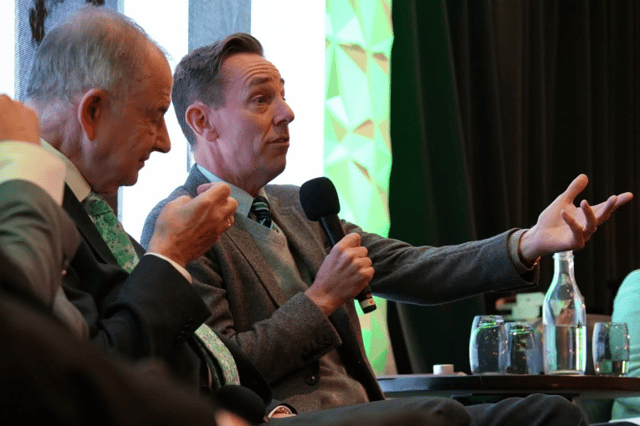

‘I am fascinated by politics, fascinated by public service and fascinated by Fianna Fáil as a political party, the ups and downs, the slings and arrows’
Broadcaster and ex-RTE star Ryan Tubridy has given his strongest indication yet that he may follow in the Fianna Fáil footsteps of his late grandfather, Dr Seán Tubridy, and his mother's family – the Andrews, where brothers David and Niall followed their father Todd into Dáil Éireann.
Speaking at the party's centenary celebrations in the Galway Bay Hotel in Salthill at the weekend, the former Late Late Show host made no secret of his fascination with politics or the possibility of one day entering the political arena himself.
He was taking part in a panel discussion entitled 'From Revolution to Representation: The Pioneers of Fianna Fáil in Galway West', alongside former Ministers Éamon Ó Cuív and Frank Fahey, historians Prof Gearóid Ó Tuathaigh and Brian Murphy, and moderated by RTÉ's Mary O'Regan.
Asked by Ms O'Regan whether he would consider a career in politics, Mr Tubridy left the door firmly open.
“How can I not?” he told the packed gathering.
“This bloody politics is coursing through my veins. I've got Andrews on one hand and Tubridy on the other.
And there is no shortage of political pedigree on the Andrews side of the family either.
His maternal grandfather was Todd Andrews, a veteran of the War of Independence, while his uncles David and Niall Andrews both served as Fianna Fáil TDs. His first cousin Barry Andrews also served as a Fianna Fáil TD and Minister of State before becoming an MEP.
Seán Tubridy represented Galway in Dáil Éireann from 1927 to 1932 and Galway West from 1937 until his death in 1939.
“It's unavoidable,” he continued.
“I am fascinated by politics, fascinated by public service and fascinated by Fianna Fáil as a political party, the ups and downs, the slings and arrows.
“Some people go to the sporting ground and watch football. I follow politics.”
He drew laughter from the audience as he imagined the headlines should he ever decide to contest an election.
“Deputy Tubridy” in “Galway West, reclaiming his grandfather's seat on the second count,” he said with a smile. “Every night of my life I go to bed dreaming 'some day'.”
Mr Tubridy also recalled how a remarkable twist of fate had saved his grandfather's life when he first arrived in Connemara to take up a position as a GP in Béal a' Daingin, near Casla and An Cheathrú Rua.
Arriving a day early, the eager young doctor wanted to begin work immediately but was persuaded to wait until the following morning.
“He was told to go and find his lodgings and 'we will see you tomorrow',” Mr Tubridy recalled.
The retiring GP had arranged to visit a seriously ill patient on an island off the Connemara coast.
“That lovely doctor said he was going to an island to look after some people who were not well and say goodbye to them,” Mr Tubridy continued.
“He went off to the island and he minded them and he said his goodbyes.”
Having completed his visits, he boarded a currach with two boatmen for the return journey to the mainland.
Tragically, the currach sank during the crossing and all three men lost their lives.
It was a tragedy that brought home just how differently things might have turned out had his grandfather started work that day.
“If my grandfather had gone on the boat there would be a spare chair here today,” he said. “Such is the vagaries of life.”
There was a lighter side to his grandfather's time in Connemara too, with Mr Tubridy entertaining the gathering with the story of the famous “Tubridy Stones”.
As a popular local GP, Dr Seán Tubridy was among the few people in the area who owned a motor car, although his driving was apparently less than assured.
According to local lore, the doctor was occasionally offered a drop of poitín, which was particularly strong in those days, and his driving ability became a source of some concern.
“The poor fella wasn't great behind the wheel and the poitín was strong.” said Mr Tubridy.
The story goes that locals took matters into their own hands, painting stones along one side of the road white so that the headlights of his car would pick them out and guide him safely home after dark.
The stones became known locally as the “Tubridy Stones”, a name that has survived down through the generations.
“I asked if this story was true,” explained Mr Tubridy, “and was told that, if you look closely you will see the peeling paint on the stones.”
Taoiseach Micheál Martin also paid tribute to Dr Seán Tubridy during his address to the centenary gathering, recalling his contribution to the community and to the early years of Fianna Fáil in Galway.
“Amongst our first TDs was Dr Seán Tubridy, a gaelgeoir of note but also a community doctor respected everywhere he went,” he said.
Having already received the Freedom of Clifden and Connemara in July 2011, Ryan Tubridy's connections to the locality stretch back even further.
His great-grandparents, Patrick and Jane Tubridy, were teachers at Scoil Mhic Dara in An Cheathrú Rua and worked with Roger Casement in 1913 to help provide free school meals for children living in poverty in the area.
With his wife, Dr Claire Kambamettu, also in attendance, Mr Tubridy offered the audience a glimpse into his own family life and his hopes for the next generation.
“I have two daughters aged 27 and 21,” he said.
“And I have some news to share with you another time.
“The main thing is that we have these two young women in my life who are interested, curious, smart and not cynical and not anti-politics.
“If you read the papers today you wouldn't think this room would be jammed full of people from Fianna Fáil.
“It is really inspirational for my daughters. Politics can be messy, careers can be messy - who are you talking to!
“Young people get a bad rap. Young people are the future. They are brilliant.”
Mr Tubridy also spoke of a renewed interest in Irish identity, particularly among younger generations.
“There is something happening in the country. Irish identity has been taken back,” he said.
“There is something shaking in the younger people.”
Funded by the Local Democracy Reporting Scheme