
Chemistry Nobel Prize awarded to duo for research solving ‘mirror image’ mystery
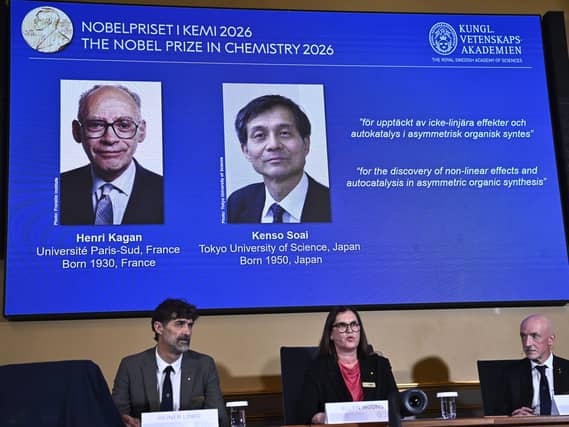

Henri B Kagan and Kenso Soai’s discoveries were said to have been ‘decisive for chemists who design reactions for the manufacture of pharmaceuticals’.
Scientists Henri B Kagan and Kenso Soai have won the Nobel Prize in chemistry for untangling mysterious mirror images in molecules, a discovery that has been used to develop countless drugs and transformed modern medicine.
Many molecules of life come in versions that look alike but are not exactly identical, such as right and left hands. One mirror-image of the chemical carvone smells like mint, for example, while the other smells of caraway.
Even life itself prefers one mirror image over the other. DNA twists to the right, and the proteins in human bodies are made of mostly left-handed building blocks.
Versions of the same molecule can behave differently when interacting with other chemicals.
When designing drugs to treat diseases, scientists want to select which mirror-image they are getting. They want the version of a molecule that will treat a cold, not the kind that will make symptoms worse.
Professor Kagan and Professor Soai found ways to make chemistry pick a side, designing and manipulating reactions to produce the desired mirror-image.
“This is probably the coolest experiment in organic chemistry,” Peter Somfai, a member of the Nobel Committee for Chemistry, said.
“Taken together, the groundbreaking discoveries by Henri Kagan and Kenso Soai have reshaped our understanding of molecular chirality — how it is created, amplified and transmitted.”
“Chirality” comes from the Greek word for “hand”.
In the 1980s, Prof Kagan’s work showed there might be a way to design reactions to produce one form of a molecule over the other.
Years later, Prof Soai brought that dream to life. He created the first chemical reaction to produce only one of a molecule’s mirror images.
“Other than life itself, no-one had previously achieved this feat,” the committee said in a news release.
“It might be difficult to say that this drug, or that drug, was developed using this,” Professor Somfai said.
“I would say all of them, because we use this as a tool, we use this as an understanding, how to develop catalysts, how they function.”
“The medicines we have today would not be possible without this chemistry,” Rigoberto Hernandez, president of the American Chemical Society, said.
In addition to developing better medicines or perfumes, deciphering the mirror images of molecules can help scientists understand the chemical architecture of life, chemist Holden Thorp, editor-in-chief of the journal Science, said.
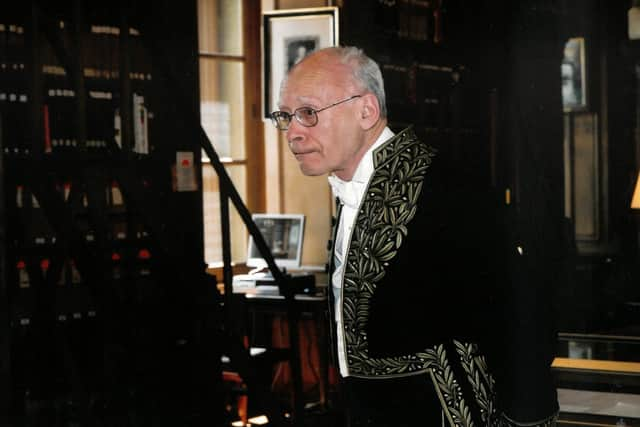
The French Academy of Sciences, where Prof Kagan is a member, congratulated him, as did French President Emmanuel Macron, who called the prize “an immense source of pride for the country” and “a recognition befitting a lifetime of research”.
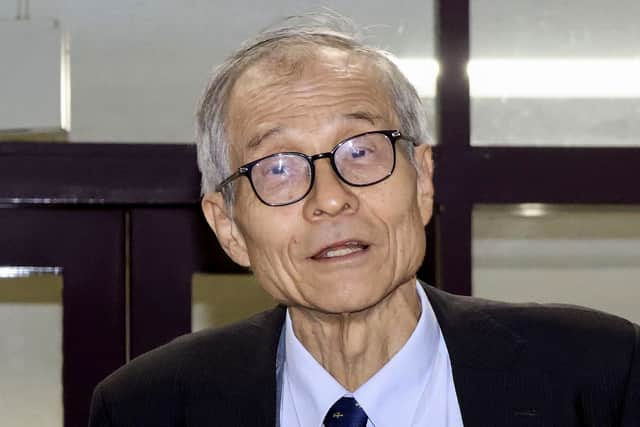
“I’m very excited to receive the very nice news,” Prof Soai told the committee and journalists by phone.
“Of course this is one of the most exciting days in my life.”
Prof Soai said he was shopping near his home when he was contacted by the Nobel committee.
“There are still fascinating aspects that remain unknown and surely more yet to be discovered,” Prof Soai said at a news conference hosted by his university in Tokyo.
“I hope to do what I can, however modestly, to contribute to help advance research in this field.”
Japan’s largest newspaper, Yomiuri, distributed an extra edition with a headline proclaiming “Nobel Prize Mr Soai”, with a large photo of the scientist.
The Royal Swedish Academy of Sciences announced the winner in Stockholm.
Last year, three scientists won the chemistry Nobel for their development of new molecular structures that can trap vast quantities of gas inside, laying the groundwork to potentially suck greenhouse gases out of the atmosphere or harvest moisture from desert environments.
This year’s prizes began with the Nobel for medicine, awarded on Monday to three scientists whose work led to a tool that uses light to help unravel how the brain works. The physics award on Tuesday recognised a scientist’s efforts to demystify a rare group of neutrinos.
The literature prize is set to be awarded on Thursday. After Friday’s peace prize is awarded, the Nobel Memorial Prize in Economic Sciences will be announced on Monday.
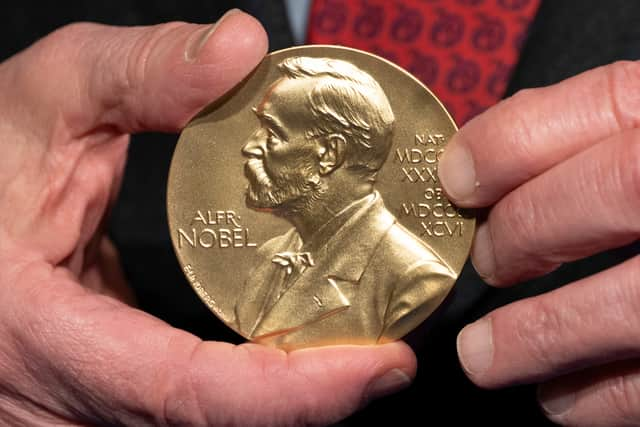
The prize money this year is 12 million Swedish kronor (about £905,000), whether for an individual, a small group of laureates or an organisation.