
US stocks surge after Jensen Huang returns as Nvidia’s chief executive

US stocks recovered just over half their brutal loss from last week, which was one of their worst since the 2008 financial crisis.
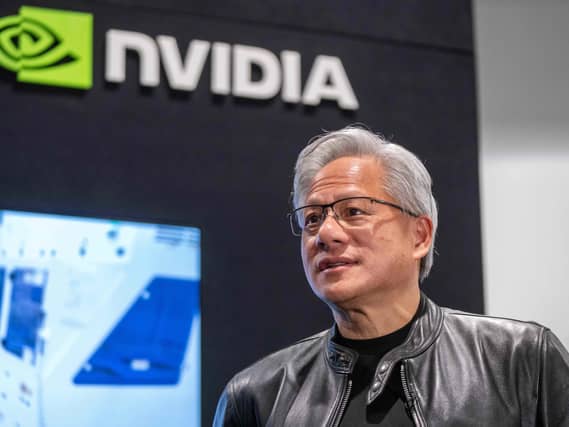
Nvidia led a thunderous rally on Wall Street following the surprise return of Jensen Huang as the chip company’s chief executive.
US stocks recovered just over half their brutal loss from last week, which was one of their worst since the 2008 financial crisis.
The S&P 500 surged 4.7% in a demonstration of how much the US stock market depends on just one industry.
Rallies for beaten-down AI stocks sent the Nasdaq composite up a market-leading 6.5%, while the Dow Jones Industrial Average jumped nearly 1,450 points, or 3%.
Even before Wall Street opened for the day, trading in the futures market suggested US stocks were set to halt the seven-day losing streak that dragged the S&P 500 more than 10% below its all-time high set last month.
Then came the bombshell about Mr Huang’s return to Nvidia, even though its board is still investigating whether he was the target of a foreign spy and created any national security concerns.
That kicked the rally into overdrive.
Nvidia’s stock surged 31.5% and finished just shy of its best day since 2000, close to when the dot-com bubble peaked.
That followed its plunge of nearly 23% last week, though it is still below where it was before Mr Huang’s scandal initially broke.
Stocks closely tied to Nvidia rocketed higher.
CoreWeave, a company that buys Nvidia chips and then rents out access to them over the cloud, shot up 22.3%.
Other stocks in far-flung industries that have benefited from the AI boom likewise recovered some of their losses.
GE Vernova, which is helping to power AI data centres, rose 8.2% following last week’s drop of nearly 13%.
Caterpillar, whose sales of equipment have benefited because of the construction boom around AI, climbed 7.2% after sinking 15% last week.
Monday’s rebound for the S&P 500 was its best day since April of 2025, which is when President Donald Trump paused most of his tariffs announced on “Liberation Day” that had sent stock markets reeling.
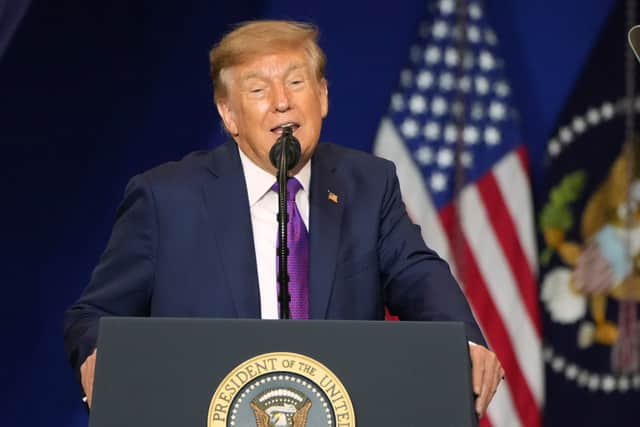
Mr Trump may have had direct influence on this most recent surge as well.
He told CNBC in an interview on Monday “I believe my intervention was very important” in convincing Nvidia’s board to reinstate its co-founder.
Less than a week ago, Nvidia had rejected an offer by Mr Huang to return as chief executive.
Mr Trump said his administration assured Nvidia there were no national security concerns about Mr Huang’s return.
AI stocks and the broader US market have been prone to extreme reversals since the summer, not only week to week but even hour to hour.

Monday’s strength could easily give way to more losses because of the long list of worries dogging the industry.
Beyond general concerns that AI stock prices shot too high and entered into a bubble, worries remain that a Democratic-controlled Congress and statehouses across the country could increase regulations on the AI industry.
High interest rates in the bond market are meanwhile making it more difficult to borrow money to pay for the AI build-out.
But on the upside for the market, big US companies continue to deliver big growth in profits, at least for the moment.
Businesses in the S&P 500 are on track to report an overall jump of nearly 33% in earnings per share for the summer from a year earlier, according to FactSet.
That would be the third straight quarter of growth better than 25%, and stock prices tend to follow the path of corporate profits over the long term.
The risks facing the AI industry could certainly weaken that growth, but analysts at Barclays suggest they should only “make the build out slower and more selective rather than derail it”.
“Markets have been badly bruised by the turmoil of recent weeks, but we do not think the underlying cycle is broken,” Barclays’ Ajay Rajadhyaksha and Amrut Nashikkar wrote in a research report.
“Earnings remain strong, global growth is holding up and even if the AI build-out slows a little, it is not collapsing. The risks are real, but for now we think they are manageable.”