
Man proposes with ‘first and only diamond cut in space’ after launching homemade probe into stratosphere with balloon
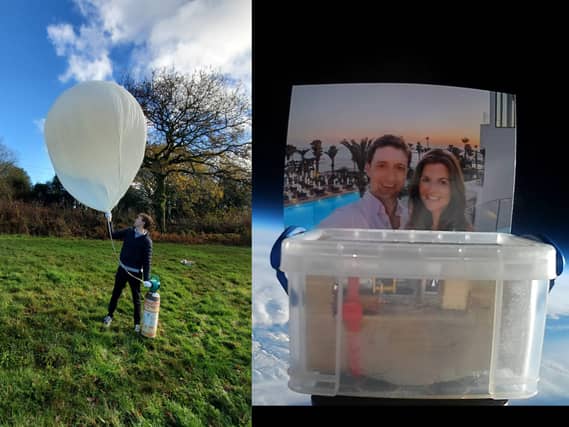

Paul Dedross conducted his own private space mission to create a ‘unique’ ring with a diamond cut in space.
A man proposed to his fiancee with what he believes to be “the first and only diamond known to have been cut in space” after launching a homemade probe into the stratosphere, filming the flight with a GoPro.
On November 29 2025, Paul Dedross, 40, a software architect from Frimley in Surrey, conducted his own private space mission, launching a homemade diamond-cutting rig beyond the upper atmosphere by helium balloon.
Paul launched the balloon through controlled airspace from Wales and then waited, “naively optimistic”, to retrieve the probe, which landed in Cambridgeshire around two-and-a-half hours later.
He had to seek permission from the Civil Aviation Authority and Ministry of Defence and said the probe, which featured a picture of the couple, reached a maximum altitude of around 38km above the Earth’s surface.
Ellie Dedross, 36, a solicitor, was later given a wooden box, made by Paul, which read aloud a series of riddles at different locations, before it opened at the final destination and revealed the ring.
Ellie was “very emotional” during the proposal on January 10, but was astonished to learn afterwards that the diamond had in fact been to space and back.
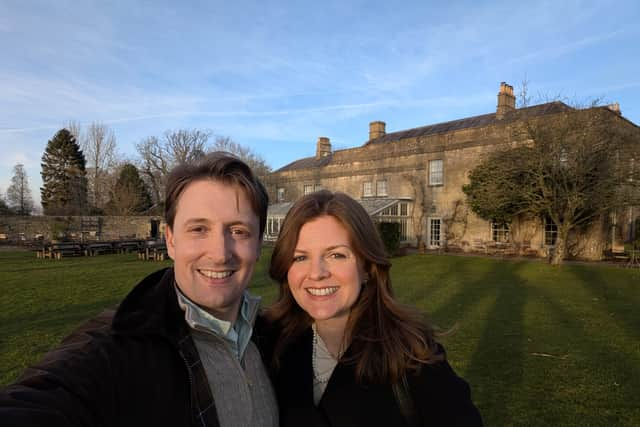
“The proposal was amazing as it was… and then he said: ‘This diamond has been to space’,” Ellie told PA Real Life.
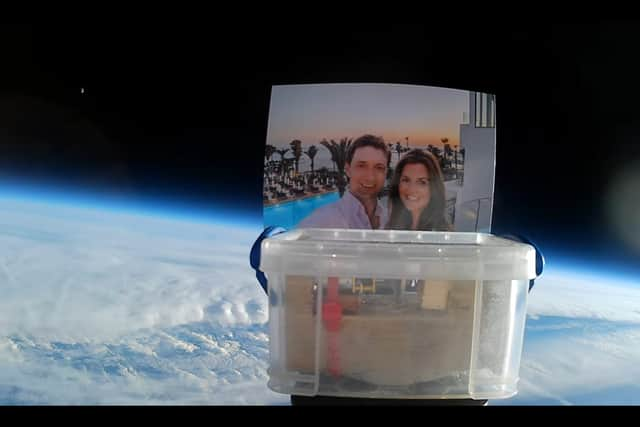
“I just could not believe what he had done and then he showed me the video of it in space, and there’s this picture of us in space. I find that footage so beautiful.
“I just couldn’t stop crying because I thought it was so amazing.”
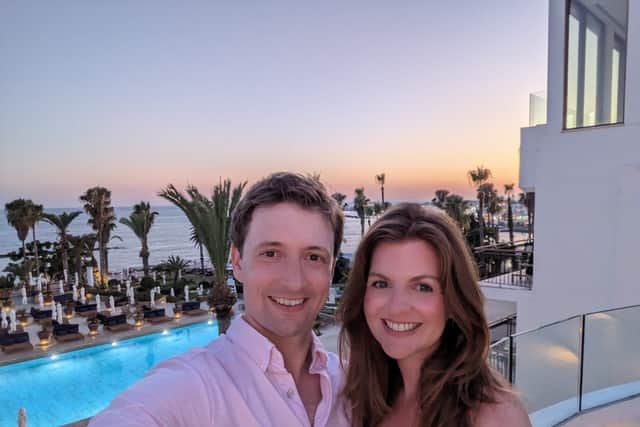
Paul and Ellie met through the dating app Hinge in 2022 and went to a pub in London for their first date.
Although the pub had “zero atmosphere”, they said they “hit it off” instantly and their relationship progressed quickly.
Ellie said: “We were there on a Tuesday night, and the lights were on and there was zero ambience, but we basically just stayed there ’til closing.
“It was lovely in its own little way.”
Paul said he knew almost “immediately” that he wanted a long-term relationship with Ellie and, after moving in together, proposing was on the cards.
Then, in the summer of last year, Paul started formulating his “elaborate plan”, which he worked on “secretly” for six months.
Ellie said: “I wasn’t aware of any of it; I had no idea what he was doing.
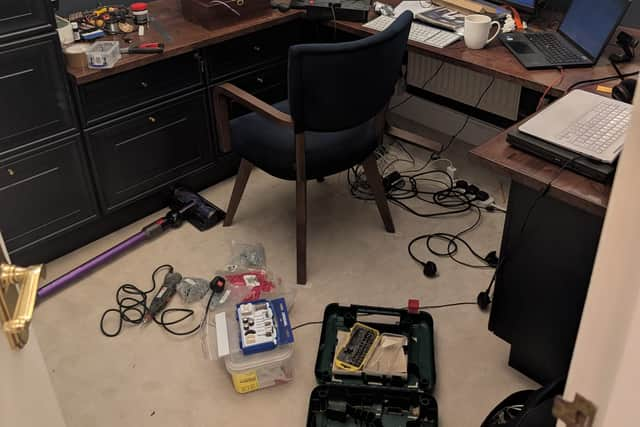
“Occasionally, he was working late, but I just thought he was working. I didn’t think he was building stuff in his office.”
Paul’s initial idea involved building a wooden box “full of clever electronics” – known as a reverse geocache – which would only open with the ring once taken through a sequence of pre-programmed locations.
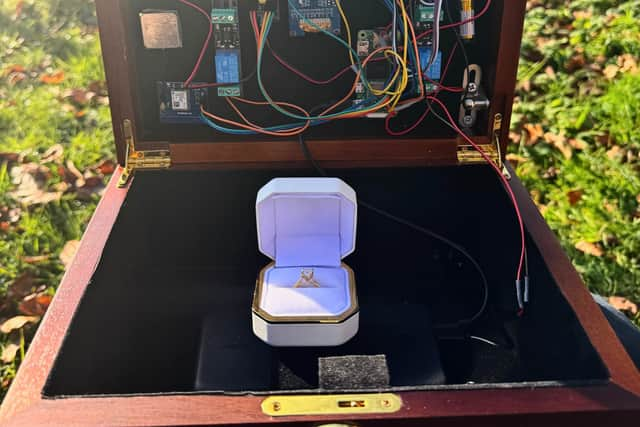
On top of the box, he built a screen, which would show and play a riddle out loud at each location and, once Ellie reached the final destination, the box would open, singing Bruno Mars’ 2010 single Marry You.
“I built the box, and that took a whole load of effort, but then as I finished that, I had a panic at the end, about whether it was special enough,” Paul said.
This is when Paul realised he wanted the ring itself to be “special and unique and have a story to it” – but he did not want to go down the custom route of an engraving, for example.
He said he had the idea of making a ring which was “a first of its kind in some sense”, and this led him to think: “So far as I could tell, there haven’t been any diamonds ever cut in space.”
“I was thinking of diamonds and stars, and, on some deep psychological level, I must have linked the two things,” he said.
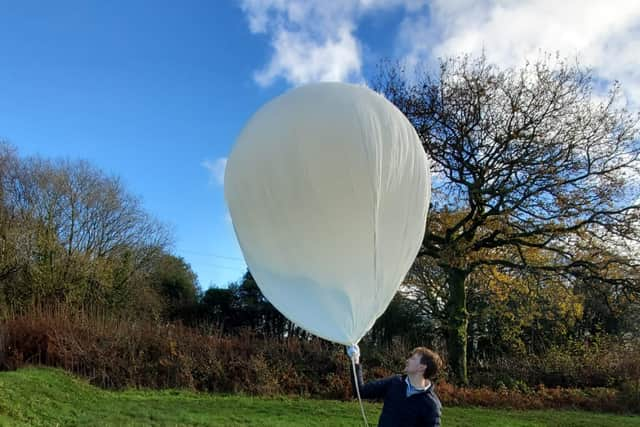
Paul then started doing his own research, which led him to discover he would need a sealed, latex balloon filled with enough helium to lift the probe into space, along with some form of location tracking.
He then completed some calculations to figure out the balloon’s path, looking at factors such as the jet stream and wind speeds at different altitudes.
“On the particular weekend that I had available to me, which was the only weekend I had when Ellie wasn’t around, the day before it would have ended up in Svalbard, on the ice sheets north of Norway,” Paul explained.
“So, that would have been totally unrecoverable without launching a massive mission.
“Then the day after I did it, it would likely have ended up in the Atlantic at the same latitude as Spain, so again, totally lost.”
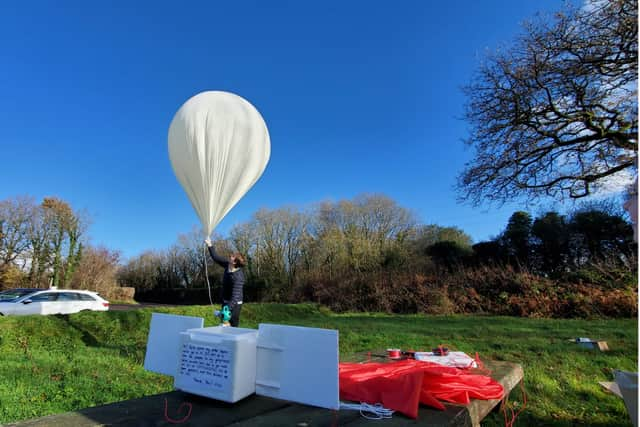
Paul had to ensure the electronics would survive in the near vacuum of space, and he attached a GoPro to record the flight, along with a picture of him and Ellie and a note with his contact details.
He filed down a 2p coin to create the “cutting disk”, adding diamond lapping paste to the surface, and mounted this to an “electric motor that was fitted with a tiny gearbox” to cut the diamond in space.
Paul said he additionally had to seek permission from the Civil Aviation Authority (CAA) and, by extension, the Ministry of Defence (MoD).
His application to the CAA read: “The purpose of the flight is to capture video footage of the ascent of a diamond into the stratosphere, which is a subsidiary component to a broader scientific experiment exploring the effects of space diamonds on my girlfriend.”
Paul said the CAA granted permission within 24 hours, and he drove to Wales on November 28 to build the probe before launch day, but he soon realised he did not have the diamond and had to drive back to Frimley and to Wales again.
With three hours of sleep, Paul then launched the probe from Kilgwrrwg in south-east Wales, near Chepstow, at around 1pm on November 29, with his calculations predicting it would “touch down somewhere north of Milton Keynes”.
After a total flight time of two hours, 35 minutes and four seconds, it landed in Stilton, Cambridgeshire, at around 3.35pm, and Paul received a phone call from a local who had discovered it, saying: “‘Hello there, I think I’ve got something that belongs to you…”
Paul said: “At the point of launch, I thought the odds of me seeing that diamond again are very slim.
“I’d never done anything like it before, the whole set-up was completely experimental, and I didn’t even know if the calculations were right.”
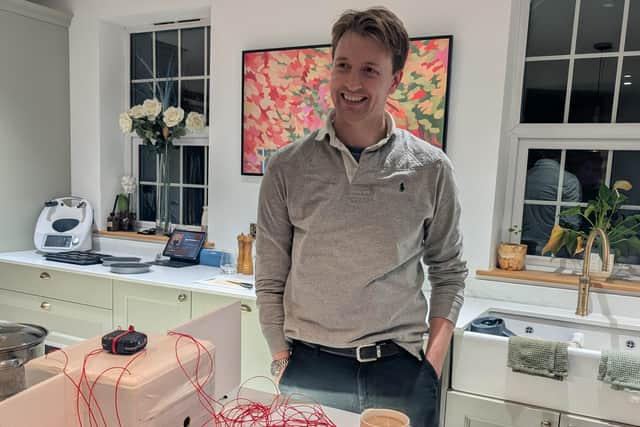
Paul said the diamond reached a maximum altitude of around 38km above the Earth’s surface, with the balloon expanding to the size of two or three cars.
For reference, commercial airlines fly at around 9km to 12km, and the Lockheed SR-71 Blackbird, referenced by the Imperial War Museums as the highest-flying and fastest military jet aircraft in history, operated at an altitude of around 25km.
Paul said he arrived at the landing site at 7.14pm, where he was greeted by the stranger who had recovered the probe for him, and then drove to his parents’ home in Essex.
He said: “(Having the diamond back in my hand) is what I imagine it must be like to win the lottery, or what an Olympian must feel like when they win a race against all the odds.”
After collecting the diamond, he subsequently set it himself in a ring he had designed, which was cast in a custom gold alloy, and he placed the finalised ring in the reverse geocache wooden box.
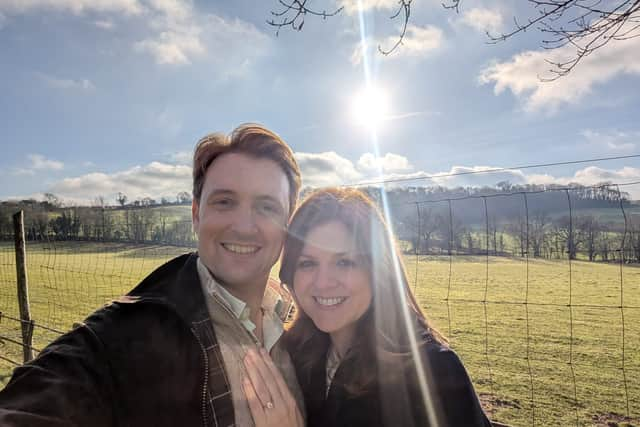
Ellie then completed the riddles, taking the wooden box to five locations over a period of several days, with the final location being The Pig-near Bath – a hotel they both loved for its beautiful natural surroundings and cosy fireside character – on January 10.
“I’d been carrying this box around… but I didn’t realise the ring was in the box the whole time,” Ellie said.
“So, when it then opened and the ring was just in there, and then Paul got down on one knee, holding the box… it was all very clever.
“The easiest ‘yes’ in the world.”
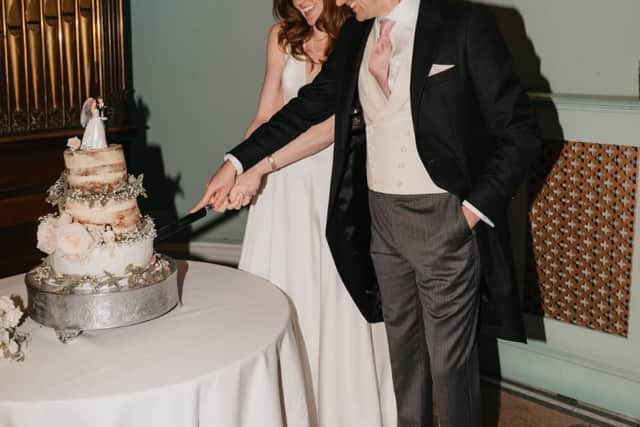
The couple married on June 13 this year in Bristol, with less than six months to plan everything, and they said it was their “happiest day”.
They then flew to Mauritius for their honeymoon for 10 days and have been enjoying life as a married couple since.
Ellie said the ring is “priceless” to her, and she still cannot believe the effort Paul put into the proposal.
“I feel very lucky, and it’s just lovely that (the ring) has its own story, so it makes it unique,” Ellie said.
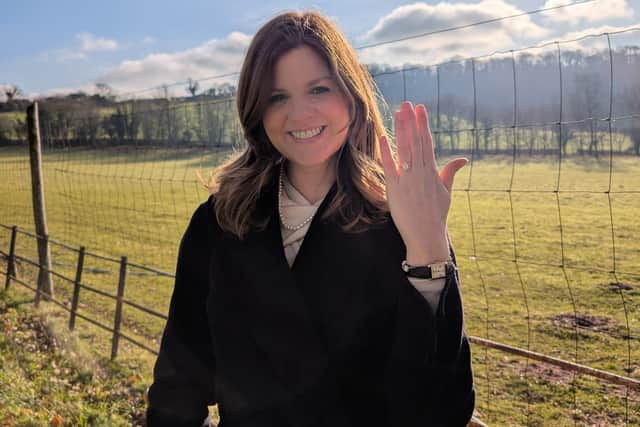
When asked what they would advise others planning a proposal, the couple suggested that it does not have to be elaborate, it is just the “the thought behind it” that makes it “special”.
Paul added, jokingly: “Don’t over-complicate it and don’t forget the diamond.”
A UK Civil Aviation Authority spokesperson said: “As the UK’s aerospace regulator, we work with a range of innovators operating in UK skies, including those want to create the perfect proposal by sending an engagement ring into a new atmosphere.”
To view the space flight, visit: youtube.com/watch?v=TXu_BW1aFA8&t=5630s.