
Malachy’s journey from west Limerick village to Big Apple journalism!

FROM his native Broadford to The Big Apple to the military bases in Gaza, you could find Pulitzer Prize - winning journalist Malachy Browne anywhere.
Today, he's in the Limerick Leader / Limerick Live offices. And he's brought some sweet treats.
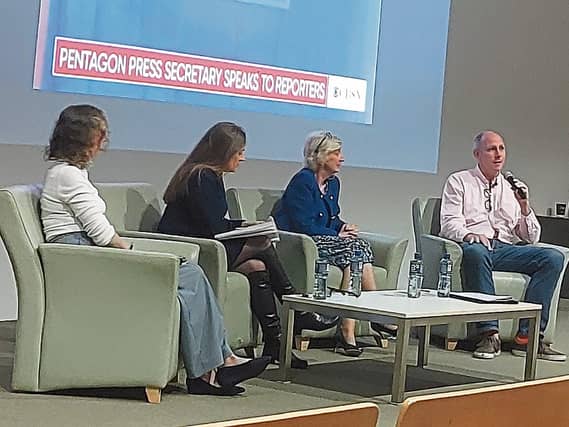
The Emmy Award winner is back in Limerick for ‘Joining the Dots: New frontiers of investigative journalism’, a seminar, part of a media series organised by the Journalism Department of the University of Limerick and funded by UL 50.
That took place in front of a full house and the following morning he walks in the doors of the Limerick Leader / Limerick Live with a very American brown paper bag containing Cadbury Dairy Milk Fingers.
Despite working at one of the most prestigious news organisation, The New York Times, Malachy still gets nervous when talking to an audience – but no one would ever guess.
“It was a little nerve wracking at the start because you're in front of your home crowd. But it was wonderful to meet the journalism students. It’s a trip down memory lane because it's been 15 years since I left.”
After completing his education in St Munchin’s College, Malachy studied engineering in UCD before completing a masters in international relations in UL.
He found his way in journalism after living with his uncle and journalist, Vincent Browne, who is currently wrapping up his latest book. Although, for him, things clicked after seeing an interview with Mary Robinson.
“I was deciding whether I would go back and do a masters. I remember her in an interview saying, “try to find something you think is worthwhile to spend your time doing,” he remembers.
Even though Malachy now lives in the States, he comes back to Limerick every summer with his wife and their three children to see his parents Mary and David, sister Susan and her family.
“My wife Siobhan is from County Limerick as well, so we come back to Limerick every summer for about two months and I work from here.”
Five years ago, Malachy started working as a senior story producer on the Visual Investigations team at The New York Times. Combining traditional reporting with digital sleuthing and forensic analysis, the reporter deconstructs important news events. Does this type of reporting help restore the public’s trust in media?
“I think it very much helps to have clear, concrete evidence supporting your conclusions about any particular event. What we try to do in our video documentaries is to explain why we're using certain evidence to explain the context around it. But also to kind of walk people through the evidence and how we're arriving at our conclusions, how it answers fundamental journalistic questions,” he says.

What was the most challenging investigation to work on?
“One that was quite difficult was the shooting of Rouzan al-Najjar by the Israeli military in Gaza. She was a volunteer medic, whom all her life wanted to be a doctor. She was on the protest fields attending to wounded people when she was shot. In that story, we didn't witness it ourselves, but we were able to go to Gaza, meet people and collect around 1,300 photographs and videos from the phones of witnesses who were there.”
Does he ever fear for his safety? “We've got a fairly robust security presence, I don't feel that there's any sort of threat to me. The worst thing that happened to me was soldiers firing tear gas at us in Gaza.”
As the reporters on his team often have to watch graphic content, he says they are provided with professional support, at all time. “We’re acutely conscious of it on our team because they're watching traumatic material and war crimes. So, we’ve brought in psychiatrists to talk about how to look out for signs of secondary trauma and methods that can minimize that.
“I think the important part of that for me was understanding what's a natural response to this, and when does it become a problem? When does it become trauma?”
Would he ever consider moving back home?
“We miss home and definitely we would like to come back here at some stage in the future. I don't know how my career would continue here. It depends on what options are available to me and where we end up,” he says.
“I think in Ireland, we haven't really shifted to understand that journalism costs money and that we need to pay for it. I think that we might be trailing behind some other countries in terms of having sustainable financial models and being able to resource in investigative journalism,” he concludes.
As the conversation comes to an end, Browne answers who would be sitting at his table, if he could have dinner with anyone – dead or alive.
“I'd love to meet my mother's father, who died before I was born. His name was George O'Mahony. He lived in Abbeyfeale, in County Limerick. He was by all accounts a larger than life character.”