
KILDARE WILDLIFE WATCH: Peregrine thought to be fastest animal on planet

Nuala Madigan from the Bog of Allen Nature Centre
It is not often you get close to a bird of prey however recently the Irish Peatland Conservation Council hosted Newgrange Falconry at the Bog of Allen Nature Centre for International Bog Day.
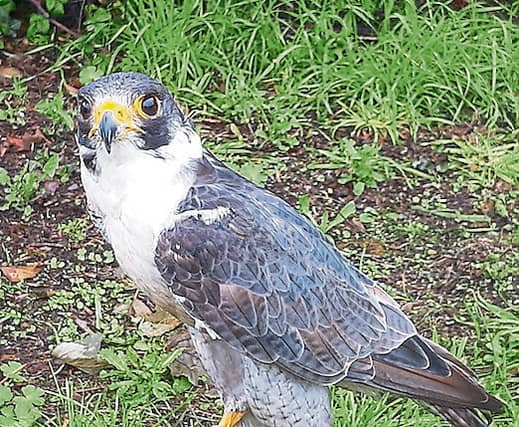
One of the birds on display was the Peregrine (Fabhcún gorm as Gaeilge). This is one of Ireland’s native wild birds of prey. It is a type of raptor meaning that when feeding Peregrines swoop down on their prey.
Reading more about Peregrines on the website of BirdWatch Ireland I learned that Peregrines are thought to be the fastest animal on the planet, as it swoops to catch its prey it can reach speeds an impressive 300km/hour.
At this speed it is thought the prey is killed instantly from the impact of the legs grabbing the prey, with the prey being smaller birds both those found on land and water.
The Peregrine females are larger than the males however both have similar features. Both the male and female have a blue-grey body, their head is black on top with a white face and throat and what looks like a black ‘moustache’ that contrasts, the beak is hooked, the tail is medium length and barred and the upper breast is white with the under parts barred.
Peregrines are known to build their nests on cliffs around the coast and on rocky faces in the uplands, however it is also known that peregrines may be found nesting more inland in places such as quarries, high rise buildings and even construction cranes. Like many birds of prey the Peregrine population declined seriously in the 1950’s and 60’s and this decline is attributed to pesticide poisoning.
Today the population of Peregrines has recovered and their conservation status is recorded as green.
I don’t know if you will come across a Peregrine in your community this week but look to the sky and if you observe a bird circling and then suddenly appears to swoop fast to the ground it may just be one.
Don’t forget if you come across a wildlife species that you would like help identifying I would be happy to help, contact me at [email protected].