
Laois harvest starts early in heatwave on 'completely dry' land

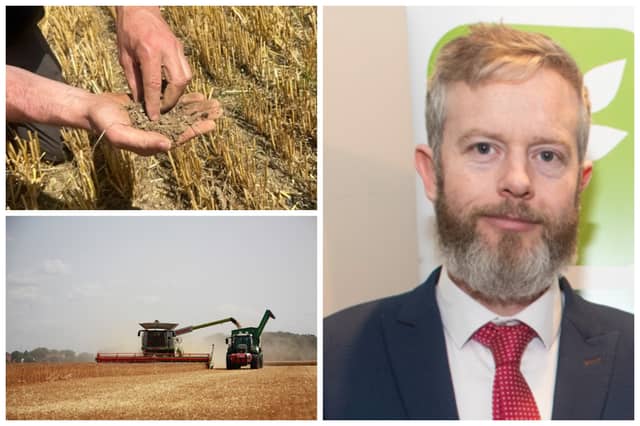

Laois tillage farmer Clive Carter talks to RTÉ about how the weather has allowed an early harvest
Tillage farmers in Laois are making the most of the heatwave by getting an early start to the 2026 harvest on what a soil expert says is ‘completely dry’ land in the county.
The impact of the hot and dry conditions on this year’s growing season was revealed in Ratheniska, where local farmer Clive Carter spoke to RTÉ about starting his winter barley crop in early July.
"We've had a good run of weather, so it's great to get going at it," he said. "We usually kick off around mid-July here on the farm. This year and last year were a little bit earlier. We were 10 July last year, and we're a few days earlier, 8 July this year.
"We're very lucky that we have a couple of good weeks at the minute to get through it, and you can take the foot off the gas a little bit."
The Laois farmer said unsettled conditions, which have hit tillage farmers in recent years, have hit the harvest.
"In broken weather, you're battling to try and get a few tonnes every day, it's just stop-start and difficult. But when you have a good run like you do now at the minute, it's easy to get it all done at your leisure ... it's bringing the crop in a little bit faster, but it's counteracted by the fact you can get through the work and get it done," said Mr Carter.
Mr Carter, who grows on land that has hosted the National Ploughing Championships seven times, said that changing weather patterns in recent years were "partly" the reason why he moved towards winter crops.
"So we're getting them in earlier in the autumn, and you're getting more days like this to get the crops out. We were suffering from a little bit of drought. The spring crops, if we didn't get them in time, were suffering from drought, and the winter crops are a little bit more drought-tolerant," he said.
He also said that he has adapted by growing more cover crops to build more soil structure to retain moisture during dry periods, but not store as much moisture during wet periods. He added that chopping straw and adding organic fertilisers are other methods he has adopted to help improve the soil.
Crops trying to grow have a deficit of moisture, says Teagasc Crop Specialist Shay Phelan, who also spoke to RTÉ at the Carter farm. He said that there was no moisture in the soil.
"There's literally no moisture in it whatsoever... It's completely dry. Crops that are trying to grow in areas that have a deficit of moisture," he said.
Mr Phelan noted that Laois is a particularly dry part of the country now and that other parts of the country are probably not as bad as this, but getting drier due to the weather. MORE BELOW PHOTO.

"What that means is that you get volatility in the crops or in the production of the crops that we grow. We get years when we might get close to 2.5 million, but then there are other years where we get less than 2 million, and that's a very difficult challenge to try to overcome in any given year. If we look at what other countries do, they put in infrastructure to try and get over this,” he said.
Mr Carter, who is also a member of the Irish Grain Growers' Group, said the rise in tillage incomes revealed in 2025 Teagasc Farm Survey does not tell the story of what farmers are experiencing.
"This is the fourth year in a row of a real struggle for farmers - usually you might get one or two bad years but this has been a tough run for the tillage industry," he said.
He called out the importation of cheap grain.
"Here we have a carbon-neutral crop of oats, and there's someone able to land it at the port all the way from deforested land in South America and we're told you have to compete with that. We've extra regulations every year, extra hoops to jump through, and it's just becoming unsustainable and unbearable for farmers to try to compete on a global scale when we have this positive image, but we just won't get rewarded for it," Mr Carter told RTÉ.
Met Éireann reported on July 13 that there is a restriction to growth in many parts of Leinster and Munster with moisture deficiencies increasing nationwide over the coming week. It said growth will become increasingly restricted across Leinster, Munster and the Midlands.