
'Immense gem': Big plans ahead after Longford's recently uncovered river secrets


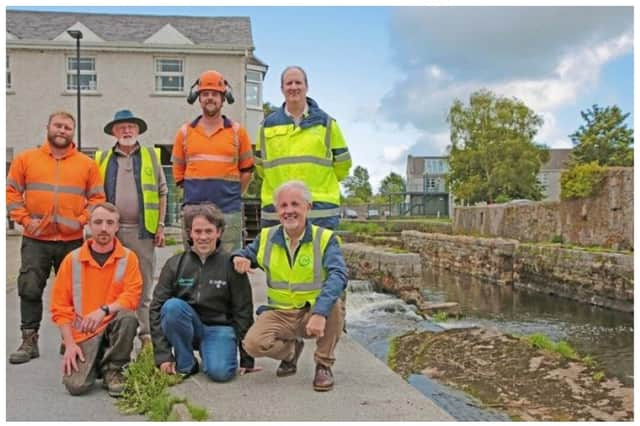
Michael Keenan of Longford Tidy Towns said they began working on the clearance works with Longford County Council in July. Senior Executive Environment Officer, Richard Smith said the clearance 'very much opened the face of what is a protected structure in the Camden Weir itself and revealed it once again'.
The Camlin Weir is at the heart of Longford's industrial life heritage and an arborist who has played an important role uncovering its history and secrets has says there are big plans ahead.
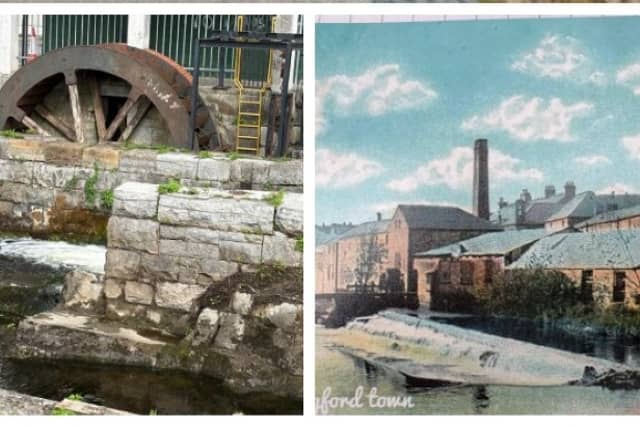
An abundance of mill-wheel features and long-hidden stonework which was previously at the heart of Longford's industrial life hundreds of years ago, was uncovered recently and it has been described as an 'immense gem' that can boost tourism.
Anthony Daly, an arborist with particular expertise in weir structures, mill wheels, and heritage assessment, has played a significant part and he led the recent on-site works.
He stated Alan Sullivan, the director of a company called Rebus, who led the fish-passage study last summer, has created a very good report on the history of the Weir and what was going on.
Mr Daly said, "They gave the whole outline of it because there are big plans ahead.
"The big thing in Europe at the moment is fish barrier mitigation and removal.
"So, a lot of our rivers have man-made structures and there was a big push to try and get a number of these sufficiently engineered that allowed fish to go back up to spawn and hopefully improve the fishing stocks on our rivers.
"There would have been very old businesses on either side of the river there: the church side and the town side."
"There would have been huge employment there well before Famine times and a good few businesses were set up there.
"There was a timber mill, which burned down in 1976, a distillery, and a flour mill there.
"So once you had a river with sufficient flow it was able to power these mill wheels, which was really the power for pushing corn and cutting timber.
"The auxiliary businesses then would have grown up around that.
"You would have probably bakers in town, you would have distilleries, a knock on effect really when you have that kind of power.
"And that goes for any town that was built on a river and the fact that you had two mill wheels, one on either side."
Fee Court in the area occupies a site that was, for decades, a major industrial centre.
The Manor Mill was located here, which in 1975, was run by John and Charles St John.
In 1849, the premises consisted of a mill, granary, hay lofts, miller's house, office, piggery, sheds, stables, sifter and store.
The property was derelict for some years before being taken over by Thomas Fee in the late 1870s.
He built up a major business that included construction, engineering, saw milling, building carts and coaches, brick making and wholesale agencies for seeds, manures, tools and hardware and by about 1900 he employed more than 350 men in total.
The company he founded went bankrupt due to the escalating costs of building the Sacred Heart Church, Roscommon, which was completed in 1903.
However, the family continued to run a smaller business in the area, which included coffin-making and funeral undertaking.
Albert Fee died in 1957 and his niece Helen Turner inherited the property and her nephew Warren Turner
Helen and her husband Harold sold their business interests in L&A.J Fee Ltd to Eamonn Glennon in 1963, and he continued to make coffins at the premises.
The building, machinery and stock were unfortunately destroyed by fire in 1976 and the mill wheel and wall plaque (near the Church Street entrance) are reminders of the site's important industrial heritage.
Eamonn's brother former county councillor and St Mel's College principal Denis Glennon, who has carried out a lot of research into the history of the area, said one of the first mills was a distillery in the 1820s.
"That was hugely important and it would have had to have had a kiln attached to it and there was a chimney, which is gone long ago.
"Obviously barley and malt were common grains used in the distillery and then the far side was described as a corn mill."
"So, there was a distillery one side and that lasted right up until the 1850s and at one stage there were between 30 and 40 people working in the distillery and further down there was a brewery.
"I came across a reference to somebody who described the quality of the ale and porter as being excellent."
Mr Glennon said during the Famine that distillery was turned into a temporary workhouse, where was food and shelter was on offer in exchange for hard labour.
A hatchery and a slaughterhouse were in the Camlin Weir area from the late 19th Century up until the 1970s and Mr Glennon and Warren Turner, who owns the Camden Weir area with his brother Derek, recalled some happy memories.
Warren said he could remember the slaughterhouse and the fishery and lots of activity.
"My uncle reared hundreds of thousands of fish there and as kids we used to go down after school and go and feed the fish," he added.
Multi-agency collaboration
Longford County Council has a very close partnership with Longford Tidy Towns regarding the Camlin Weir and they are working together positively on the clearance work.
Senior Executive Environment Officer, Richard Smith, said the local authority is assisting the project through financial backing, technical support, and the tendering process.
Mr Smith said the clearance has 'very much opened the face of what is a protected structure in the Camden Weir itself and revealed it once again'.
"There now is a proposal for us to facilitate improved fish passage through this Camlin Weir development but not alone will it help the fish but it actually helps the retention of what is the protected structure in and around that area as well.
"We have put a very strong application together for funding and we are due to hear back either this month or next month and, if successful, there is likely to be substantial funding of €1 million invested in a potential enhancement of the Camden Weir
Mr Smith said the local authority authority is assisting the project through financial backing, technical background and the tendering process.
He stated the Camden Weir is privately owned by brothers Warren and Derek Turner and they will only undertake any work to the Camlin Weir with the consent of the stakeholders.
Mr Smith said the multi-agency work at the Camlin Weir is about lots of organisations engaging positively together.
"This is all about partnerships and collaboration so when you think of the local authority and you think internally we are getting regeneration, we're getting planning, we're getting environment, we're getting climate action, we're getting biodiversity and we're getting PPNs (Public Participation Network and the public partnerships)
"And then in terms of external stakeholders we are thinking of Inland Fisheries [Ireland], NPWS Parks and wildlife services and then you're thinking about tidy towns you are thinking about angling association centres as well and how they can help, you're thinking of the Mall sports complex you're thinking of businesses and schools."
Mr Smith said they are now also prioritising the whole stretch of the 40 kilometre Camlin Weir for a water quality assessment to try and identify locations where there might be threats from inappropriate discharges coming into the water for improved cleanliness and quality.
He added, "I know of one school, St Michael's where one of the one of the nature trails they went on was actually to discover the source of the Camlin.
"How brilliant is that, there are teachers who have brought their children to see what this is.
"So, it's an educational tool, it's recreational too and I really don't see a disadvantage and in many regards it has been a sleeping success story."