
OPINION: Every Lidl helps... but in Queen's and King's County?

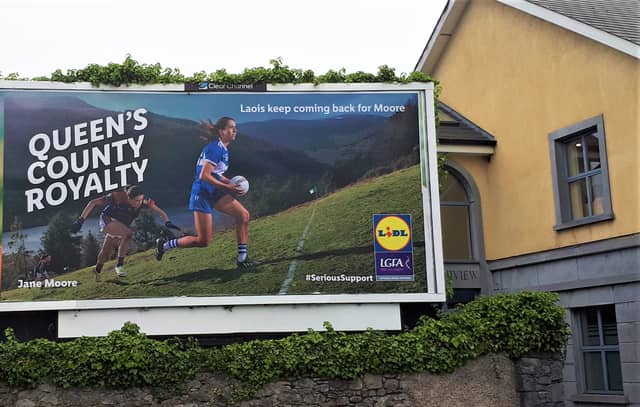

O DEAR, o dear. I expect the Germans have a word for it but it escapes me. You will be aware that the supermarket chain Lidl has egg all over its corporate face following a major faux-pas (yes, the French have two words for it!) in Portlaoise.
There, emblazoned across a huge poster for the Ladies Gaelic Football Association, it had a picture of Laois footballer Jane Moore with the words `Queen’s County Royalty’ and `Laois keep coming back for Moore’ scrawled across it.
Dear, o dear. Bless my sweet republican soul but what amadan thought that would be a good idea for a poster? In Laois? In Portlaoise? You’d need a blind spot the size of the planet Jupiter not to see the dangers there. The mistake, we are told, was made by the creative agency employed by Lidl, which agency knew little about Laois history. Or how `inspiring’ the word `royal’ can be where most Irish people are concerned, not least those who play GAA.
And, if I might digress for a moment, that does not mean Irish people do not – for instance – admire such a person as Queen Elizabeth II, including this Irish republican. You can be an Irish republican and hugely respect the patriotism, sense of duty, and character of a woman who has served her country as monarch so diligently for over 70 years and still not favour monarchy as a system of governance. I raise a glass in toast to Elizabeth.
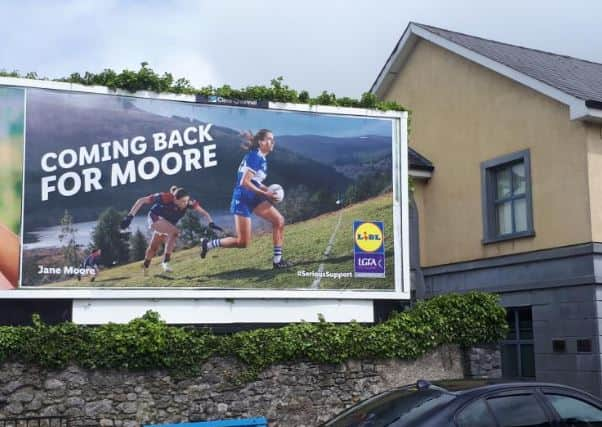
The fact that Lidl is German-owned probably means that’ll be it for now. Move on, nothing to see here. They wouldn’t be expected to understand the nuances of Irish sensitivities. But if it had been a British-owned firm, like Tesco etc, who had put up such as poster, you can only imagine the explosion of indignation it would have set off, not least in the current Northern Ireland protocol/Brexit debacle context. It might even be seen as possibly deliberate.
But it was a reminder that, until 1922 these two Midland counties – Laois and Offaly – were known, respectively, as Queen’s County and King’s County, with Portlaoise named Maryborough after the relevant Queen, Mary.
It is generally assumed the king referred to in King’s County was the king of England but no, it was King Philip II of Spain. In fact the plantation of both counties by Queen Mary was one of the earliest plantations in Ireland and, it is said, was used by the English as an experiment from which they learned much that they would later apply when colonizing what became the New England states in the north-eastern United States.
One historian who specialises in this area of scholarship is Dr Nicholas Canny whose tutorials I had the good fortune to attend when a history student at UCG, as it was then, now NUI Galway and shortly to be renamed the University of Galway (I don’t know why they couldn’t have left it as University College Galway, UCG!). There Dr Canny lectured us on how the plantation of Laois/Offaly played such a significant role in modern US history.
Laois became Queen’s County in 1556, being named after Mary Tudor, only daughter of Henry VIII and his first wife Catherine of Aragon who had the comparative good fortune to die naturally, if of cancer.
Mary was Queen of England etc. for just five years, from 1553 to 1558, and also died naturally, though only 42, in a flu epidemic. A committed Catholic, she attempted to undo the Reformation put in place by her father and set about it with such vigour she became known as "Bloody Mary" among her Protestant subjects, some of whom she had executed by burning at the stake. No pussy-footing there.
She also married Philip II of Spain, a devout Catholic of course, and it was after him that Offaly, or King’s County, was named, in 1556 also. And the two new main towns in both counties were Philipstown (now Daingean) in Offaly and Maryborough (now Portlaoise) in Laois, named after both king and queen.
An immediate reason for the plantation of both counties by settlers from England was that the local O’Moore (they haven’t gone away you know!) and O’Connor clans were continuously raiding the Pale area around Dublin to the east and which was ruled by the English.
An order went out that the O’Moores and O’Connors were to be driven from their lands to the hills and bogs, and be replaced with loyal settlers. And it was done, but the O’Moore’s and O’Connors sustained a guerilla campaign against the new settlers for most of the following 40 years until, in 1578, the English massacred most leaders in both families having invited them for peace talks.
Ah, perfidious Albion. According to the `Annals of the Four Masters’ that day: “A horrible and abominable act of treachery was committed by the English … upon that part of the people of Offally and Leix … under their protection. It was effected to thus: they were all summoned to shew themselves, with the greatest number they could be able to bring with them, at the great rath of Mullach-Maistean (Mullaghmast) and on their arrival at that place they were surrounded on every side by four lines of soldiers and cavalry, who proceeded to shoot and slaughter them without mercy, so that not a single individual escaped, by flight or force.”
Another medieval Irish text, the `Annals of Loch Cé’ (in Co Roscommon) stated that no uglier deed than what happened in Mullaghmast was ever committed by the English in Ireland.
Up to then. There more such deeds in later history.
The English used the land secured in this way to reward loyal servants of the Crown – Catholic and Protestant – and Queen Mary hoped it would also ease the cost of running Ireland. It was hoped that the armed settlers would control the Laois and Offaly natives (some hope!). She also hoped that the towns and villages the planters would set up might act as `beacons of civilisation’ and calm the native Irish (Ah now!).
Among the requirements of the new settler families was that they have at least one archer to protect themselves. They were to bring weapons and not marry or employ the Irish.They had to build stone houses, set up towns and villages, and cultivate the land in an English manner.
It didn’t work. It was a failure.
Enough planters could not be persuaded to take up the offer of such lands because the reputation of the O’Moores and O’Connor’s preceded them, striking terror into timid English hearts. And, obligingly, the O’Moores and the O’Connors continued to conduct raids on those planters who did arrive to take their land.
Furthermore, and for the same reason, those planters who settled in both counties were soon unable to attract workers from England and faced the ignominy of having to employ Irish labour. Eventually more money was being spent protecting these planters than was raised by them. The plantation was no longer even financially viable. It was kaput.
Moral of the story? Don’t mess with an O’Moore or an O’Connor anywhere, but particularly in Laois or Offaly.