
POSITIVE PSYCHOLOGY: Clocks have gone back and these dark evenings might get you down


THE clocks have gone back and dusk is falling ever earlier. At this time of year it is normal to feel just a bit more tired than usual, to experience a dip in energy levels, a desire to shut the hall door and hibernate at home especially on the duller, darker evenings.
However, what if these feelings actually are more than just a touch of the winter blues and actually seriously interfere with your mood and functioning in everyday life?
Then you may be experiencing Seasonal Affective Disorder (SAD).
This is a form of clinical depression that has a seasonal pattern. Most common is the winter pattern, but there is a smaller number of people who experience SAD in the summer months.
Symptoms overlap with those of major depressive disorder and include feelings of worthlessness, sadness, guilt, poor attention and decision-making, a loss of interest in formerly enjoyed activities, changes in sleep and appetite and in some cases thoughts of suicide.
Sufferers report needing to sleep more but still feeling tired, being hungrier especially for carbohydrates.
This kind of depression typically starts in September/October and continues until springtime, when the symptoms remit.
In psychiatry, you have to have experienced this pattern for at least two consecutive years in order to meet criteria for the diagnosis.
Indeed, if you are prone to depression you may find that your mood worsens in winter. SAD is not just a milder form of depression.
Research suggests that four times as many women as men suffer from SAD and you are more likely to experience SAD if you are a younger rather than older adult.
In Ireland, figures suggest that one in 15 adults suffer from SAD. People who live further from the equator in either direction are more at risk.
So, what causes SAD? The consensus seems to be that there are a few factors involved. Reduced sunlight means that we produce more melatonin, a hormone produced by the pineal gland that responds to darkness by making us feel sleepy. Because we are not outside as much in winter months, reduced exposure to sunlight means that we produce less vitamin D which can impact serotonin levels.
Serotonin is a neurotransmitter which impacts on our mood. It is thought that low levels of serotonin are linked to depression. Reduced sunlight is also thought to affect our circadian rhythm, that is, our body clocks.
It is thought that people with SAD find it harder to adjust their body clocks to the shorter days.
So how can SAD be best treated? There are a number of approaches.
Medication may have a role to play, most often SSRIs the antidepressants that specifically target serotonin levels. Some people report good results with phototherapy (light therapy) which basically simulates the benefits of sunlight exposure.
Psychologically, the treatment approaches that we regularly discuss in this column are effective.
Cognitive behavioural therapy, mindfulness and meditation are really important for handling distorted and unhelpful thoughts and for helping us to accept but not resign ourselves to fluctuating moods.
Healthy lifestyle choices like diet and exercise are hugely important.
Getting outside, even if it’s a dull day and the sun is proving elusive, is good, especially in the first half of the day. A winter sun holiday would be nice if we had the funds.
Social interaction is again very important. We have discussed the adverse effects, physically and psychologically, of social isolation in this column previously.
A former professor of ours, an expert in the field of cognitive psychology, had a phrase which resonates with both of us: “It is easier to act yourself into a feeling than feel your way into an action”.
We regularly remind clients of this when they are struggling with motivation.
So, making the effort to connect with friends and family even on those dark evenings when we really would rather hibernate, is probably a very self compassionate idea.
Morning of Mindfulness and Relaxation
A PRACTICAL half day experiential course on using mindful meditation and deep relaxation to improve emotional balance and general wellbeing will be presented by Imelda Ferguson and Julie O'Flaherty on Monday, November 21 in Tullamore.
Imelda Ferguson and Julie O'Flaherty are Tullamore-based chartered clinical psychologists in private practice with extensive experience working in the adult mental health field.
Over the course of the morning there will be an overview of the principles and attitudes of mindfulness as well as practice of several core mindful meditations including body-scan meditation, acceptance-based meditation, compassion-focussed meditation and progressive muscular relaxation.
It will take place on Monday, November 21 next from 10am to 1pm in the Central Hotel, Main Street, Tullamore.
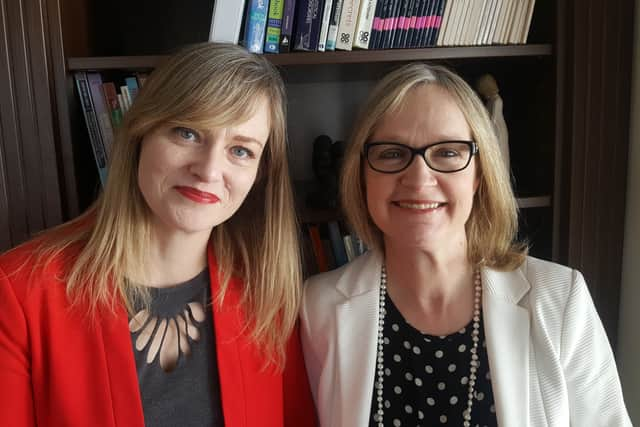
They recently ran a three-evening 'Beat Anxiety Bootcamp' in Offaly which was very well attended and received.
Places on the Morning of Mindfulness and Relaxation cost €100 (there is an early bird discounted fee of €80 for those who book and pay by November 14) and the fee includes tea and coffee.
To book a place, contact Imelda on 087 2271630 or Julie on 087 2399328.
Advance booking is essential.
Also, Imelda and Julie can be found on Facebook by looking up Mind Your Self Midlands.
They can also be contacted through the Psychological Society of Ireland www.psihq.ie (Find a Psychologist section).