
Hamas and Fatah sign declaration to form future government as war rages in Gaza
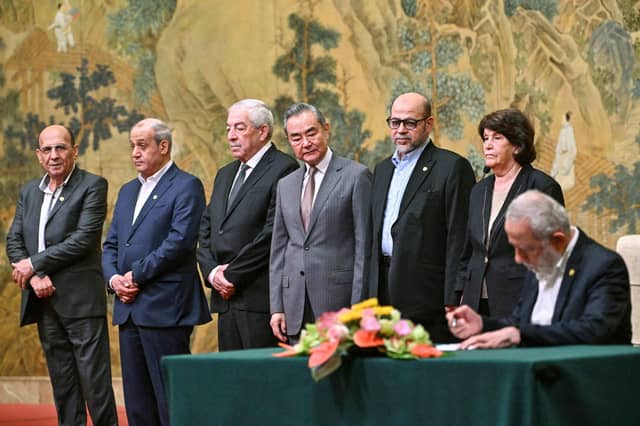

Palestinian factions Hamas and Fatah have signed a declaration vowing to form a government together.
The event, hosted by China, is the latest attempt at resolving the years-long rivalry between the two groups.
Both sides said the accord, which provided no guarantees or timeline, was only an initial step.

Israel swiftly denounced the agreement while the US and other Western countries have refused to accept any Palestinian government that includes Hamas unless it expressly recognises Israel — a factor that has helped wreck past unity attempts, along with the factions’ own competition for power.
Chinese state broadcaster CCTV announced that the two sides and other, smaller Palestinian factions signed the Beijing Declaration on “ending division and strengthening Palestinian unity”, pledging to form a unity government for the Palestinian territories.
The agreement offered only broad outlines of how they would work together.

The declaration comes at a sensitive time, as the war in Gaza rages on into its 10th month and as Israel and Hamas are weighing an internationally backed ceasefire proposal that would wind down the war and free dozens of Israeli hostages held by Hamas.
One of the thorniest issues is the question of who will run Gaza after the war — and the unity efforts are in part motivated by Palestinians’ desire to offer a scenario for post-war rule.
But Israel vehemently opposes any role for Hamas, which it has vowed to destroy after its October 7 attack on southern Israel.
It also has rejected US calls for the Palestinian Authority to govern Gaza after the fighting ends, though it has not presented a cohesive post-war vision of its own.
Palestinian President Mahmoud Abbas’s Fatah has been deeply reluctant to share power with its long-time rival.

During the current war, Hamas officials have said the group does not want to return to ruling Gaza and advocates forming a government of technocrats to be agreed upon by the various Palestinian factions.
That government would then prepare for elections in Gaza and the West Bank, with the intention of forming a unified government.
Reacting to the announcement out of China, Israel’s foreign minister said no joint governance between Hamas and Fatah in Gaza will take place “because Hamas’ rule will be crushed”.
The agreement also underscored China’s attempts to have a growing role in Middle East diplomacy, after its success in mediating the restoration of relations between Saudi Arabia and Iran.
“To be sure, China is still in the process of trying to earn credibility as a global mediator,” said James Char, a research fellow at the Institute of Defence and Strategic Studies at Nanyang Technological University in Singapore.
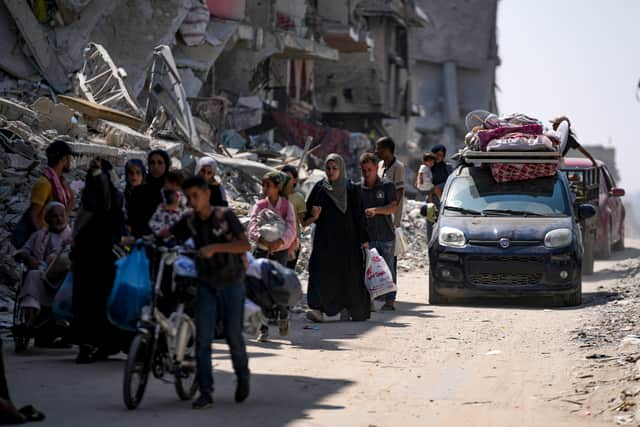
The Palestinian factions issued a joint statement announcing the deal but giving no details on how or when the government would be formed, saying only that it would be done “by agreement among the factions”.
It said they promised to follow up on previous reconciliation agreements signed in 2011 and 2022.
In the statement, all the factions, including Hamas, said they were committed to the creation of a Palestinian state on lands Israel captured in the 1967 Mideast war.
Hamas, whose original charter directly called for Israel’s destruction, has said it would accept a Palestinian state based on the pre-1967 war borders but refuses to officially recognise Israel.
The Palestinian Authority, meanwhile, has recognised Israel and works within the framework of peace deals signed in the early 1990s.
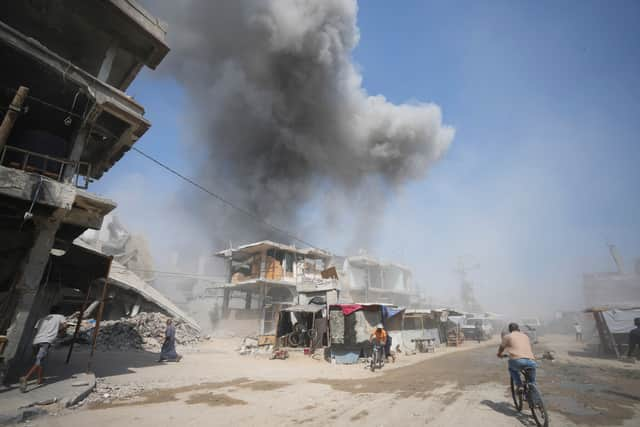
Many Palestinians view the authority as corrupt, out of touch and a subcontractor for Israel because of their joint security co-ordination.
The unity announcement is based on widening the membership of the Fatah-led Palestine Liberation Organisation (PLO), including Hamas, said Jamal Nazzal, a Fatah spokesperson.
“It’s a long way ahead, and most of it will be implemented after a possible ceasefire,” he added.
Hamas members have never been part of the PLO, the umbrella group of Palestinian factions that undergirds the Palestinian Authority.
Husam Badran, a Hamas political official based in Qatar, called the agreement a further “positive step towards achieving Palestinian national unity”.
US President Joe Biden’s administration envisions a revamped Palestinian Authority ruling post-war Gaza and has sought reforms that might make it a viable presence in the war-ravaged territory. However, Israel rejected that idea.
The Palestinian Islamic Jihad, a smaller militant group allied with Hamas, issued a statement after the talks saying it still “rejects any formula that includes recognition of Israel explicitly or implicitly” and that it had “demanded the withdrawal of the Palestine Liberation Organisation’s recognition of Israel”.