
Skeoge Health Action Plan launched in Guildhall
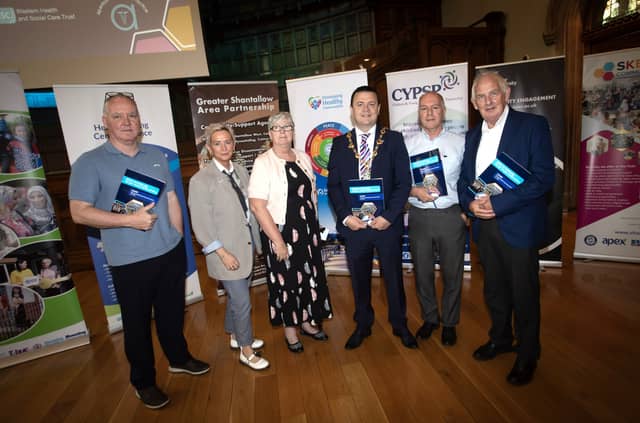

‘How we have ended up with a huge population and no attendant facilities beggars belief in this day and age’ - Tony Doherty, SHARP
“The deficits you find at another level throughout the city, all appear to spike in the Skeoge area.
“There are alarming levels of poverty, suicide, drug addiction, dometsic violence and poor mental health in Skeoge, while there is a dearth of community infrastructure and social measures to meet the needs of this relatively new neighbourhood.”

Tony Doherty, chairperson of Skeoge Health Action Research Project (SHARP).
Derry edging towards Inishowen, Mr Doherty described Skeoge and the adjacent H2 Cashel development - between the Whitehouse Road and Coshquin - as akin to “building a small town outside of the city”.
The SHARP steering group comprises: Rory McParland, Greater Shantallow Area Partnership; Nicola Mullan, Greater Shantallow Area Partnership/Skeoge Community Hub; Dr Nóra Church, Aberfoyle Medical Practice; Edel O’Doherty Developing, Healthy Communities; Paul Sweeney, Western Health & Social Care Trust; Claire Mulrone, Ulster University; and Teresa McCloskey, Apex Housing Association.
The group launched its report Sláinte na Sceitheoige: Skeoge - People, Health and Place in Derry’s Guildhall on June 25, and the statistics it contains bear out Tony Doherty’s analysis.
Speaking to The Derry News, Mr Doherty referred to some of the indicative statistics provided for the report by Dr Michael McKay from Ulster University.
He said: “For example, even though the overall number of anti-social incidents in Skeoge remained relatively similar over the past three years, as a proportion of the overall incidents in Ballyarnett, they increased in that same period, accounting for almost half of all incidents in 2023/2024.
“Between 2021 and 2023, almost half of all domestic crimes in the Ballyarnett area took place in Skeoge and that in the overall period, around one in ten such crimes in the Foyle constituency took place in Skeoge.
“Initially SHARP was a collaboration between Dr Nóra Church and me. In terms of the serious health inequalities within the city, we thought it would be useful to make an exploration of Skeoge - how it came about and how it looks at the moment.
“So, we approached a couple of people to join the SHARP and after some discussion, we decided we would focus on drawing up a health action research project.
“Skeoge has a hugely young population - 60% or maybe more of the population is under 40 and, in terms of how the area was planned, I’m sure Tony Hassan [the late Sinn Féin councillor for the area] would be very disappointed at how his long campaigned for Skeoge has turned out to be something different from the aspiration.
“While there is the Skeoge Hub in the area, it is a small building. It is not a community centre. There are no community centres in the area. There is no recreational space. Even if youngsters wanted to play a game of football on a green, there is nowhere for them to play and all the teenagers all gather up at the one shop and cause nuisance.”
According to Mr Doherty, Skeoge’s problems are compounded by having a dual carriageway driven right through both sides of a housing estate.
“So even for parents to get up to the shop is an ordeal the way the traffic lights are located,” he said.
“One of the most serious flaws has to be how these matters are approached from a planning perspective. Skeoge was approved for planning before responsibility for planning was passed to Derry City and Strabane District Council.
“How we have ended up with a huge population and no attendant facilities beggars belief in this day and age.
“Obviously there is a lot within Skeoge that needs to be put right and hopefully we will be moving on to that stage looking at the hard infrastructure deficit.
“Currently there are no football teams. There is no school. All you have is houses, a hub and a number of shops, that is basically it.
“When my family moved to Galliagh in 1974, it was much the same. There was nothing. You had a lot of green space but other than that it was just housing and green space. People had to set up mobile shops.
“And today, more than 50 years on, nothing appears to have changed in terms of what constitutes a healthy, well planned community.
“There is no provision for the population currently living in the area or due to move to the area over the next number of years. 78% of Skeoge tenants are single parents and there is no childcare whatsoever in the vicinity.
“There is no social provision, no hard infrastructure, no soft infrastructure. People are being basically left to their own devices and what is tending to happen here more and more is that the community sector is expected to pick up the pieces. It is all wrong.”
Explaining how poor planning has impacted negatively on Skeoge, he said: “Each development went through the planners in small lots, which meant there was less onus on planners to pick up on the lack of hard and soft infrastructure. The whole planning system in terms of public housing is badly flawed.
“It needs far more attention from the planners to prevent similar poor social engineering in the future.”
Mr Doherty who is also regional co-ordinator of the Healthy Living Centre Alliance said the next step in the process in Skeoge was to examine what people would like to do in the area.
“One of the huge deficits is the number of two-bedroom houses. The preponderance of two bedroom housing creates instability and lack of cohesion because if a young couple moves in and has a child or two, they are moving back out again,” he said.
“There is a tendency then for single people to move into the property and that creates a transient housing culture in the area and anybody who is trying to create a degree of stability will be up against it. Accommodation in Skeoge should have been more evenly divided between the various sizes of houses.
“By the same token you couldn’t fault the housing. People live in the house but the house exists without an environment in which people are supposed to thrive. The population of Skeoge would be up against it in terms of a thriving community,” said Mr Doherty, who added that the work carried out by SHARP should really be done in advance of planning or as part of planning processes, to “avoid the worst and plan for the best”.
“We are looking forward now to working with local people in organisations including the housing authorities to try and turn around the fortunes of this whole area,” he added.
“We want to inform the planners. There needs to be a reform of planning. We will take it forward to Derry City and Strabane District Council and bring a presentation to its Planning committee.
“This also needs to be addressed at Assembly level, which is obviously where the policy is made and handed down to the Housing executive and the various housing associations. At this stage of the game nobody would be able to stand over the planning process. Everybody agrees it is flawed.”