
It Occurs to Me: The Donegal Pubs in Derry


‘The Rosses Bar often thrummed with Donegal accents - ‘ag caint as Gaeilge’ - as they breakfasted before getting the Derry Boat to Glasgow’
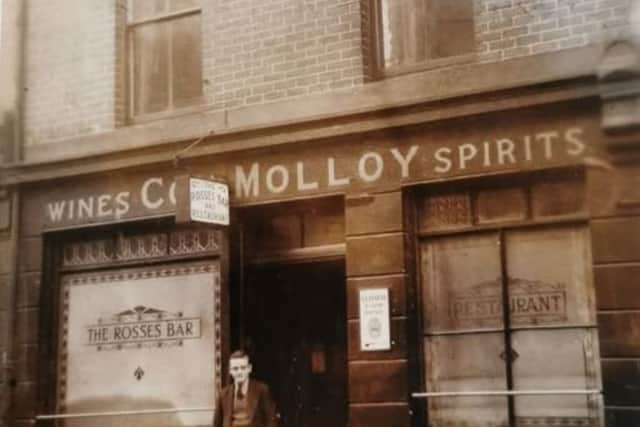
The attached photograph shows another Anthony Molloy standing outside his father's bar on Waterloo Street in Derry in 1937.
His father was Con Molloy and he came from Burtonport and was married to Margaret Boyle from Maas, outside Glenties, and their Rosses Bar often thrummed with Donegal accents - ‘ag caint as Gaeilge’ - as they breakfasted before getting the Derry Boat to Glasgow.
Not far away was the Gweedore Bar, owned by Margaret Boyle from Gweedore, whose husband Charles Sweeney had died in Glasgow, so she came to Derry with her family and in common with The Dungloe (established in 1892) and The Rosses Bar, fed and watered thousands of west Donegal souls heading for the tatty-hoking and the tunnelling.
The Gweedore was eventually passed to Margaret's oldest grandson, Thomas Bryce, and the Bryce family became synonymous with the famous landmark bar.
When I first moved to Derry, I became friendly with Michael Cunningham, a native of Carrick, who managed the upstairs bar with his brother-in-law, Danny Bryce, in the ‘60s and ‘70s.
At the height of the Troubles, in June 1975, the Bothy Band played in Derry’s Embassy Ballroom as part of the city’s first Civic Week and during the encore, enquired: “Would there be a drink to be had anywhere in town at that time of night?”
As my old friend, the late Eamon Baker recalled (he was there): “Michael (Cunningham) was well able to answer that question in the affirmative - the Gweedore would be only too willing to throw open its doors. The word went out and up weaved a flow of folk from the Embassy to the Gweedore at the foot of Waterloo Street for a ‘lock -in’ that was to last the guts of three days and nights and pass into traditional music folklore here.”
Seamus Bryce, who also managed the Gweedore, made the upstairs lounge available on Wednesday evenings to school teachers and senior students who might wish to speak Irish while having a drink.
Sadly, Colm Bryce, author of Little Donegal - The Irish in the Gorbals and Govanhill, passed away at the age of 60 last year, and is buried in Magheragallon, Gweedore.
No breakfast for the Donegal ‘wans’
Here’s a Derry newspaper extract from 1929: “Waterloo Street, Derry, has come into prominence as a result of recent litigation whereby Donegal men are debarred from obtaining their usual refreshments on arrival of the Scotch boat in the early hours of the morning. It is a well-known fact that Waterloo Street is a home from home for natives of Donegal passing through Derry.
Many of the business houses in that thoroughfare are conducted by Irish-speaking Donegal families and bear trade names recalling particular parts of Donegal, such as Gweedore, Cloughaneely, etc.
“Waterloo Street is not only convenient for travellers, but it is congenial. For a very long number of years natives of Donegal have been able to freely obtain admission to any of its restaurants, where a warm breakfast and bed awaited them after a rough crossing at sea. Now, owing to the Six-County Government legislation, these men and women are debarred from getting such refreshments, because, forsooth, the premises are licensed premises. This inflicts great hardship on a continual stream of quiet, inoffensive, hardworking people, most of whom will now have to tramp the streets for hours in the early morning with boxes and baggage.
“A feature of Waterloo Street is its varied shops. There is not a single private dwelling-house in the entire length of the street. Most of the shops are given over to the sale of second-hand clothing. Many are public-houses, and a number cater for teas, religious objects or groceries. Visitors from every part of Donegal never fail to pass through Waterloo Street, and it is not surprising, therefore, to find that the buses running to Fanad, Kerrykeel, Milford, Sheephaven, Dunfanaghy and all other Donegal places have made Waterloo Street their headquarters. Cead mile failte go sraide Waterloo I Doire Columbcille, de luain go bra. This is the street that was all boarding houses for Donegal people 100 years ago before sailing to the USA.”
The Gorbals
Many of the Donegal people ended up in the Gorbals, where the conditions were horrific. Gang warfare with opponents from different parts of the city was commonplace.
Here are some statistics from newspapers in the ‘30s.
“It is not uncommon for eight, ten, or twelve persons to be together in a single room. There are (in Glasgow) 175,000 ‘houses’ without baths, and 105,000 ‘houses’ have no ' internal sanitation.”—News of the World, 29/4/34.
“Glasgow’s infantile death rate, which was mainly caused by tenement congestion, was 112 in the thousand in 1932 compared with 67 per thousand in London and Birmingham.
The infantile death rate in tenement wards is four to six times greater than in residential areas where there are few tenements.”—Daily Herald, 16/8/34.
“The spear of a swordfish and a wicked-looking Gurkha knife were among the number of weapons taken possession of by the police following an alleged gang fight in Kerr Street, Bridgeton, yesterday afternoon. The ‘battlefield’ was strewn with weapons after the fight ... a piece of copper tubing . . a brass-headed poker . . . a cudgel two feet long with a knob of wood as thick as the head of a drumstick ...an axe weighing 14 lb. .. . a steel file two feet long… a bayonet-like knife…and an iron rod three feet long with a hook at each end. Many of these articles, it is stated, were thrown away by the alleged gangsters in their flight from “the police.”—Glasgow Evening Times, 17/6/31.
READ NEXT: It’s Good to Talk: The September reset
“A gang disturbance in the East End of Glasgow, arising out of jealousy on the part of a sister of one of the gangsters, led to the appearance of four young men .. . at Glasgow Sheriff Court to-day. Accused, all unemployed . . . were stated to be members of a gang known as the ‘Eminent Gang’ which frequented the Calton district. .. .” (This report goes on to
describe how the jealous girl threatened her fickle lover that she would bring her brother round to “cut off his head.”) When one of the accused was arrested, he said he thought it
was a fighting man they had to deal with and there would be no court case. . . . In many cases no complaint was made because those who ought to be the complainers were afraid.” —Evening Times, 26/12/29.
“Razor SLASHING.”—Sir, It is depressing and serious to take up one’s paper and read the daily catalogue of assaults and murders with knives, razors and other lethal weapons. Indeed, razor slashing and stabbing are becoming so common that they appear to be accepted as part of our modern youth’s recreation, etc., etc “— Letter to Editor, Glasgow Evening Times, 14/3/30.
By the same token, there were some sixteen schools, fifteen churches, three synagogues, libraries, swimming baths, dance halls, picture houses, two theatres, a hundred shops and, by one 1948 count, around 130 pubs. A ‘Picture Post’ reporter who came that year to write the expected horror story left instead with an unexpectedly warm portrait — a poor place, certainly, but one of ‘kind, friendly folk, with a strong feeling for social justice’, where murder was rare and organised crime scarcer than the newspapers claimed. By the 1950s something had to be done, and Glasgow did it with a bulldozer. Mercifully, The Gorbals, once synonymous with overcrowding and urban deprivation, is now a much sought-after neighbourhood that has undergone a great deal of redevelopment over the years. Located on the southern banks of the Clyde, it's a thriving community close to the centre of Glasgow.
Doonbeg
In the Indo, Kevin Doyle wrote: “Who could have predicted Donald Trump’s visit would turn into a triumph for everybody involved?”
In the Examiner, Brendan O Brien wrote: “Despite Shane Lowry's fairytale Irish Open win, politics and power came first. A tournament played at a golf course owned by a deeply divisive US president layered this story with more troubling dimensions. Politics and power came first, sport a distant second, Trump’s unexpected promise to address tariffs on Irish whiskey at the end of his speech just another prop in his unpredictable play.”
Terry Prone went uber-silly in the same Examiner with “ Trump not as unique in presidential awfulness as we might assume.” Clutching at desperate straws!
I agree with O’Brien’s analysis. Here’s a thought…if Lowry’s playing partner Jacob Skov Olesen had won, would Irish whiskey have even got a mention? Now you have it!