
First Minister to be questioned by police over Garvaghy Road protest
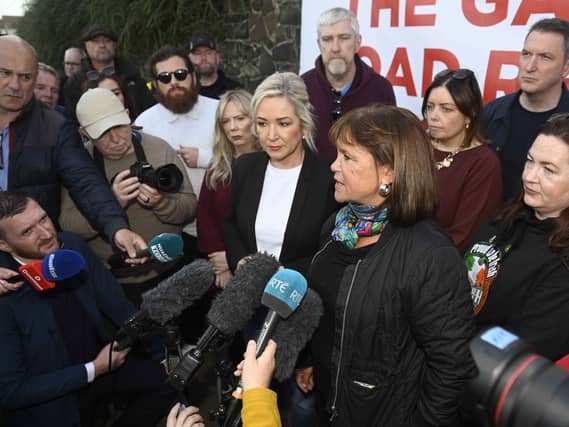

Michelle O’Neill told MLAs ‘you’re not my judge and you’re not my jury’ as the fallout from the dispute was raised repeatedly at Stormont.
Northern Ireland’s First Minister is to be interviewed by police in relation to her attendance an a counter demonstration to the Drumcree Orange Order march.
Michelle O’Neill told MLAs “you’re not my judge and you’re not my jury” as the fallout from the dispute was raised repeatedly during Assembly questions on Monday.
A number of Sinn Féin representatives including Ms O’Neill, party president Mary Lou McDonald, executive ministers and MLAs, were pictured on the mainly nationalist Garvaghy Road over the course of a nearly two-week stand-off.
In late September the Parades Commission granted the Orange Order permission to march down the Garvaghy Road for the first time for nearly 30 years, but the march was unable to go ahead as thousands of protesters blocked the road.
The Portadown district of the Orange Order and residents of the Garvaghy Road had a number of meetings with Northern Ireland Secretary Sir Chris Bryant but were unable to reach agreement.
Sir Chris then stepped in to overturn the commission’s decision after police said they were unable to facilitate the march going ahead.
In a post on the social media network X, Ms O’Neill said she will be interviewed by police later this week.
“I will be interviewed by the PSNI later this week in relation to the peaceful protest in solidarity with Garvaghy Road residents,” she said.
“Alongside many others, I was proud to stand with the Garvaghy Road community to protect 28 years of peace and progress.”
She went on: “I will always stand up for what is right. We have come too far to allow our society to be dragged backwards to the days of domination and supremacy.
“Everyone must be allowed to live their lives free from sectarian intimidation and harassment. There is no going back – not now, not ever.”
Ms O’Neill and three other Sinn Féin ministers faced, ultimately unsuccessful, motions of no confidence from unionist parties, who contest they broke their pledge of office by attending demonstrations on the Garvaghy Road.
DUP MLA Gareth Wilson said in the last 10 years 73 people have been convicted of obstructing a public road, with four receiving custodial sentences, four a community sentence and 52 a monetary penalty, before asking Ms O’Neill which she and her colleagues “deserve if the course of law is followed”.
Ms O’Neill replied: “The hypocrisy hanging out of the DUP is incredible. Hypocrisy all day long.
“I have said that I own my decision to stand with the Garvaghy Road residents, and I am proud to have done so, and I will continue to do so.
“I will deal with whatever processes come my way, but you are not my judge, and you’re not my jury. You do not get to adjudicate.
“I will deal with the processes in my time and in my way. So I’m sorry, but you’re not going to get the answer from me that you want.”
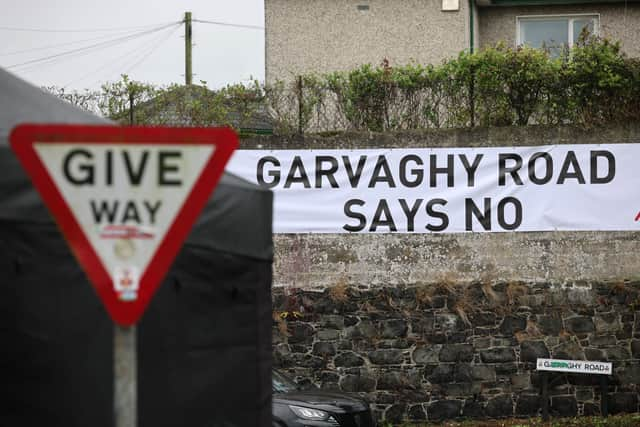
Alliance MLA Andrew McMurray said he had been contacted by a school student whose “number one concern” was community tensions arising from the Drumcree row, as he asked what the first minister was doing to improve community relations.
Ms O’Neill said the peace of the last 28 years is “secure” but the region must keep “building for progress”.
“Despite the moments like this, huge setbacks in terms of community relations, we have to work even harder to try to build on those community relations and I’ll work with any willing partner on which to do so,” she said.
“As a matter of fact, I do think there is going to be a lot of healing and necessary attention given to the wider Portadown area because I think we do need to do everything we can to build community relations again.
“But it’s for those people, and I say to the student, the people in the Garvaghy Road didn’t want this. I didn’t want this. You didn’t want this.
“It’s for those people in political unionism that decided to bring us back 28 years, to bring us back into one of the most horrible and traumatic times of the late ’90s.
“I ask the question of them, why? Why do they want to do that? I still don’t understand the answer, why do people want to bring us back?”