
Craughwell residents demand answers as families face dangerous walks into village

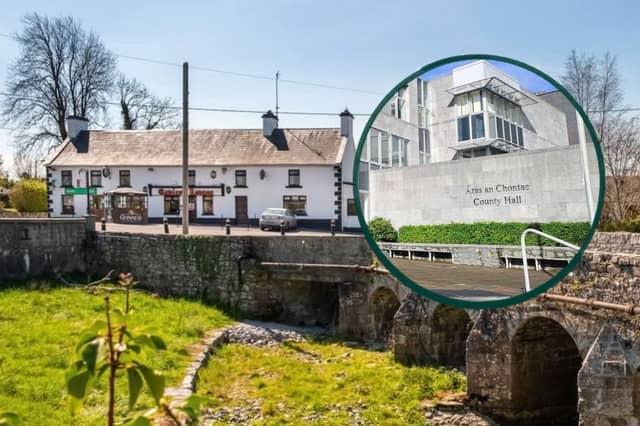

Families living just minutes from the centre of Craughwell say they are being forced onto busy roads while trying to walk around the village.
Residents have raised concerns about several danger spots, including a missing footpath serving more than 100 homes on Ballymore Lane, cars blocking footpaths and a hazardous walking route to Craughwell train station.
Local resident Vinny McGrane, who lives in Slí Uí Mhaoilíosa with his family, said the problems can make taking the car feel like the safer option, even for short journeys into the village.
“For us, and a lot of people in the housing estates on Ballymore Lane, if we want to go for a walk down to the village, we have to drive,” he said. “It is less risky.”
One of the main concerns is Ballymore Lane, where an approximately 270-metre gap in the footpath leaves residents of Slí Uí Mhaoilíosa, Slí na gCapall and surrounding homes without a safe walking route into Craughwell.
A total of 108 households are affected. Vinny moved to Slí Uí Mhaoilíosa five years ago and said he understood at the time that a footpath was planned along Ballymore Lane.
“We were told not to worry about the main road, that a footpath was planned,” he told the Connacht Tribune.
Funding was subsequently allocated for the footpath, but Vinny said it was not enough to complete the project.
“Due to insufficient funding, it was never built and appears to have stalled completely,” he said.
Five years on, the gap remains. The lack of a safe walking route along Ballymore Road is not a new issue.
Galway County Council records from 2009 noted the lack of public footpaths along Ballymore Road, apart from a section along the front of Slí na gCapall.
Almost two decades later, the missing stretch remains. Vinny has repeatedly contacted Galway County Council and has received different explanations for why the footpath has not been completed.
He was told there were difficulties obtaining some of the land needed for the route and that there was not enough funding to complete the project. He was also told that acquiring the necessary land through a Compulsory Purchase Order was not pursued.
And he questions why difficulties completing the entire path should prevent other sections from being built.
“If they don’t want to CPO it, build a footpath to that house and then after that house,” he said. “Ninety per cent of a footpath is better than nothing.”
For him, the situation raises a wider question about how new homes can be built while families are still left without a safe way to walk into the village.
“You would never build without a road or an electricity connection,” he said. “Housing developments require roads, electricity, and telecommunications, yet basic pedestrian infrastructure can be left incomplete.”
He also wants answers about development contributions paid to Galway County Council when housing was built in the area.
“The developer had to put significant money into the council as part of the planning permission for the housing estate,” he said. “Where did the money go?”
Development contributions can be imposed as a condition of planning permission and can be used to help fund public works, including footpaths. Around the GAA grounds, parking can become a particular problem, with cars parked on both sides of Ballymore Lane.
“If you walk along that road and there is a GAA match on, best of luck to you,” he said. “There is no defined path and people are parked on both sides.”
He said this can also restrict the view of motorists, particularly when children emerge from between parked cars.
“There are lots of situations on Ballymore Lane where cars are parked on both sides of the road,” he said.
“I could be driving at 20km/h and kids come out of the GAA club between cars and you don’t see them.”
The problems are not confined to Ballymore Lane.
Even where footpaths do exist in Craughwell, he said parked cars can make it difficult for families to use them, leaving parents with buggies and young children with little choice but to move out onto the road. He has raised these concerns with Gardaí and has criticised what he sees as a lack of enforcement.
A separate concern is the route to Craughwell train station, where an estimated 70 to 80-metre stretch without a footpath on the R347 can leave people walking alongside passing traffic.
Temporary works beneath the railway bridge have improved the route from one direction, including for residents of Gleann na hAbhainn, but people approaching the station from the village side can still find themselves walking on the road.
“To get to the school you have to walk on a narrow part of the road,” Vinny said. “The train station is even more dangerous.”
He said the road can give motorists little indication that they are approaching an area where they may encounter people walking.
“You are driving on what feels like a country road the whole time,” he said. “You don’t really notice that you are entering the village.”
He has spoken to a Galway County Council engineer about safety beneath the railway bridge and was told plastic bollards could be installed.
After repeatedly raising the different problems, he said one of his biggest frustrations is trying to establish who is responsible for addressing them.
He contacted Galway County Council about the missing footpaths and raised road safety and parking concerns with Gardaí, but said he has been unable to get a solution.
“You contact the council and you contact the guards and they all say they can’t do anything,” he said. “We are not getting anywhere.”
He has also contacted local TDs but felt the point he was trying to make was misunderstood. The frustration has even prompted local fundraising towards a footpath on Ballymore Lane.
“These issues point to a broader pattern where active travel and pedestrian safety in Craughwell take a back seat until an avoidable accident occurs,” he said.
Funded by the Local Democracy Reporting Scheme