
'Hare-brained idea' as Galway City Council rejects Salmon Weir Bridge bus corridor plan

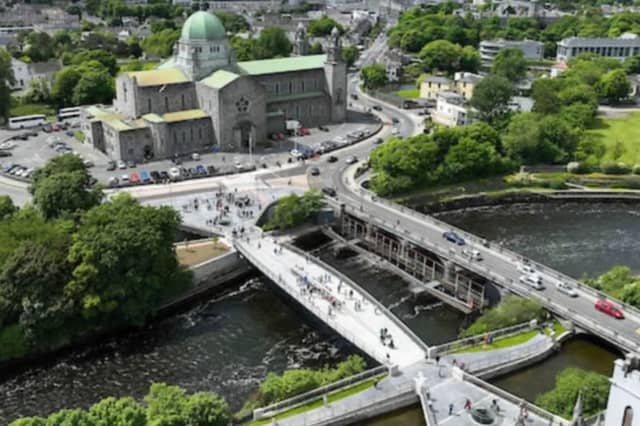

A proposal to restrict traffic on Galway's Salmon Weir Bridge to buses between 7am and 7pm has been branded a "hare-brained idea" as city councillors rejected the controversial plan.
Cllr Peter Keane (FF) called for the proposal, brought forward by the Galway Commuter Coalition, to be “knocked on the head immediately,” arguing that Galway could not afford further restrictions on traffic crossing the River Corrib.
He questioned how a proposal from an unelected group had progressed through the council's Project Development Strategic Policy Committee (SPC) without being rejected at that stage.
However, Director of Services Derek Pender confirmed that he had personally authorised the Galway Commuter Coalition to make its presentation to the committee.
"I allowed that group to come in and present,” Mr Pender told councillors at this week's Galway City Council meeting.
“I authorised their attendance to give a presentation on the proposal."
He stressed, however, that allowing the presentation did not amount to approval of the scheme, making it clear that an SPC had no authority to authorise works on a public road.
"I want to make it crystal clear. An SPC does not have the authority to approve that," he said.
Councillors expressed frustration over the publicity surrounding the proposed bus corridor and the impression that it had already secured political approval.
Cllr Keane said the proposal had caused “considerable consternation among residents”.
Describing the suggestion of closing the Salmon Weir Bridge to general traffic as a "hare-brained idea", he called for it to be rejected with immediate effect.
His motion was seconded by Cllr Frank Fahy (FG) and carried by the council.
Mr Pender outlined a number of obstacles to the proposal, including the cost of implementing the restrictions and the statutory consent that would be required.
He told councillors that the scheme would cost more than €30,000 and would require a Section 38 process under the Road Traffic Act.
He also raised the issue of the planned BusConnects scheme, which he said would have valid planning consent, and questioned the possibility of having two statutory consents covering the same stretch of road.
Cllr Níall McNelis (Lab) said councillors had already voted in favour of BusConnects, although he acknowledged that Galway was a different city when the original plans were agreed.
He suggested the situation might have to be revisited in the future but said proper bus infrastructure would have to be in place before restrictions of this nature could be considered.
He also expressed concern that residents had been “caught on the hop” by reports of the proposal, which had come from a non-statutory organisation.
Cllr Frank Fahy (FG) was particularly critical of how the proposal had been communicated to the public.
"That's not the way we should run a city," he said.
"I don't know who they are from Adam – to run with it to the media and make it gospel," he added.
He said councillors had received phone calls and emails about the plan, which he considered illogical in advance of the delivery of BusConnects.
Cllr Shane Forde (FG), who attended the SPC meeting at which the Coalition made its presentation, welcomed the clarification provided by Mr Pender “of what we can or can't do”.
Cllr Forde acknowledged that the Coalition had acted with “good intentions” but said its public statement had upset a considerable number of people.
Mayor of Galway City Cllr Helen Ogbu (Lab) also raised concerns about misinformation surrounding the proposal and stressed the importance of ensuring that the correct information was communicated to the public.
Independent Cllr Mike Cubbard clarified what had actually been agreed at the SPC meeting.
The intention had been for the matter to move from the SPC to the Corporate Policy Group (CPG) and ultimately to a full meeting of Galway City Council.
"They gave a presentation. We agreed to move it on to the next level," he said.
"It was simply a conversation grown into a massive story."
The Galway Commuter Coalition had proposed introducing the bus-only corridor between 7am and 7pm as a short-term measure to improve bus journey times and reliability while awaiting the delivery of the wider BusConnects Galway Cross-City Link.
The group said it had carried out extensive research and costings before presenting the proposal to the SPC in September.
In a statement following the rejection of the proposal, the Galway Commuter Coalition insisted it had always made clear that the proposal was moving through a process and had never suggested that its implementation was guaranteed.
"The Coalition never viewed any stage of this process as a given or a rubber-stamp," it said.
It added that it had been grateful for the opportunity to present its research and for the openness shown towards public transport reform at the original SPC meeting.
"Any narrowing of the facts was not conducted on our part, and we never engaged in any discussion that did not include the word 'if' or 'could'," the statement continued.
The Coalition said any timelines discussed publicly had been based on those raised at the SPC meeting and were always presented as hypothetical.
It maintained that the proposal had been well researched and balanced and said it remained convinced of its merits despite the council's decision.
"The Galway Commuter Coalition has committed significant time to researching this case and still believe in the merits of the proposal," it said.
The Coalition said the discussion generated by its proposal had been valuable and demonstrated the importance of addressing difficult questions about Galway's transport future.
Funded by the Local Democracy Reporting Scheme