
Achill man’s inquest finds death by misadventure

Man (39) who died after altercation with bouncer outside Castlebar bar died by misadventure, inquest finds
RECOMMENDATIONS ?The jury at the inquest of Patrick O’Donnell made three recommendations after a verdict of death by misadventure was recorded.
Death by misadventure verdict in inquest on 39-year-old Achill man
Jury make recommendations after 39-year-old with heart trouble died after incident outside Castlebar late bar
A jury returned a verdict of death by misadventure on Thursday last at the inquest into the death of Patrick (Paraic) O’Donnell (39) with an address of 3, St Fionnan’s Close, Achill Sound, Achill Island.
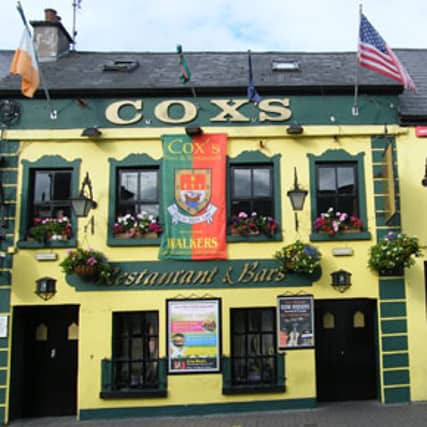
Mr O’Donnell, a carpenter by trade and a single father with one daughter, was involved in an altercation with security staff at Cox’s Bar in Castlebar after he was asked to leave the premises in the early hours of June 7 last.
CCTV footage at the inquest showed a dispute between Mr O’Donnell and one of the bouncers during which Mr O’Donnell attacked the bouncer and was then wrestled to the ground by two security men until Gardaí arrived, arrested him and he was taken in a patrol car to Castlebar Garda Station. He was unresponsive when the car reached the garda station, had no pulse and was pronounced dead less than an hour later at Mayo General Hospital. The inquest heard conflicting evidence as to whether or not Mr O’Donnell was responsive when arrested by gardaí outside Cox’s.
The official cause of death recorded by Deputy State Pathologist Dr Michael Curtis, who performed the post-mortem on June 7, was ‘coronary artery atheroma and cardiomegaly, in a situation of excitement of physical struggle’. Dr Curtis told the inquest that this meant one of the three main arteries leading to Mr O’Donnell’s heart was narrowed and that he had an enlarged heart (cardiomegaly), both of which were pre-existing medical conditions.
The two day inquest, on Wednesday and Thursday last, heard from a total of 26 witnesses while the statements of four other witnesses, unavoidably absent, were read to the court.
The inquest heard that, as Mr O’Donnell was in garda custody shortly before he died, the matter was referred immediately to the Garda SióchΡna Ombudsman Commission (GSOC). They sent a file to the Director of Public Prosecutions who decided that no person should be prosecuted in relation to Mr O’Donnell’s death.
Paul Hanna, the lead investigator for GSOC, gave a summary of events on the night. He told the inquest that Mr O’Donnell had been in two pubs, the Irish House and Rocky’s, before going to Cox’s late bar. The inquest also heard that Cox’s did not have a valid license for a late bar on the night in question. Mr O’Donnell had been served a total of ten pints according to bar staff at the three pubs and first came to the attention of security staff at Cox’s when they were told that someone had vomited in a corridor near the toilets.
‘Had enough on him’
Denis Fitzgerald, a bouncer at Cox’s, told the court that he went to observe CCTV of the area where there was vomit and saw that it was Mr O’Donnell who got sick. He said he went and spoke to Mr O’Donnell, who admitted that he had got sick, and that after speaking to him and having observed the CCTV, Mr Fitzgerald formed the opinion that Mr O’Donnell ‘had enough on him’ and asked him to leave. Mr Fitzgerald said Mr O’Donnell walked out voluntarily.
The inquest heard that when he got outside, Mr O’Donnell became verbally abusive and aggressive when outside Cox’s and, said Paul Hanna of GSOC, kept approaching Denis Fitzgerald ‘in a threatening manner’ and was also abusive towards a second bouncer, James Tanner, when he came to the doorway. One witness, Kevin Mullahy, an off-duty garda, told the inquest that Mr Fitzgerald had been ‘nothing but professional’ in his handling of the situation.
Mr Fitzgerald said Mr O’Donnell then came towards him with his hand ‘up in my face’ and Mr Fitzgerald then sought to restrain him. At this stage, he said Mr O’Donnell ‘went out of control’ and started ‘punching and assaulting me’. He said that ‘with great difficulty’ both he and James Tanner wrestled Mr O’Donnell to the ground and restrained him. The inquest heard that Mr Fitzgerald received a cut to the ear and Mr Tanner was bitten on his thumb in the altercation. With Mr O’Donnell restrained on the ground, Mr Tanner called gardaí.
‘Appeared unconscious’
A civilian witness, Joanne Maloney, who was walking to Cox’s with her boyfriend on the night in question, said that Mr O’Donnell ‘appeared unconscious’ on the ground while restrained by the bouncers. Barrister Conal McCarthy, counsel for the O’Donnell family, instructed by James Hanley, solicitor, put it to Mr Fitzgerald that Mr O’Donnell was unresponsive whilst he was being held on the ground by the bouncers.
Mr Fitzgerald refuted this and said that Mr O’Donnell had simply stopped resisting as he knew gardaí were on the way. Mr Fitzgerald added, in response to another question, that the reason he kept Mr O’Donnell on the ground was ‘for the safety of myself and my colleague’.
Mr McCarthy said that the fact that two gardaí and two bouncers had to lift Mr O’Donnell into the patrol car further demonstrated that he was unresponsive at that time. Mr Fitzgerald said it was because Mr O’Donnell didn’t want to co-operate. He added that he was ‘satisfied’ Mr O’Donnell was breathing as he could see his chest going up and down and that he was ‘grunting and groaning’.
Responding to a question from Coroner John O’Dwyer about why, when Mr O’Donnell had left the premises, Mr Fitzgerald didn’t go back inside, Mr Fitzgerald said it is part of his duty to stand at the door to watch patrons as they enter the premises. He added that he felt it was the right decision to ring the gardaí as opposed to an ambulance.
James Tanner said he didn’t feel there was an emergency when Mr O’Donnell was on the ground or else he would have rang an ambulance. He said that Mr O’Donnell was not unconscious before gardaí arrived.
Checked pulse
Garda SeΡn Ryan told the inquest that he and Garda Tom Kiely responded to the call for assistance at Cox’s Bar. He said that he handcuffed Paraic O’Donnell as there was a fear of further violence based on what the bouncers at Cox’s had told him but he denied that Mr O’Donnell was unconscious when that was put to him by Conal McCarthy. He said that he thought Mr O’Donnell was just not co-operating and that he moved his arm away when being cuffed and ‘mumbled’ when told he was under arrest.
Garda Ryan said he did check for a pulse as this was a ‘habit’ he had ‘if someone was not co-operating’ and said he did find a pulse. Both gardaí and the two bouncers lifted Mr O’Donnell into the patrol car. Garda Ryan said that when they got the short distance to Castlebar Garda Station, Mr O’Donnell was unresponsive and there was no pulse. Frantic efforts took place to revive Mr O’Donnell and Garda Ryan and Garda Jim Daly performed cardio-pulmonary resuscitation (CPR) on him before an ambulance arrived. Mr O’Donnell was taken to Mayo General Hospital, arriving at 1.30am and despite further efforts there, Mr O’Donnell was, in effect, dead on arrival and was pronounced dead at 2.10am.
In response to a question from John Hannan, counsel for An Garda Siochana, Deputy State Pathologist Dr Michael Curtis said that fatal heart failure could happen to anyone with a heart enlarged to the extent of Mr O’Donnell’s ‘at any stage’ of his life but that you cannot ignore the context of the night in question and the struggle on the ground would have contributed.
Coroner John O’Dwyer asked Mr Curtis if Paraic O’Donnell’s life could have been saved if he had been brought straight from Cox’s to Mayo General Hospital instead of to Castlebar Garda Station. Mr Curtis said it was ‘possible’ as resuscitative efforts could have begun sooner.
John Hannan for An Garda SíochΡna said an inquest verdict of death by natural causes could be entertained. He said Mr O’Donnell could have died at any stage in any circumstances as he was a ‘very compromised individual medically’. However Coroner John O’Dwyer said such a verdict would ignore everything that occurred on the night in question. He recommended to the jury a verdict of either misadventure or accident. He told them a death by accident is where an unintended act results in an outcome whereas misadventure is an intended act. He used the example of someone drowning as being an accident but it would be misadventure if that person went swimming after taking drugs.
The jury of five women and three men (two other male jurors were excluded when the inquest was told they had ‘issues’ with Cox’s) returned a verdict of death by misadventure and made three recommendations. The first was that when gardaí arrive at a scene in future and a person is unresponsive, professional medical intervention be sought. The second called for all gardaí to be trained in CPR and all garda stations to be equipped with a defibrillator. Their final recommendation was that all security staff be trained in first aid and CPR.
John O’Dwyer said one of the aims of inquests is to try to prevent similar tragedies in the future and he hoped this would be the case here. He added that the inquest’s decision wouldn’t be binding for any other cases in future.
Superintendent Pat Diskin said, during the course of the inquest, that An Garda SíochΡna would ‘take on board’ any recommendations arising from the inquest. All parties involved extended their sympathies to the O’Donnell family.